Saturday, April 20, 2013

Make Way for Muslims


"We might summarize the content of the universal homogenous state as liberal democracy in the political sphere combined with easy access to VCRs and stereos in the economic. . . Islam has offered a theocratic state as a political alternative to both liberalism and communism. But the doctrine has little appeal for non-Muslims, and it is hard to believe that the movement will take on any universal significance. 

"There would still be a high and perhaps rising level of ethnic and nationalist violence. . . even in parts of the post-historical world. Palestinians and Kurds, Sikhs and Tamils, Irish Catholics and Walloons, Armenians and Azeris, will continue to have their unresolved grievances. . . But large-scale conflict must involve large states still caught in the grip of history, and they are what appear to be passing from the scene."

--Francis Fukuyama, “The End of History?” (1989)

The return of Islamic extremist terrorism to our shores reminds Americans that history has hardly ended. Fukuyama’s famous joy over the decline of Soviet--and the transformation of Chinese--Communism in 1989 was premature. No, instead of “ending history,” we find ourselves more in the world of the late Harvard professor Samuel Huntington’s 1993 “Clash of Civilizations” article--the West v. Islam.

Islam is in many forms benign. But the Muslim religion and culture constitute in today’s world a fundamental rejection of the worldwide, Hollywood-based “sex, drugs, and rock and roll” culture. Many (most?) Muslims feel out of place in the West, and are struggling to retain their separate identity. Instead of just asking Muslims to fit in, the rest of the world may have to make room for Islam. Certainly, that is how the future looks from Tehran, Mecca, Cairo, Ankara, Islamabad, and other Muslim centers.

Two reasons why Muslims could change the world:

First, the size and growth of Islam.

(Hit Map to Enlarge)
According to the Pew Forum on Religion & Public Life (see map):


The world’s Muslim population is expected to increase by about 35% in the next 20 years, rising from 1.6 billion in 2010 to 2.2 billion by 2030. . . Globally, the Muslim population is forecast to grow at about twice the rate of the non-Muslim population over the next two decades – an average annual growth rate of 1.5% for Muslims, compared with 0.7% for non-Muslims.
As the following chart shows, by 2020, 1 of every 4 people in the world will be Muslim.  

(Hit to Enlarge)

Second, the large population of unemployed Muslim males.

Listen to (Muslim) Malaysian prime minister Najib Razak, who recently wrote in the New York Times:
The Muslim world is experiencing a “youth bulge.” In 2010, people under 30 comprised about 60% of the population in Muslim-majority countries. A younger population means a bigger labor force. Higher investment and capital is needed to utilize this spare capacity. A big demographic change can warp fiscal policy for decades. . . [T]he short-term impact can be even greater. A youth bulge introduces latent energy into a nation’s economy and society. Left untapped, it can become a destabilizing force. In 2010, youth unemployment in the Middle East was 25%; in North Africa, 24%. Such levels are toxic.
A growing population, especially including unemployed males. A culture at odds with the West. The potential clash is greatest when it comes to the role of women in society. Here’s a map of countries that require modesty in female dress, whether or not the women living there so desire such codes:

(Hit to Enlarge)

Wednesday, April 17, 2013

Ruining American Education: The Public School Too-long Experiment with “How-to-ism”

Middle School Class, China
Jal Mehta, an assistant professor at the Harvard Graduate School of Education, writes in the New York Times about how to fix education. He puts down Michelle Rhee’s reform efforts in Washington D.C. and he puts down the movie Waiting for Superman's praise of charter schools. Instead, he has good words for the teachers unions that are such a roadblock to education reform.

Unsurprisingly, given his ed school background, Mehta recommends more pay and much more status for teachers, seeking to elevate their profession to the level of physicians. And he wants much more money for educational research and development--including at Harvard, one assumes.

In making his point, Mehta notes the U.S.’s poor showing in international student competitions:
In the nations that lead the international rankings — Singapore, Japan, South Korea, Finland, Canada — teachers are drawn from the top third of college graduates, rather than the bottom 60% as is the case in the United States. Training in these countries is more rigorous, more tied to classroom practice and more often financed by the government than in America.
These countries also have much stronger welfare states; by providing more support for students’ social, psychological and physical needs, they make it easier for teachers to focus on their academic needs. These elements create a virtuous cycle: strong academic performance leads to schools with greater autonomy and more public financing, which in turn makes education an attractive profession for talented people.
Here’s the problem. The international rankings Mehta references, the Program for International Student Assessment (2009) or PISA, shows 7 entities at the top--Mehta’s 5 plus China and Hong Kong. China, represented by its leading city, Shanghai, in fact leads the PISA world in all three categories--reading, math, and science. Hong Kong finishes ahead of Singapore and near the top in reading and science, and just behind Singapore in math.

The only non-East Asian (Singapore is mostly Chinese) entities at the top are Canada--9% Asian (2006), less than 2% total Hispanic and Black, i.e., not the U.S.--and Finland, a nation of 5.4 million, smaller than Shanghai or Hong Kong, and about the size of Singapore (5.2 million). Finland’s high PISA ranking--2nd in science, 3rd in reading, 6th in math--is so surprising it’s called “The Finnish Miracle”.

In reading, the only category where Mehta’s PISA-referenced report breaks down the U.S. scores by ethnicity, U.S. Asians outscore everybody but China, U.S. whites are even with Canada, and the U.S. ranks 15th overall because of low scores by Hispanics and Blacks (38% of U.S. public school population). Ethnicity, or culture, is the big divider, but in discussing PISA scores (even though he elsewhere mentions, “huge gaps by race . . . persist”), Mehta’s article completely ignores culture.

Mehta also draws a failing grade for his assertion that Singapore, Japan, South Korea, Finland, and Canada “have much stronger welfare states” that contribute to their higher PISA scores. In fact, only Finland and Canada put a higher share of Gross Domestic Product (GDP) than does the U.S. into government, with Canada nearly the same; less than 1% higher. The East Asian entities--those with most of the top scores--all have lower government shares of GDP, with Hong Kong, China, and Singapore less than half the U.S.’s share.  Be wary of academics writing in the New York Times.

E. D. Hirsch, Jr., a professor emeritus of education and humanities at the University of Virginia, has examined the same PISA data as Mehta. He writes the nations that best combine “excellence with equity” include Korea, Finland, Japan, and Canada, where “everyone knows what is required to get a given qualification, in terms both of the content studied and the level of performance that has to be demonstrated to earn it.”

According to Hirsch:
In those countries’ classrooms, opportunities for a student to make correct meaning-guesses and build vocabulary occur frequently because the schools follow definite content standards that build knowledge grade by grade, thus offering constant opportunities to learn new words in contexts that have been made familiar.
Hirsch is focused on the verbal gap between advantaged and disadvantaged students, which he calls “the Matthew Effect”--Matthew 25:29 says: “For unto every one that hath shall be given, and he shall have abundance: but from him that hath not shall be taken away even that which he hath.” Hirsch believes
Advantaged students who arrive in the classroom with background knowledge and vocabulary will understand what a textbook or teacher is saying and will therefore learn more; disadvantaged students who lack such prior knowledge will fail to understand and thus fall even further behind, relative to their fellow students.
Hirsch understands the cultural gap that so pervades U.S. lower education. He concludes with something no ed school professor like Mehta is likely to reveal--U.S. education went bad 80 years ago:
an intellectual revolution needs to occur to undo the vast anti-intellectual revolution that took place in the 1930s. We can’t afford to victimize ourselves further by continued loyalty to outworn and mistaken ideas [such as] how-to-ism—the notion that schooling should concern itself not with mere factual knowledge, which is constantly changing, but rather with giving students the intellectual tools to assimilate new knowledge. My hope is that some influential district superintendent will require a specific grade-by-grade knowledge sequence. The striking success of [just] one major urban district could transform . . . the nation.
But don’t we have such an effort in Barack Obama’s “Race to the Top”?   Ze'ev Wurman, a prominent software architect, electrical engineer and longtime math advisory expert in California and Washington, D.C., says of the federal attempt to impose a national math curriculum on America’s schools:
I believe the Common Core marks the cessation of educational standards improvement in the United States. No state has any reason left to aspire for first-rate standards, as all states will be judged by the same mediocre national benchmark enforced by the federal government. Moreover, there are organizations that have reasons to work for lower and less-demanding standards, specifically teachers unions and professional teacher organizations. While they may not admit it, they have a vested interest in lowering the accountability bar for their members. ...This will be done in the name of “critical thinking” and “21st-century' skills,” and in faraway Washington, D.C., well beyond the reach of parents and most states and employers.
Better to keep searching at the local level for solutions that work with disadvantaged students, particularly from ethnic minorities, while staying away from “solutions” favored by status quo teachers unions with outdated “how-to-ism” (or “progressive”) education agendas.
Tuesday, April 16, 2013

Ruining American Education: University Political Correctness

Marxist Herbert Marcuse
“Marcuse . . . asserts in good faith that he remains a Marxist.”

--Robert Langston, “Herbert Marcuse and Marxism,” International Socialist Review, November-December 1968 (Marcuse died in 1979 at the age of 81)

Politics is about power. And power--politics--is ruining American education.

Let’s begin at the top, with America’s highly-respected universities. The progressive elite, centered at the country’s college campuses, draws its power from the Democratic Party--a special interest marriage of our government-media-academia-non-profit sector-entertainment industry-trial lawyer-dominated national elite with the government-dependent coalition that gives the party its votes: public sector unions, minorities, unmarried women, and youth. Identity politics, the mother of “political correctness,” must thrive and dominate for Democrats to retain power.

So no surprise political correctness prevails on university campuses.

Conservative Washington Post columnist George Will quotes Greg Lukianoff, 38, a graduate of Stanford Law School and author of Unlearning Liberty: Campus Censorship and the End of American Debate. Lukianoff, who describes himself as a liberal, pro-choice, pro-gay rights, lifelong Democrat, says:
What happens on campus doesn’t stay on campus [because censorship has] downstream effects. . . those with the highest levels of education have the lowest exposure to people with conflicting points of view [, which encourages] the human tendency to live within our own echo chambers.
Daniel Henninger of the conservative Wall Street Journal has dug down to the origins of political correctness:
Back in 1965, when American politics watched the emergence of the New Left movement. . . a famous movement philosopher said the political left should be "liberated" from tolerating the opinions of the opposition: "Liberating tolerance would mean intolerance against movements from the Right and toleration of movements from the Left."
That efficient strategy was the work of Herbert Marcuse, the political theorist whose ideas are generally credited with creating the basis for campus speech codes. Marcuse said, "Certain things cannot be said, certain ideas cannot be expressed, certain policies cannot be proposed." Marcuse created political correctness.
And political correctness founder Marcuse was an avowed Marxist, by the way (see opening quote). He was part of an anti-democratic movement that preaches and practices dictatorship (of the proletariat).

Henninger continues, comparing Marxist Marcuse to Democratic Party leader Obama:
Marcuse. . . also proposed the withdrawal of toleration "from groups and movements . . . which oppose the extension of public services, social security, medical care, etc." Barack Obama [said]: "They have suspicions about Social Security. They have suspicions about whether government should make sure that kids in poverty are getting enough to eat or whether we should be spending money on medical research."
Marcuse called this "the systematic withdrawal of tolerance toward regressive and repressive opinions." That, clearly, is what President Obama. . .has been doing to anyone who won't line up behind his progressivism. Delegitimize their ideas and opinions.
In the end, Henninger writes,
A Marcusian world of political intolerance became a reality on U.S. campuses. With relentless pushing from the president, why couldn't it happen in American political life? . . . As he said in the inaugural: "Preserving our individual freedoms ultimately requires collective action." That is Marcusian.
And Marxist! Heavy stuff. No wonder Henninger refrained from branding (correctly) Marcuse as a Marxist. But to take it down a notch, it’s all politics. Obama's Democrats would truly love to be the only party, but live with the fact that probably won’t happen. It has largely happened, however, on college campuses, to the detriment of true education for the students involved, past, present, future.

George Will casts the absence of university learning in a different, still-unflattering light:
college has become, for many, merely a “status marker,” signaling membership in the educated caste, and a place to meet spouses of similar status — “associative mating.” Since 1961, the time students spend reading, writing and otherwise studying has fallen from 24 hours a week to about 15 — enough for a degree often desired only as an expensive signifier of rudimentary qualities (e.g., the ability to follow instructions).

Monday, April 15, 2013

Possible economic fixes generate hope and optimism.

The economy is bad, but it’s good that the worldly-wise Economist understands why. The magazine writes:
there are good reasons for thinking that the 21st century’s innovative juices will flow fast. But there are also reasons to watch out for impediments. The biggest danger is government. . . officialdom tends to write far more rules than are necessary for the public good; and thickets of red tape strangle innovation. Even many regulations designed to help innovation are not working well. The West’s intellectual-property system, for instance, is a mess, because it grants too many patents of dubious merit.
The state has also notably failed to open itself up to innovation. Productivity is mostly stagnant in the public sector. Unions have often managed to prevent governments even publishing the performance indicators which, elsewhere, have encouraged managers to innovate. There is vast scope for IT to boost productivity in health care and education, if only those sectors were more open to change.
As for the private sector, one would expect Thomas Donohue, CEO of the U.S. Chamber of Commerce, to have a positive response to his somewhat-loaded “big question” of how to get stronger private sector growth that “will put Americans back to work?” And Donohue indeed has an answer:

First, we must attract global talent.

Second, we must responsibly develop our extraordinary natural resources.

Third, we need to sell more stuff to the 95% of the world’s customers who live outside of the United States[, and] welcome global investment—foreign capital directly or indirectly sustain[s] 21 million U.S. jobs.

Next, we must . . .stem the tide of the huge regulatory tsunami that the current administration is planning for the next four years.

And finally, [d]iscretionary, defense, and especially entitlement spending will have to be curbed.

A seemingly more objective expert, Harvard Business School professor Michael Porter, offered recommendations on CNBC’s “Closing Bell” that are remarkably similar to Donohue’s:

1.  Fix the corporate tax system, lowering corporate rate and closing loopholes.

2.  Arrive at a sustainable budget compromise.

3.  Take advantage of America’s energy windfall.

There is an alternative to Porter’s “closing tax loopholes” recommendation, if the Washington will to close loopholes isn’t there. Reihan Salam, who has a Reuters blog, reports that
Robert Pozen of the Brookings Institution and Harvard Business School and his research associate, Lucas Goodman, . . .call for cutting the corporate tax rate from 35% to 25%[, while capping at] 60% to 85%. . . the amount of interest companies can deduct from their tax bills, sharply reducing debt bias and keeping the proposal revenue-neutral. [S]tart-ups that don’t have the option of raising money by taking on . . . debt would find themselves at far less of a disadvantage[, possibly generating] an entrepreneurial renaissance, as lumbering corporate dinosaurs [currently using] cheap credit to scare off competitors [face] innovative new rivals.
Even within the context of a sharply divided Washington, these are recommendations that might work.

In the end, though, improved economic performance comes down--at least partly--to psychology, to attitude. We need belief in the future.

Here’s Emily Esfahani Smith, in the Atlantic:
having a positive outlook in difficult circumstances is not only an important predictor of resilience -- how quickly people recover from adversity -- but it is the most important predictor of it. . . people who find meaning in adversity are ultimately healthier in the long run than those who do not.
As Winston Churchill taught us, “A pessimist sees the difficulty in every opportunity; an optimist sees the opportunity in every difficulty.”

Sunday, April 14, 2013

Hope = smaller, more effective government; greater choice.

Over the last ten years, more than 60% of the three million new jobs in American were created by the nine states without an income tax. Every year for the past 40 years, states without an income tax had faster growth than states with the highest income taxes. Economic growth in the nine states without income taxes was 50% faster than in the nine states with the highest top income tax rates. Over the past decade, states without income taxes have seen nearly 60% higher population growth than the national average.

--Gov. Bobby Jindal (R-LA)  

policies [that encourage enterprise and spark economic growth] have been pursued not only by Republicans but also by Democrats who don't share their national party's notion that business should serve as a cash cow to fund ever more expensive social-welfare, cultural or environmental programs.

--Joel Kotkin, Wall Street Journal  

historically, “people have always turned to Washington in times of economic crisis, but now they’re losing confidence in the government’s ability to reshape the economy, and that affects their buying and investing habits.”

--Thomas Friedman, New York Times

Conservatives, even Friedman-type moderates, know big government isn’t working. We live with two obvious truths: 1) progressive government is failing to provide economic growth and jobs, and 2) the bottom 75% suffer as a result.

The economy is bad, and geographer and ex-liberal Joel Kotkin thinks he knows why:
the decline of small-business sentiment constitutes arguably the biggest reason for our poor job-creation numbers. If small business had come out of the recession maintaining just the rate of start-ups generated in 2007. . . the U.S. economy would today have almost 2.5 million more jobs.
Kotkin points specifically at the difficulties faced by smaller community banks, those most likely to lend to entrepreneurs. Kotkin thinks the Fed's policies and a growing regulatory environment have created an “unprecedented concentration” of financial assets in the hands of a few large "too big to fail banks," just as the number of smaller community banks is shrinking--330 fewer since the passage of Dodd-Frank bank regulations. Says Kotkin, “In 2013, the top four banks controlled more than 40% of the credit markets in the top 10 states, up by 10% from 2009 and roughly twice their share in 2000.”

The real reason for investment-killing low interest rates: government needs low rates to fund itself. Kotkin laments,
corporate cronyism remains at the core of this administration and, sadly, the once-proudly populist Democratic Party. [It’s all] reminiscent of . . . the declining days of the Roman Empire. The masses get bread (food stamps) and circuses, with virtually all of Hollywood and much of the media ready to perform on cue. The majority, losers in the Bernanke economy, lack the will . . . to realize what is happening . . . "The Roman people are dying and laughing," the fifth-century Christian writer Salvian wrote. Like America today, entertainment-mad Rome suffered from a declining middle class, mass poverty and domination by a few wealthy patricians, propped up by a compliant government.
We suffer from a sharp disconnect between our rulers and the rest of us. As Matthew Continetti at the conservative Washington Free Beacon reported, when CBS asked, “What do you think is the most important problem facing this country today?” only 3% of responding Americans said guns, and immigration did not make the list. The economy, the deficit, and health care came in 1,2,3. The American political class is debating issues that have nothing to do with the priorities of most of those the elite claims to represent.

 Continetti believes that
the current liberal moment [won’t] persist indefinitely. The gun or immigration [drive] most likely will fall apart if Republicans, or even Democrats who still might like to speak for the working man, wake up and ask why American politics is occupied by the pet issues of liberal elites.
The libertarian magazine Reason’s Ronald Bailey wants us to remember that total government spending in the U.S. has grown from 17% of GDP in 1948 to 35% in 2010. Remember this growth, because according to public choice theory,
the more resources government bureaucracies control, the more lobbyists, crony capitalists, and entitlement clients will appear seeking to divert handouts into their pockets. Such would-be beneficiaries need experts to construct the facts that they use to justify to political patrons and agency bureaucrats why they deserve a share of the government's largesse. To the extent that we live in a "post-truth era," it is in good measure because it pays so well to dissemble, exaggerate, and spin for government grants and favors.
Public choice theory calls for a reconciliation of social values and individual choice. And Bailey sides with urban planners Horst Rittel and Melvin Webber, who argued in a 1973 paper that the bias should be in favor of individual choice, which:
“would promote widened differentiation of goods, services, environments, and opportunities, such that individuals might more closely satisfy their individual preferences." Instead of entrusting decisions to purportedly "wise and knowledgeable professional experts and politicians" who aim to impose the "one-best answer," individuals should be allowed to pursue their own visions of the true and the good.
The institution best known, of course, for increasing differentiation between goods, services, environments, and opportunities and for enabling people to express differing values is the free market. Markets don't need experts. Every entrepreneur with a new idea, service, or product can try to profit from what they believe to be the truth.

Friday, April 12, 2013

Conservative “Hope and Change”

“A market economy with many competitors has incentives and constraints that are the opposite of those in a government monopoly. . . businesses know[] that their mistakes have been common and large. But red ink on the bottom line lets them know that they are going to have to shape up or shut down. Government agencies face no such constraint.”

--Thomas Sowell, Stanford’s Hoover Institution  

"even if a government were superior in intelligence and knowledge to any single individual in the nation, it must be inferior to all the individuals of the nation taken together."

--John Stuart Mill (19th century)  

“The end of American exceptionalism will come not when we run out of gas, wheat or computers, but when we end the freedom of the individual, and, whether for evil or supposedly noble reasons, judge people not on their achievement but on their name, class, race, sex or religion -- in other words, when we become like most places the world over.”

--Victor Davis Hanson

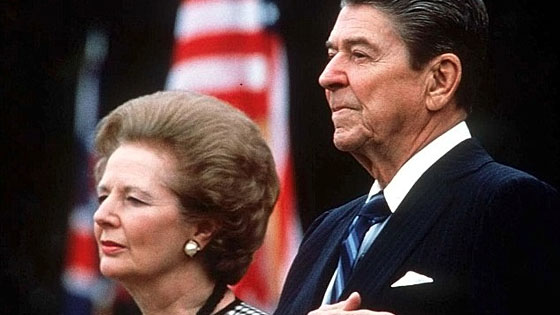
How about this story from the Economist about former British prime minister Margaret Thatcher, who died this week:
As she prepared to make her first leader’s speech to the Conservative Party conference in 1975, a speechwriter tried to gee her up by quoting Abraham Lincoln:
   “You cannot strengthen the weak by weakening the strong.

   "You cannot bring about prosperity by discouraging thrift.
   "You cannot help the wage-earner by pulling down the wage-payer.”
When he had finished, Mrs Thatcher fished into her handbag to extract a piece of aging newsprint with the same lines on it. “It goes wherever I go,” she told him.
The Economist called Lincoln’s words “a fair summation of her thinking:”
Thatcher believed that societies have to encourage and reward the risk-takers, the entrepreneurs, who alone create the wealth without which governments cannot do anything, let alone help the weak. A country can prosper only by encouraging people to save and to spend no more than they earn; profligacy (and even worse, borrowing) was her road to perdition. The essence of Thatcherism was a strong state and a free economy.
A free economy, individualism, individual responsibility. True in the 19th century, true in the 20th, true today. A conservative path out of economic morass that grips our nation and Europe, along with an understanding--now 80 years old--that we owe our less fortunate a social safety net.

What’s truly, completely old fashioned today is the idea that our “betters” should rule over us ordinaries.  Again, from Thomas Sowell:
Implicit in the wide range of efforts on the left to get government to take over more of our decisions for us is the assumption that there is some superior class of people who are either wiser or nobler than the rest of us. Yes, we all make mistakes. But do governments not make bigger and more catastrophic mistakes?
Too many among today's intellectual elite see themselves as our shepherds and us as their sheep. Tragically, too many of us are apparently willing to be sheep, in exchange for being taken care of, being relieved of the burdens of adult responsibility and being supplied with "free" stuff paid for by others.
And from Arthur Brooks, president of the conservative American Enterprise Institute:
America's poor people have been saddled with generations of disastrous progressive policy results, from welfare-induced dependency to failing schools that continue to trap millions of children.
Meanwhile, the record of free enterprise in improving the lives of the poor both here and abroad is spectacular. . . the percentage of people in the world living on a dollar a day or less. . . has fallen by 80% since 1970. This is the greatest antipoverty achievement in world history. . . billions of souls have been able to pull themselves out of poverty thanks to global free trade, property rights, the rule of law and entrepreneurship.
Thatcher and Ronald Reagan believed in progress, in the individual, in a better future. What is big government--progressivism, liberalism, social democracy--but an historic, outdated response to the Great Depression disaster; an overreaction influenced by Stalinist Russia’s and Nazi Germany’s 1930s economic gains, as both geared up for war?

The West, reduced to slow growth by the 1970s, saw real progress from 1979-83, after Thatcher and Reagan got a grip on their respective economies. Progress continued through the 1980s and 1990s as Soviet Communism collapsed, then Britain under Tony Blair and the U.S. under Bill Clinton and a Republican congress kept government restrained and achieved unparalleled prosperity.

Muslim extremism set back Western progress after 2001, again justifying big government and its ruling class ever alert to new reasons for hanging onto power. Though big government is once more choking economic growth in America and Europe, the hopeful movement toward individual freedom in politics (democracy) and in economics (capitalism) not only remains the logical alternative to stale Western social democracy, it is also the combination bettering lives, at least economically, in much of Asia, Mexico, and Brazil.

Hope and change.

Monday, April 08, 2013

God and Hollywood: Believers Push Back

Jill Abramson
"In my house growing up, The [New York] Times substituted for religion."

--Jill Abramson, executive editor of the New York Times

Right. The New York Times as the liberal Bible. Here we have it, from one of the newspaper’s editors herself.

Hollywood and the media we know today seem shaped by baby boomers’ late 1960s rejection of the conformist lifestyle they knew as children and youth. Their determination to fight for civil rights, equal rights for women, and against the Vietnam war also meant breaking down the barriers organized religion’s conventional Christian values placed between them and a freer, “if it feels good, do it” lifestyle. In their shared university experiences, future members of our national elite learned to side--decisively--with science over religion.

But as Robert Tracinski, a conservative who writes at “RealClearPolitics,” noted, abandoning religion comes at a cost:
Modernist culture. . . sought to break down traditional values and rules but was unable to replace them with anything better. It left us in a cultural void where, as the New York Times . . . puts it, everyone is afraid that "serious commitment to any belief will eventually be subsumed by an opposing belief, rendering the first laughable at best and contemptible at worst."
In the second half of the 20th century, this corrosive Modernist skepticism brought us the ruling concept of contemporary popular culture: the "cool." Remember the original meaning of the term. To be "cool" is to be emotionally cool, to refuse to be caught up in enthusiasm. . . This is the sense in which James Bond was "cool." But by the end of the 20th century, the culture of cool increasingly came to mean a studied lack of response to values. It meant refusing to be carried away by enthusiasm about anything.
This is the void Hollywood sought to fill, as the well-known and recently deceased film critic Roger Ebert so well understood. Ebert, according to S. Brent Plate writing in the progressive “Huffington Post,” knew that “covering film was not simply to be relegated to the ‘entertainment’ section,”  because movies tap directly into people’s “dreams and fears and desires.”

Yet Hollywood--the dream factory--remains a cultural sewer for that part of the nation still clinging to traditional values. Believers are the people who flocked to the heretofore seldom-viewed History Channel to watch the recent miniseries "The Bible," for the moment making the channel the top cable network. “The Bible’s” March 3 premiere drew 13.1 million viewers, with last episode still holding 12.3 million viewers.

America’s 78 million Catholics, along with millions of other people of faith, have been encouraged by the selection of Pope Francis--a Jesuit priest devoted to the poor and focused on social justice--to head the 1.2 billion member church. As Walter Russell Mead, of the moderate American Interest, wrote about the saint whose name the new pope has taken:
St. Francis holds up a credible ideal for our time, an example that can speak powerfully to the values young people care about. But he’s also a symbol of the opposition between Christian values and the tinselly values of the secular world. Materialism and the quest for prestige and power are the chief ends of life for many. . . The contemporary world admires the virtues of St. Francis, but it cannot live up to them. That gap is where Christians must speak if they are to gain a hearing in these difficult times.
Difficult times indeed for believers, difficulties hardly overcome by a cable TV miniseries or a new pope. Mead, a non-Catholic, is very aware of how the erosion of faith affects those beyond Pope Francis’ flock, having earlier written that Protestant denominations:
are suffering from the same troubles that afflict the Church of Rome.  . . Textual criticism has challenged traditional views about the antiquity, accuracy and authority of the scriptures. The social consequences of cheap and easy birth control have opened a rift between traditional religious teachings about human sexuality and the ideas and behavior of many people in the West. The consumer society and the mass media associated with it constantly pull people, perhaps especially young people, away from Christian ideas even as an increasingly secular civil society pushes religion off to the side of the public square.
Mead identifies the New York Times specifically as a place “where hostility to all things Roman Catholic is a longstanding tradition,” singling out the paper’s Frank Bruni and his article, “The Wages of Celibacy:”
Bruni’s discussion of celibacy omits any possible benefits that might flow from this way of life. . . For millions of Catholic and Orthodox monks, priests and nuns down through the centuries, [celibacy] was a choice that they consciously made. They felt called to sacrifice earthly ties to deepen their relationship with God and to focus exclusively on serving him rather than tending families on earth.
As Mead says,
many great scholars and philosophers have [with Bruni] held [that] God either doesn’t exist or is so much in the background of things that he might as well not be there at all. Satisfaction is to be sought in the here and now; this life on earth offers all we need . . . Forget . . . mystical unions with Christ, forget the ecstasies of the saints, the Beatific Vision, the dream of fulfilling your life by picking up your cross and following Christ as closely as you can. Find an age-appropriate spouse of whatever gender works for you, and lead the rich and satisfying life of an upper middle class professional who enjoys the newspaper of record, and try not to think about old age, death, or anything else that suggests that the natural order is either incomplete or flawed.
That’s the view from Bruni, the New York Times, and much of our national elite. But even if you don’t relate in any way to organized religion, the challenge remains of finding meaning in life beyond an all-too-transitory pursuit of what feels good. Listen to Arthur Brooks, president of the conservative American Enterprise Institute:
Defending a healthy culture of family, community and work does not mean imposing an alien "bourgeois" morality on others. It is to recognize what people need to be happy and successful—and what is most missing today in the lives of too many poor people.
While the national elite mostly preaches a secular culture vividly portrayed by Hollywood, it's the poor who suffer most under Hollywood's value system.  Perhaps Pope Francis truly does offer hope in a largely poor and value-challenged world.

Sunday, March 31, 2013

God and Hollywood: The Onslaught Continues

Republicans do badly with young voters [because] they’re seen as uncool. . . [It’s the] “Footloose” [factor.] For a large majority of people, the political question is, “How would the sanctimonious preacher from the movie ‘Footloose’ feel about this subject?” They answer the question, and then take the opposite position.

--Glenn Harlan Reynolds, New York Post

Michelle vs. “the sanctimonious preacher.” That’s one way to encapsulate the cultural war Democrats seem to be winning. As former adviser to the Romney campaign Tevi Troy wrote recently:
Throughout 2012, . . . Obama continually demonstrated an unprecedented and often disturbing level of pop culture fluency, showing himself to be up to date on music, movies, and especially TV. Obama, at one time or another, mentioned Homeland, Modern Family, Boardwalk Empire, and Mad Men as among his favorite shows. . . Obama also knew where to go to demonstrate how hip he was, appearing on more than two dozen “soft” entertainment-style interviews during the campaign. . . He told the deejays [he] enjoys working out to Carly Rae Jepsen’s “Call Me Maybe.”
Obama also used his strong relationships with pop culture figures to get stars like George Clooney and Sarah Jessica Parker to direct their pro-Obama efforts toward targeted demographic groups in which the Obama data machine discovered that they would have the greatest appeal. . . the strategy paid off, especially with America’s screen-loving youth.
Nothing symbolized that strong Hollywood-Democratic Party relationship more vividly that Michelle Obama’s center-stage role at this year’s televised--to a gigantic worldwide audience--Oscar ceremony, presenting the award for best picture from the White House, backed by the U.S. military in dress uniforms.

This blog has repeatedly noted that Hollywood seems to have supplanted religion’s place in American culture. Now with the First Lady, in the role of Queen Michelle, tying herself to Hollywood the way presidents used to grab onto God and religion at key moments in our history, who can doubt Hollywood's triumph?

Much of this is due to organized religion’s decline. Listen to Washington Post ombudsman Patrick Pexton, charged to be the keeper of his employer’s conscience, justifying a Post reporter’s attack on religious conservatives:
most journalists have a problem with religionists telling people what they can and cannot do. We want to write words, read books, watch movies, listen to music, and have sex and babies pretty much when, where and how we choose.
In other words, at one of America’s top newspapers we now call people of faith “religionists” (as opposed to socialists?), while defending “if it feels good, do it” morality.

And what of Republicans, who still tend to take organized religion seriously. What role can they possibly hope to play in America’s current “cool” and “hipster” culture? Liberal sage James Fallows, in the Atlantic magazine he once ran, pointed out that “Ridicule is generally more threatening to a public figure or a public idea than ‘logical’ rebuttal is. That's why Colbert and the Daily Show matter.” (The Daily Show and Colbert Report dominate late night TV among viewers 18-to-34, as well as among young men.) Fallows is right, so why should there be serious talk (as we just attempted) about culture, religion, values, and morality at all?

Over 50 years ago, Federal Communications Commission chairman Newton Minow famously called television a “vast wasteland.” There are notable exceptions, but generally Hollywood movies and TV have sunk lower since, to today’s open sewer.  Don’t we think of Rome as marked by excesses of immorality and violence that sent it into decline, with Emperor Caligula’s reign an especially low point?

Yet earlier this month, Justin Timberlake hosted Saturday Night Live. Timberlake, a respected member of Hollywood’s performing elite, ran through a series of tasteless, raunchy skits, topped by one where he played Caligula as a sympathetic figure! How low can they go? Hollywood, though ostensibly in jest, admiring Rome at its worst.

Timberlake sympathetically playing sadist Caligula touches the most objectionable side of Hollywood’s Rome-like decadence--its affinity for gratuitous violence. The Newtown massacre last December raised anew the possible link between mass media violence and impressionable potential mass killers. And once again, Hollywood, at least in the form of Tinseltown’s Vincent Bruzzese, president of the motion picture group at the market research firm Ipsos, brushed off any responsibility for the consequences of their work:
If [violence] didn't make money, studios wouldn't make these movies. It comes down to what's the biggest audience we can get for the best film we can make. The studios would put out a four-hour documentary about how to garden tulips if they thought they'd have a $100-mil opening weekend. But it doesn't work that way.
So that’s it. From the industry that routinely attacks capitalism’s greed, a straight defense of violence when it feeds Hollywood’s greed.

Happy Easter.

Sunday, March 24, 2013

Just Maybe? “Marriage + Family = Success”?

There are signs our national elite is awakening to America’s broken home disaster. Megan McArdle of the liberal-leaning “Daily Beast” is a moderate former senior editor at the (liberal) establishment Atlantic.

McArdle has fixed on Pascal-Emmanuel Gobry’s critique, in Forbes, of economist and author of The Great Stagnation Tyler Cowen’s New York Times op-ed. In his column, Cowen proclaims--to much approval from his fellow economists--that economists are biased (toward “good,” but biased anyway). Gobry notes that “economists praise Cowen’s finding,” even though it “undermines economics’ claim” to be based on “scientific knowledge.”

Gobry offers an example of economists’ bias: the discipline’s relative treatment of college versus marriage as a path to success. As McArdle puts it, “College improves your earning prospects.  So does marriage.  Education makes you more likely to live longer.  So does marriage.”  So she sides with Gobry when he asks why economists strongly back initiatives to move people into college, yet rarely back initiatives to get people married.

McArdle quoting Gobry:
economists’ “cosmopolitan perspective” (as Cowen puts it) makes them not feel good at the idea of public policy that would interfere with personal choices (allowing for a second that getting married is a “personal choice” in a way that going to college isn’t). Most economists think that government should not interfere or have a stance one way or another with decisions that feel intimate to people. That is a complete value judgement. And it’s a completely defensible one.
But at the level of the economics profession, this leads to bias: much more ink is spilled on, and thought given to the college wage premium than the marriage wage premium. One is mostly praised and interpreted in a certain way, while the other is mostly ignored. And, of course, the thing that academic economics focuses on has an effect on elite debate and public policy, especially when the socially liberal, pro-higher ed biases of economists line up well with those of the rest of the elite.
McArdle offers her own reason economists ignore the value of marriage:
all economists are, definitionally, very good at college.  Not all economists are good at marriage.  Saying that more people should go to college will make 0% of your colleagues feel bad.  Saying that more people should get married and stay married will make a significant fraction of your colleagues feel bad.
An even clearer sign our elite are finally grappling with marriage’s relationship to success comes from a recent column by liberal Ruth Marcus in the liberal Washington Post. Marcus defends the latest campaign of nanny City (“No Big Gulp sodas here!”) of New York Mayor Michael Bloomberg, this one against teen pregnancy. In addition to the poster above, Bloomberg is papering his city with ads that say, "I'm twice as likely not to graduate high school because you had me as a teen," and "If you finish high school, get a job, and get married before having children, you have a 98% chance of not being in poverty."

Marcus adds other relevant facts, including children of teenagers are more likely to be born prematurely and at low birth weight, more likely to be abused or neglected, less likely to complete high school, with boys twice as likely to end up in prison as the sons of mothers aged 20 and 21, and girls three times as likely to become teen mothers themselves compared to mothers who wait until 20 or 21. Only half of teen mothers obtain a high school diploma by age 22 compared to 89% of women who did not give birth as teenagers, and less than 2% of mothers who give birth before age 18 obtain college degrees by age 30, with half below the poverty line and the family's chances of living in poverty increasing as children grow older.

Marcus believes the New York City ad campaign will work. The city’s existing anti-pregnancy effort includes making “Plan B” emergency contraceptives available in schools, the effort helping drop teen pregnancies 27% over the last decade. And in Milwaukee, which once had the country’s second-highest teen pregnancy rate, teen pregnancies have fallen five years in a row -- faster than the national average -- since the city instituted "shock advertising" similar to New York’s. Says New York City's human resources director Robert Doar, "Cultural messages do matter, whether it's smoking or drunk driving or obesity."

Who would oppose a campaign against teenage pregnancy? Marcus calls out New York State Sen. Liz Krueger ("This campaign seems laser-focused on shaming already struggling teen parents or, ludicrously, convincing teens not to get pregnant because really bad things will happen"), City Councilwoman Annabel Palma (Teenage mothers across the city will feel "shamed and stigmatized"), and most of all, Planned Parenthood of New York City, whose Haydee Morales complained the ad campaign "creates stigma, hostility and negative public opinions about teen pregnancy and parenthood."

Of Planned Parenthood’s objections, Marcus responds, “Excuse me, but we're not supposed to have a negative opinion about teen pregnancy and parenthood? Isn't that the planned part of Planned Parenthood?”

Marcus writes that saying it's a shame when a teenager gets pregnant certainly isn’t the same as shaming pregnant teenagers. Being squeamish about pregnancy does teenagers no favor. To Marcus’ credit, she goes on to criticize “undue squeamishness” about “out-of-wedlock births in general.”

Though neither Bloomberg nor Marcus directly advocate marriage before baby, a campaign to slow down children having children does move our largest city in the right direction.

Thursday, March 21, 2013

No Dad, Big Problem (II)

Walter E. Williams is a black, conservative economist at George Mason University. He also is appalled at America’s working-class family breakdown.

In Investors Business Daily, Williams makes these points:
  • 29% of white children, 53% of Hispanics and 73% of black children are born to unmarried women. The absence of a husband and father from the home is a strong contributing factor to poverty, school failure, crime, drug abuse, emotional disturbance and a host of other social problems. [emphasis added] 
  • the low marriage rate among blacks is relatively new. Census data show that a slightly higher percentage of black adults had married than white adults from 1890 to 1940. 
  • In 2009, the poverty rate among married whites was 3.2%; for blacks, it was 7%, and for Hispanics, it was 13.2%. The higher poverty rates — 22% for whites, 35.6% for blacks and 37.9% for Hispanics — are among unmarried families. 
  • Other forms of cultural deviancy are found in the kind of music accepted today that advocates killing and rape and other vile acts. Punishment for criminal behavior is lax. 
Glenn Harlan Reynolds, a University of Tennessee law professor, is similarly alarmed. In USA Today, Reynolds writes:
why don't people get married. . .? [B]ecause they don't have to. Single motherhood (or fatherhood) is no longer looked down upon . . . Shotgun weddings are largely a thing of the past. Welfare payments and other social assistance can (partially) replace a father in the house. (When you subsidize something, you get more of it -- and we're subsidizing unmarried mothers). And. . . marriage [is] much less attractive . . . than it once was. [emphasis added]
marriage and kids [are] now seen as something closer to exile from adult life -- imprisonment in the land of Chuck E. Cheese and My Little Pony. Suburban parents often drive SUVs instead of minivans because minivans, though more practical, are associated with low-prestige activities like parenting, while SUVs are associated with higher-prestige activities like whitewater kayaking. . .masculinity in today's society [is] not a dad -- just look at the bumbling doofuses who portray dads on pretty much every TV commercial and sitcom.
The problem [is] the kids do worse. A government check isn't a substitute for a father, and. . . single-mom kids . . . tend to do worse on measures ranging from educational attainment and future income to criminality. And the process feeds on itself: Women want "marriageable" men -- those with good incomes and stable lifestyles -- but the more single-parent households there are, the fewer men are likely to be "marriageable" in the next generation.
Neither Williams nor Reynolds mention Charles Murray’s research on families Coming Apart, but both seem in tune with Murray’s concern that a government-encouraged moral breakdown contributes to the problem.

Wednesday, March 20, 2013

No Dad, Big Problem (I)

Derek Thompson, writing in the Atlantic, is appalled by what’s happening to American families. He’s stung that “58% of first births in lower-middle-class households are now to unmarried women,” while “two in five of all births are to unwed mothers, an all-time high.” To Thompson, the big question is, “Why so few marriages?"

His answer:
  • marriage like any other contract [is] most likely to happen when the gains are big. So we should expect marriages among low-income Americans to decline if women perceive declining gains from hitching themselves to the men around them. 
  • Low-skill men have had a rough two generations. The evaporation of manufacturing work has gutted their main source of employment, while globalization has held down their wages. Marriage has declined the most among men whose wages have declined the most (see graph below--hit to enlarge). 
 
  • Thompson quotes from The Truly Disadvantaged author William Julius Wilson, who argues that "high rates of unemployment and incarceration mean. . .the local dating pool [is] populated by unmarriageable men--[so] women chose to live independently." 
  • Thomson also believes it’s much easier to raise a child and keep a home given modern household innovations, including cheap prepared foods, cheap clothes, machines to wash and dry, and to vacuum. Machines not only encourage women to seek work, but also make it easier for them to raise a child alone. 
In the end, this is bad news, suggests Thompson, meaning “women find themselves drifting ‘unintentionally’ into parenthood with men they have no intent of marrying,” thereby creating “another generation of problems.”

To Thompson, it’s pretty much economic determinism, a concept associated with Marxism. At least Thompson, however, sees family breakdown as a problem.

This blog, in contrast to Thompson, has repeatedly followed the lead of Charles Murray, whose book Coming Apart first and best documents family breakdown in the white working class since the 1960s.   Murray pins the breakdown on “Hollywood” values combined with government policies that encourage single (female) parent families, while lowering the importance of (male) employment.

Monday, March 18, 2013

Harvard takes on Princeton (II)

Harvard's Alesina
“Way back in 2010, when everybody in Washington seemed determined to anoint Representative Paul Ryan as the ultimate Serious, Honest Conservative, I pronounced him a flimflam man. Even then, his proposals were obviously fraudulent: huge cuts in aid to the poor, but even bigger tax cuts for the rich, with all the assertions of fiscal responsibility resting on claims that he would raise trillions of dollars by closing tax loopholes. . . Since then, his budgets have gotten even flimflammier. . .

“[L]et’s turn to the serious proposals. . . the one released by Senate Democrats[, b]y comparison with the Ryan plan, . . . is a very reasonable plan indeed.”

--Paul Krugman, New York Times

As the title indicates, this is our second time going to Harvard to answer Paul Krugman, the Nobel prizewinning Princeton economist. Our thanks to Daniel Henninger, who in the Wall Street Journal, has grabbed onto the work of Harvard economist Alberto Alesina.

Henninger calls Alesina “the last economist that Democrats want to deal with” at a time the country is gaining sympathy for spending cuts. He notes that Democrats have long believed in the 1931 Keynesian multiplier (“spend your way to prosperity”; Paul Krugman), saying no president believes in it more than Obama.

Alesina contrarily argues for a combination of significant, permanent cuts in public spending and small tax increases, if any. His views come after Alesina and his colleagues analyzed the International Monetary Fund history of all fiscal plans enacted by 17 OECD governments--including the U.S., Canada and Japan--between 1978 and 2009. Together, these countries tried everything to grow the economy—raise spending, cut spending, raise taxes or cut them, in endless combinations.

Alesina and company concluded:
"Adjustments based upon spending cuts are much less costly in terms of output losses than tax-based ones.  [Cuts] have been associated with mild and short-lived recessions, in many cases with no recession at all. Tax. . . increases—have been associated with prolonged and deep recessions."
Alesina says the European debate over "failed austerity" is misleading because it emphasizes the spending cuts but rarely refers to tax increases. In truth, "austerity" plans fail to revive growth when they too heavily rely on raising taxes—in Europe or in the U.S.

The studies found that fiscal plans based on large, permanent spending cuts lead to renewed growth more than any alternative policy mix tried. Canada is the leading example the past 15 years. Henninger adds that in the U.S., the Dow reached its all-time high after the sequester happened. Weren’t the cuts the first credible step in rebuilding private-sector confidence?

The Patty Murray Senate budget: A $975 billion spending cut and a $975 billion tax increase. The Paul Ryan House budget: $4.6 trillion of spending cuts and no new taxes beyond the fiscal-cliff increases.

Henninger concludes the Murray budget would be a disaster, while the Ryan budget is the way to go, if Harvard’s Alesina is right.

Thursday, March 14, 2013

Viva il Papa! Francis fights poverty.

"Francis . . . is attuned to the needs of the impoverished, perhaps more than any of his predecessors since John XXIII. If [he] first addresses . . .social justice, it may be the result of his pent-up frustration with the increasing gap between rich and poor"

--John Moody, Fox News and former TIME Vatican correspondent and Rome bureau chief  

“Francis, Go and rebuild my Church, which you can see has fallen into ruin." 

--God to St. Francis

The Catholic church’s renewal and reform effort is in its 55th year, having begun with the papacy of John XXIII in 1958. Francis will continue this renewal, which weaves between reform (John XXIII: 1958-63 and John Paul II: 1978-2005) and consolidation (Paul VI and Benedict XVI), with Francis' elevation suggesting another surge forward. That is good.

The 1.2 billion-member church faces what secularists believe to be its terminal crisis, the one resulting from the scientific progress sweeping religion aside in Europe, North America, and even Latin American cities. Relevancy is important in the Catholic fight for survival; empty churches symbolize approaching death.

The previous great Catholic renewal effort--the 100 year Counter-Reformation which began in 1545 with the Council of Trent--rebalanced Europe between Catholics and Protestants, and kept the church relevant through the next three centuries. In the present renewal, John XXIII (and Paul VI) democratized the faith with vernacular language masses, greater reliance on scripture and the life of Jesus, devolution of greater authority to bishops (over 5,000 today), and greater participation by lay people.

John Paul II is remembered for drawing developing world Catholics into full church participation. But John Paul’s greatest contribution was precipitating the Soviet empire’s collapse, which began in Poland with his 1978 selection as pope, an event that led directly to the rise of Lech Walesa, Solidarity, liberation of the Eastern Europe satellites the following decade, and finally the U.S.S.R.‘s complete break-up in 1991.

Now Francis will be going after poverty--the developing world’s greatest problem by far, however little the issue grips a Western elite fixed on birth control, abortion, and gay rights. (To those arguing population growth is bad for the economy, my response is: Julian Simon, The Ultimate Resource.)  Will a Catholic war on poverty restore the church’s relevance?

I would think so.

Monday, March 11, 2013

Ryan says, "close tax loopholes to spur growth, not to enlarge government."

Yesterday, House budget chair Paul Ryan said on “Fox News Sunday”:
By continuing to raise taxes to fuel more spending, you’ll never get tax reform, which is critical for economic growth and job creation. And so yes, we have an impasse right now, which is that the president wants to continue raising taxes not for deficit reduction, but to fuel more spending, and we see tax reform as an incredibly important goal in policy, to getting pro-growth economics, to getting business growing again and to hiring people. Tax reform to us is an economic growth-generating exercise.   .   .
I do believe there is a consensus for tax reform. There are a lot of moderate Democrats, especially in the Senate, that are in favor of lowering tax rates by closing loopholes. That's what we are proposing. Stop picking winners and losers in Washington. Let people keep more of their hard-earned money. You don't lose revenue for the federal government. And you make it easier for small businesses to create jobs and hire more workers. We think there is a bipartisan consensus for that and I'm hoping the president comes to join that consensus.
Obama wants to close tax loopholes benefiting the wealthy, in order to underwrite more government spending. Ryan and Republicans instead want to lower tax rates, especially the corporate tax rate now at 35% the highest in the developed world, in order to fuel private sector growth and investment.

“Tax reform” to Ryan means using Obama's desired loophole closing to finance lower tax rates, and to do so during this time of unbalanced budgets by keeping net taxes where they are now. Ryan is not, as some Republicans want, asking to lower total tax collections, nor does he want to raise them, as Obama advocates.

Ryan’s goal is economic growth.  And if you want economic growth and jobs, Ryan's tax reform path of exchanging loophole closing for lower rates is the road to follow.

Friday, March 08, 2013

Huh? Jobs up, stocks up, Obama approval drops?

Big numbers are making big news. The two biggest economic numbers are the monthly jobs report (which includes the unemployment rate), and the daily Dow Jones closing. Both are doing well, with the Dow at all time highs. Yet the most important political number--the president’s job approval rating which is tracked daily like the Dow--isn’t doing well at all. What gives?  


Jobs

The U.S. economy created 236,000 jobs in February and the unemployment rate fell to its lowest level since late 2008. This in spite of expectations that higher taxes and federal spending cuts would damage the economy. The number of people who found work in February easily topped Wall Street forecasts of 160,000 jobs. The job creation pace in February was the fastest since November, and entering the new year, the U.S. has averaged more than 200,000 new jobs a month.

The unemployment rate, meanwhile, fell to 7.7% from 7.9%. Experts said the unemployment rate would stay at 7.9%. The last time the jobless rate was this low was in December 2008, before Obama took office.  

Yet . . .

“MarketWatch’s” Jeffry Bartash, who supplied the positive figures quoted above, added in his report:
the falling jobless rate stemmed mostly from a small decline in the size of the labor force, reflecting the most negative aspect of an otherwise upbeat employment report. The percentage of people who have a job or are looking for one fell a tick to 63.5% and matched a 32-year low.
Some 22.6 million Americans remain out of work, including nearly 5 million who have been without a job for at least six months. The unemployment rate is an even higher 14.3% when including people who have gotten too discouraged to look for a job or who can only find part-time work.

Stocks

The market is booming . Wall Street loved the latest jobs figures, sending the Dow (14,397) to an all time high for the fourth day in a row, with NASDAQ (3,244) higher than it’s been since 2000, and the S&P 500 (1,551) within 14 points of its all time high.  My FOX Index (see chart), which tracks the distance from 15,800, the “healthy” market minimum total of a Dow of 12,000, an S&P 500 of 1,300, and a NASDAQ of 2,500, reached its all-time high of +3,392. (Obviously, since the Index only began in August 2008.) It’s all seemingly great economic news.  

But. . .

While Jeffrey Anderson at the conservative Weekly Standard points out that since March 2009, the Dow Jones Industrial Average has risen about 100% in inflation-adjusted dollars, at the same time, the typical American family’s income has fallen 6% or $3,168 (from $54,752 to $51,584), and the share of employed Americans has dropped by 1.3% (from 59.9% to 58.6%). Anderson believes that
the big government-big business alliance benefits the big guy.  . . heavy-handed regulation and cronyism, and . . . redistributing some portion of the [wealth] isn’t actually an effective solution to income inequality.  Rather, this approach — an example of trickle-down economics if ever there was one — has managed to undermine growth and equality simultaneously. A far better approach would be to decentralize power.

Job Approval

Most people pay little attention to Obama’s job approval ratings, if they even know such a number exists. But after years of closely following political reporting out of Washington, I’m convinced the almost-daily job approval tracking numbers from Gallup and Rassmussen, along with results from other recent polls and especially when brought together in the “RealClearPolitics” President Job Approval average, is to political junkies what the Dow is to stock brokers.

Few if any Washington potentates refer to the “RealClearPolitics” average. That’s possibly because the site as yet lacks the prestige of Dow Jones, possibly because “RealClearPolitics” seems to lean conservative (while striving to be scrupulously nonpartisan), and more than possibly because the D.C. pontificaters like to think they practice an art, not something reduced to a three-digit number. But the number exists, and its hard for a commentator to write Obama is flying high when his approval rating is below 50%, and the commentator’s fellow scribes all know it.

It’s time for this blog to record, therefore, the fact that Obama’s "RealClearPolitics" job approval average has now fallen below 50% for three days running, something that didn’t happen in Obama’s first term until November 26, 2009, or more than a year after he was elected. As the chart below shows, the president’s approval rating shot up after last year's re-election, probably emboldening him to go after Republicans on tax increases and to defend big spending in hopes of destroying the GOP. It didn’t work, his job approval rating dropped, and recently, his partisan attacks have eased.  

Still. . .

Will the economy help Obama, if job growth continues and the stock market boom is extended? Of course it will, and his job approval ratings--closely tied to the economy--will reflect that positive development. But the stock market rise and job gains first have to translate into real economic growth. That hasn’t happened yet.


Tuesday, March 05, 2013

Schizophrenia and Mass Killings: Feds Botch Treatment

Dr. E. Fuller Torrey, founder of the Treatment Advocacy Center, tells us that 50 years ago, the federal government created community mental-health centers, or CMHCs, to take the place of state mental hospitals. The fed action was historic because care of the mentally ill had been a state responsibility for over a century.

And the fed take-over was a big mistake.  Quoting Torrey:
  • Over the following 17 years, the feds funded 789 CMHCs with a total of $2.7 billion ($20.3 billion in today's dollars), as the number of patients in state mental hospitals fell by three quarters—to 132,164 from 504,604—and those beds were closed down. 
  • From the beginning, it was clear that CMHCs were not interested in taking care of the [discharged] patients. Instead, they focused on . . . "the worried well." [Though] individuals discharged from state hospitals initially made up [just] 4% and 7% of the CMHCs patient load,. . . the longer the CMHC was in existence the lower this percentage became.  [CMHC] failed because it did not provide care for the sickest patients released from the state hospitals. 
  • half [those discharged from state mental hospitals], many of whom lack family support and suffer from the most severe illnesses such as schizophrenia and bipolar disorder, have done poorly. . . these untreated mentally ill are responsible for 10% of all homicides (and a higher percentage of the mass killings), constitute 20% of jail and prison inmates and at least 30% of the homeless. Severely mentally ill individuals now inundate hospital emergency rooms and have colonized libraries, parks, train stations and other public spaces. 
  • Meantime. . . Medicaid and Medicare [--not] originally intended to become a major federal support for the mentally ill [--] now fill that role. In 2009, 4.7 million Americans received [social security support] because of mental illnesses, not including mental retardation, a tenfold increase since 1977. The total cost was $46 billion. 
  • The total Medicaid and Medicare costs for mentally ill individuals in 2005 was more than $60 billion. . . the annual total public funds for . . . treatment of mentally ill individuals is now more than $140 billion. The equivalent expenditure [when] the CMHC program [began] was $1 billion, or about $10 billion in today's dollars. 
  • President Obama['s] Substance Abuse and Mental Health Services Administration['s] contribution to the . . . Dec. 14 Newtown tragedy focused only on school children and insurance coverage. . . its current plan of action for 2011-14, a 41,000-word document, includes no mention of schizophrenia, bipolar disorder or outpatient commitment. 
Torrey states the federal experiment has failed, as seen most recently in the mass shootings by mentally ill individuals in Newtown, Conn., Aurora, Colo., and Tucson, Ariz. He concludes, “It is time for the federal government to get out of [mental health treatment] and return the responsibility, and funds, to the states.”

Schizophrenia and Mass Killings: The Facts

Paul Steinberg, a psychiatrist in private practice, has in the New York Times given us a compelling picture of what’s wrong with our current treatment of potential mass murderers. According to Steinberg, we are the victims of
too little education about the public health impact of untreated mental illness.
too few psychiatrists to talk about and treat severe mental disorders — even though the medications now available can be remarkably effective.
too much concern about privacy, labeling and stereotyping, about the civil liberties of people who have horrifically distorted thinking.
As a result, we neglect the rights of ordinary Americans to be free from being shot.

Steinberg makes these points:
  • The most common source of severe psychosis in young adults is schizophrenia, . . a physiological disorder caused by changes in the prefrontal cortex, an area of the brain that is essential for language, abstract thinking and appropriate social behavior[, a] brain area . . . weakened by stress. . . often . . . in adolescence. 
  • [schizophrenia] may result in auditory hallucinations, as well as disorganized thoughts. When the voices become commands, all bets are off. . . symptoms include . . . distorted thinking. . . a spaceship, or a comic book character — is controlling one’s thoughts and actions. 
  • People with schizophrenia are unaware of how strange their thinking is and do not seek out treatment. 
  • At Virginia Tech, where Seung-Hui Cho killed 32 people in a rampage shooting in 2007, professors knew something was terribly wrong, but he was not hospitalized for long enough to get well. 
  • The parents and community-college classmates of Jared L. Loughner, who killed 6 people and shot and injured 13 others (including a member of Congress) in 2011, did not know where to turn. 
  • what demons tormented Adam Lanza, who slaughtered 26 people at an elementary school in Newtown, Conn. on Dec. 14, are not known, though his acts strongly suggest undiagnosed schizophrenia. 
Steinberg specifically criticizes the so-called Goldwater Rule, an ethical standard of the American Psychiatric Association that prevents psychiatrists from commenting on someone’s mental state if they have not 1) examined the person and 2) received permission to discuss the case. As a result psychiatrists, the ones who know the most about severe mental illness, have been marginalized.

And he reminds us that medication and treatment work. The vast majority of people with schizophrenia, even untreated, are not violent, though they are more likely than others to commit violent crimes.

Steinberg believes we need
criminal penalties for those who sell weapons to people with clear signs of psychosis; greater insurance coverage and capacity at private and public hospitals for lengthier care for patients with schizophrenia; intense public education about how to deal with schizophrenia; greater willingness to seek involuntary commitment of those who pose a threat to themselves or others; and greater incentives for psychiatrists to treat the disorder [over] less dangerous conditions.
For an idea of what Steinberg’s recommendations are up against, listen to Abby Rapoport, writing in the progressive American Prospect:
The stereotype that the mentally ill are very violent is simply incorrect. According to the National Institute for Mental Health, people with severe mental illness, like schizophrenia, are up to three times more likely to be violent, but “most people with [severe mental illness] are not violent and most violent acts are not committed by people with [severe mental illness.]” On the whole, those with mental illness are responsible for only 5%  of violent crimes.