Tuesday, January 17, 2012

Liberal Elite, Center-Right Country

“Those who underestimate the conservative movement are the same people who always underestimate the American people.”

--Ronald Reagan (1988)

1965. The last year it was great to be a liberal. The year of the Great Society’s Voting Rights Act and Medicare, as well as the Immigration Act of 1965, which opened U.S. immigration to the increasingly important non-European, nonwhite world. 1965 also brought sustained U.S. bombing of North Vietnam, the introduction of U.S. combat troops into full-scale combat in Vietnam, doubling of the draft to 35,000 a month and Pentagon requests for an escalation to 400,000 troops. The war’s escalation in turn led throughout the nation to teach-ins, mass demonstrations, draft card burnings, and the first American self-immolations. 1965. The first year it was bad to be a liberal.

From 1965 on liberals had little to celebrate, as Republicans made major gains in the 1966 elections, then elected Nixon president in 1968 and 1972. In 1976 Democrats barely beat Gerald Ford following Watergate with an inept and increasingly unpopular Jimmy Carter, who presided (1977-81) over an energy crisis, rising unemployment, slow growth, inflation (“stagflation”), the Soviet invasion of Afghanistan, and the Iran hostage crisis.

Ronald Reagan’s successful presidency (1981-89) turned the nation away from liberalism, led to the elections of Bush 41 and Bush 43 (1989-93, 2001-09), and even under “New Democrat” Bill Clinton (1993-2001) yielded up GOP control of congress over Clinton’s final six years, including his 1998 House impeachment for perjury.

The 1997-99 impeachment fight marked a turning point for Democrats, even though Republicans did control both the White House and Congress for most of 2001-06. In 1997, Southerner Clinton gave up on being “GOP lite.” He instead embraced progressive Democrats, who provided Clinton the one-third of the Senate he needed to stave off a perjury conviction and early removal from office.

Southern conservative abandonment of the Democratic Party, complete by 2000, made the surviving Democratic core more purely progressive. At the same time, Democrats had solidified their domination of America’s ruling class, the government-connected elite fighting to hang on to the power they seized during liberalism’s growth years. Elites play by different rules—their rules. To elites, words are weapons, truth is relative, the law is flexible, and God is a myth created for the masses. Smarter, richer, better educated, elites know what’s best for us.

Bush 43’s failed presidency, abetted at every step by liberal domination of government, the media, academia, entertainment, and the arts—the knowledge economy—led by 2006 to Democrats controlling Congress for the first time since 1994. Democrats then recaptured the entire country in 2008 with Barack Obama’s smashing victory and further Democratic congressional gains.

Democrats have subsequently moved us toward a European-style social democracy of big government, higher taxes, crony capitalism's tamed businesses, and masses dependent on bureaucratic largesse centered on universal health care. Progressives want equality not of opportunity, but of results. It helps Democrats that the people who benefit most in such a society are the national elite, the ones who run the show.

The progressives’ coalition—a knowledge-economy head, a dependency underbelly—importantly rests upon minorities and unmarried women. They along with educated young people (our future knowledge economy) provided the 2008 votes that truly returned progressivism to power for the first time since 1965.

Valerie Jarrett (picture), we learn from New York Times reporter Jodi Kantor’s biography The Obamas, is a very important person in today’s progressive coalition. Jarrett touches every coalition base. She is African American, unmarried (divorced), from an elite family, born in Iran, a graduate of Stanford and Michigan law school, and Barack and Michelle Obama’s closest confidante. In the conservative Weekly Standard, Matthew Continetti paints this revealing miniature of Jarrett:
Jarrett told author David Remnick that the reason she bonded with Barack Obama was that “he and I shared a view of where the United States fit in the world, which is often different from the view people have who have not traveled outside the United States as young children.” Remnick goes on to write that Jarrett viewed America “as one country among many, rather than as the center of all wisdom and experience.”
Do progressives feel isolated in a center-right nation? Not really, for they know, as Valerie Jarrett knows, they live in a larger world that like their coalition is nonwhite and majority female, and looks to them for leadership.

Within the U.S. though, as the 2010 elections demonstrated, progressives remain a minority. Here’s John Feehery in The Hill:
Among all whites, now just 35% approve of [Obama’s] performance and 58% disapprove. . . the Obama White House has made the decision that it doesn’t need those white voters to win. That may be true in 20 years, but it is not true today. The swing vote in this next election is the same as it has been in the last six elections. It is the white working-class voter.
More facts on progressive weakness from conservative Nile Gardiner, writing in The Telegraph (UK):
in 2011, . . . 40% of Americans continu[ed] to describe their views as conservative, 35% as moderate, and 21% as liberal. . .conservatives have become the single largest group, consistently outnumbering moderates since 2009 and outnumbering liberals by 2-to-1.

As Gallup’s surveys show, Americans’ fear of big government is now at near-record levels, with nearly two thirds of Americans identifying it as the greatest threat to the country:

The 64% of Americans who say big government will be the biggest threat to the country is just one percentage point shy of the record high, while the 26% who say big business is down from the 32% recorded during the recession.
One would think this Democratic coalition, importantly built upon minority votes, would cater to minority demands. But Joel Kotkin, in Forbes, asks “does the progressive agenda actually support minority upward mobility?” Kotkin believes that
From its inception the Obama administration’s focus has been on the largely white information economy, notably boosting universities and the green-industrial complex based in places like Silicon Valley. The Obama team’s decision to surrender working class whites to appeal to what Democratic strategists call the “mass upper middle class” makes political sense but could lead to problems for an American working class that is itself increasingly minority.
I think Kotkin is understating the political cost of such a strategy. If Democrats are giving up on the white working class, they really are giving up on the working class of all colors, and of both sexes. That could well be a prescription for minority status.

Tuesday, January 10, 2012

The Romney Fix: Conservatives Speak Out


"Democrats do believe that Romney is eminently beatable, the perfect foil for President Obama, in fact. . . from the start, it’s been clear that Romney is the choice of the Beltway GOP establishment, which regards conservatives and Tea Partiers as the grubby unwashed. Meanwhile, Democrats and their media allies have been busy measuring Romney for the Occupy Wall Street/One Percenter memorial bad-guy suit. They can’t wait to rip him apart over his background as a corporate turnaround specialist who may have saved some golden parachutes but put ordinary folks out of work."

--Michael A. Walsh, New York Post

"[Republicans’] non-Mitt mood just won't go away. Indeed, it's intensifying. [People] doubt whether he is in fact the best candidate to beat President Obama. For instance, you hear conservatives wondering more and more whether all of the attention from the White House is a head fake. Romney certainly makes a convenient foil for a presidential campaign already in populist overdrive."

--Jonah Goldberg, Los Angeles Times

"Today's historical moment is one shaped by recession and belt-tightening. It's also shot through with outrage. The American people are animatedly angry at their political and corporate elites. Romney is both a political and corporate elite, and it's difficult to imagine him animated about anything, much less angry. All the open shirt collars and appearances on Letterman can't . . . blot that damning picture from Bain Capital, where Romney grins as dollar bills flutter downwards [see above]."

-- Matt Thomas, American Spectator

"What most pundits think of as 'electable,' a safe candidate attractive to moderate voters, has historically been highly unlikely to unseat an incumbent president. In the five elections since World War II in which the party out of power has picked a 'safe' candidate to take on a sitting president, the result was defeat[--Tom Dewey (1948), Adlai Stevenson (1956), Walter Mondale (1984), Bob Dole (1996), John Kerry (2004). Safe] choices have been zero-for-five at unseating incumbents.

--Lawrence B. Lindsey, Weekly Standard

Comment: I made the same point here.

"Romney’s establishment Republicans, . . . like the Bourbons of France, forget nothing, and learn nothing. Since 1896, only Republicans who have campaigned on a pro-growth platform have been elected. Mitt Romney, instead of being the most electable, is firmly in the tradition of Thomas Dewey, Jerry Ford, Bob Dole, and John McCain."

--Peter Ferrara, Forbes

"What may unite Republicans more than anything else is their desire to oust President Obama from the White House, and that may be enough to propel Romney or another Republican to a general election victory. But banking on that strategy is risky business."

--Brian Calle, Orange Country Register

"Romney’s biggest challenge, [said Sherry Bebitch Jeffe, a political analyst at the University of Southern California:] 'He just doesn’t ring authentic. Charisma is good, but better is authenticity or a perception of authenticity by the voters. And I think that is where Romney fails and that is part of what the Obama campaign is going to focus on.'”

--George E. Condon Jr., National Journal

Monday, January 09, 2012

The Fix: Democrats Want Romney.

“Liberals have a rendezvous with regret. Their largest achievement is today’s redistributionist government. But such government is inherently regressive: It tends to distribute power and money to the strong, including itself.”

--George Will, Washington Post

In Communist societies, mostly withering carcasses today, the operating ideology was redistributionist. And socialists, as George Will suggests, rule through an elite of major beneficiaries, known variously as the “inner party” (1984), the nomanklatura (USSR), the “New Class” (Yugoslavia), or “the princelings” (today’s China).

A version of this Socialist/Communist redistributionist ideology survives today in Democratic Party America. Republicans can either accept the ruling class’s chosen Republican for retaining elite power—Mitt Romney—or they can fight the elite’s preferred candidate with all the energy left at their disposal.

Why is the Republican nominating process thus far yielding up Romney? In part, it’s because the entire Democratic establishment has nothing to do this season but mess with the Republican nomination. Here’s how liberal “messing around” in the GOP selection process is benefiting Romney:

First, Democratic involvement has meant money for Romney, media concentration on Romney, and a systematic effort to knock off every conservative rival to Romney as that rival emerges. Conrad Black, writing weeks ago in the conservative National Review, described the Democratic blowback after Newt Gingrich had emerged as the latest conservative alternative to Romney:
The Obama administration . . . character-assassination squads, though their ranks are now so deep they are the largest such work party since the scores of people who crowded into the firing squad to execute the Ceausescus, [cannot] believe their good fortune. [In] a replication of the 25-battleship sustained bombardment of Okinawa[, they are now going all-out to bring] Newt down.
Second, as we have said, the conservative rump of the ruling class—GOP intellectuals working in the Northeast—truly believe one of their own is most likely to stop Harvard law’s Obama. That would be Harvard law and Harvard business school graduate Romney. The conservative elite has therefore done its best to bring down Romney’s opponents in succession—Bachmann, Perry, Cain, Gingrich, and now Santorum, while leaving Romney’s undistinguished Massachusetts governor record largely unexamined.

Third, the media have held a huge series of debates featuring such a large number of candidates that it is difficult to bore in on serious issues, and relatively easy to knock down participants through “wrong” responses to “gotcha” questions, responses that nevertheless fail to keep the minor candidates from returning again and again, and confusing the succeeding debates. Debates quite obviously also favor candidates such as Romney who are intellectually superior and who benefit from previous campaign experience.

Fourth, the media and Democrats have quietly helped along Ron Paul by treating him as a serious candidate, while hiding his overwhelming dependence on young people—essentially Democrats—attracted to his extreme anti-war and pro-drug legalization platform. Republican Paul is receiving the same kid glove treatment the media gave Obama in 2008. Like Romney, Paul additionally benefits in debates from having previously gone through them. Paul’s presence is complicating the conservative effort to find a single alternative to Romney, as is Jon Huntsman’s candidacy.

Fifth, Democrats and the media are playing a deep game that has confused conservatives about exactly what’s going on. Here’s FOX News anchor Chris Wallace talking to Democratic Party chair Debbie Wasserman Schultz this past Sunday:
WALLACE: Republicans are just beginning to pick . . . their nominee [and already] your party is putting out ad after ad targeting Mitt Romney. And, in fact, during the debate last night, the DNC sent out several e-mails going after Romney but no one else. Why all of the focus by your party on Mitt Romney?

WASSERMAN SCHULTZ: Mitt Romney has earned that scrutiny. He had spent his entire campaign relentless attacking President Obama, distorting his record, decategorizing his record.

WALLACE: Forget about distorting. That fact is all of the Republicans are going after Obama. But you guys are going after Mitt Romney.

WASSERMAN SCHULTZ: Well, Mitt Romney is one of the candidates who was near the top, or at the top. . .
If Democrats like Romney, why are they attacking him? Do they in fact fear Romney? As we noted earlier, conservative radio king Rush Limbaugh thinks Democrats are indeed attacking Romney, even though they want him to be the GOP nominee, because they want to delay the nomination as much as possible and force Romney to waste resources now that won’t be available to fight Obama later.

Limbaugh, having to defend his Machiavellian thinking against disbelievers, has just seized upon former Democratic Party chair Donna Brazile’s frank statement, on CNN, that Democrats do indeed want Romney to win:
BRAZILE: Mitt Romney won tonight because no one touched him -- and for Democrats, you know what? It was good news for us.
Limbaugh calls Brazile’s comment “a major faux pas.” Rush:
The line that's supposed to come out of the Democrat Party is they're scared of Romney. The line is, "Oh, no, they don't want to face Romney. Romney is the toughest guy." [But] the Democrats know that our experts are stupid enough to believe that the Democrats will be honest and tell us who they really don't want to face.
Confused? Wallace says Democrats are out to stop Romney, and Limbaugh says the opposite. I think Limbaugh is largely right. Democrats want the fight to go on and waste Romney’s resources. But they also want Romney to win, and are quietly working for that outcome. They want Romney to win because they want the election to be about which party is more compassionate, and certainly not about whether business or government does better at job creation.

Romney’s reluctance to engage in “class warfare,” a reticence based on his Wall Street background and his being born with “a silver spoon in his mouth,” makes beating him easier than taking on a non-elitist. Romney also largely forfeits the GOP’s ability to attack Democrats on Obamacare; after all, Romney is the father of Romneycare. More generally, Romney’s meritocracy background puts the election battle on a field upon which Democrats are comfortable winning, the same way John Kerry’s decision to battle George Bush in 2004 on national security gave comfort to Republicans.

Democrats do sincerely believe the Republican extremist candidates are easier to beat than Romney, but they also see a real risk in fighting on a new battlefield, not only for them, but for the country as a whole. The country cannot afford Gingrich/Santorum/Perry. Better the devil you know than a truly awful outcome, such as Reagan’s victory over Carter in 1980.

Saturday, January 07, 2012

200,000 jobs. Look at that!

The good economic news for Obama keeps coming. Yesterday’s report of 200,000 new jobs in December means payroll growth in the U.S. beat consensus forecasts by 45,000. At the same time, as the economy kicked off 2012, the unemployment rate dropped unexpectedly to 8.5%, its lowest level in almost three years. The 200,000-job increase did follow a November gain revised down to 100,000, smaller than estimated last month. Still, in another positive development, averages rose of both hours worked and weekly earnings, measurements that indicate future job growth.

Below is how, with 9 months left, Obama is doing gauged against his two most important employment targets: the unemployment rate and total number of jobs when he took over in January 2009. For the first time since we began charting the gap between current totals and the targets, it seems possible Obama may actually reach at least one. While December’s total of 200,000 jobs created may not repeat itself nine more times in succession, job creation could indeed theoretically average 200,000 (actually, only 185,000) a month over that same period.

Saturday, December 31, 2011

Yearend Reading: Romney, GOP

“What do you call it when someone steals someone else's money secretly? Theft. What do you call it when someone takes someone else's money openly by force? Robbery. What do you call it when a politician takes someone else's money in taxes and gives it to someone who is more likely to vote for him? Social Justice.”

--Thomas Sowell, Stanford’s Hoover Institution

"The central conservative truth is that it is culture, not politics, that determines the success of a society. The central liberal truth is that politics can change a culture and save it from itself."

--Daniel Patrick Moynihan (via Jonah Goldberg, Los Angeles Times)

"Raise a Banner of Bold Colors, Not Pale Pastels!"


--Ronald Reagan

Culture is a way of life that evolves to support economic survival. Rules that emphasize caring for one’s family, hard work, getting along with others, avoiding destructive behaviors. Hunting, farming, food on the table, clothes, shelter.

In dealing with modern American culture, I have seized upon the insight of Jared Diamond, author of Guns, Germs, and Steel (1997), about how societies evolve. Diamond is a political outsider (his fields are physiology, biophysics, ornithology, environmentalism, ecology, geography, evolutionary biology, and anthropology) who flatly asserts that government equals kleptocracy—theft from the people.

In simple terms, the U.S. used to have a culture based upon lots of farmers and a small government. Then liberal Democrats used politics from 1933 to 1968 to replace the old culture with one supporting big government, government as your friend. Conservatives who prefer the old culture want smaller government. They want a free enterprise economy that once again works.

Looking at the quotes above, Sowell writes about government theft, Moynihan wrote about liberal use of politics to overturn the culture we had, and Reagan said the country must fight back, battling today’s status quo.

Mitt Romney, Mr. Pale Pastel, isn't the leader Republicans need now. Listen to Steve McCann, who writes in the conservative American Thinker:
As with so many others previously christened by the establishment, [Romney] is a candidate who would maintain the status quo in Washington -- the most important agenda item for the ruling class.
McCann showed his open distaste for the GOP elite when he added:
the Republican primary voters are being told by the Republican establishment and many "conservative" pundits that [Romney] is in his heart a real conservative. . . It is expected of the mainstream media to cover for Barack Obama but for the so-called conservative media to ignore Romney's record is outright betrayal.
Conservative Jonathan Tobin, in Commentary, similarly argued:
Romney is the candidate of his party’s elites. . . the epitome of the notion that the best and brightest deserve the highest rewards. . . He is at his best when fixing broken things–-be it companies, Olympic games or budgets. But as a standard bearer for a movement or as someone who can exercise the vital task of articulating moral leadership, Romney seems out of place.
Romney has alienated himself from populist Republicans, as ABC News’s Matt Negrin recently found:
“There is a huge anti-Romney sentiment,” said Judson Phillips, the founder of Tea Party Nation. [Phillips] said that surveys of Tea Party Nation members show that as many as half of them say they’ll refuse to vote for him in a general election because he’s too “liberal.”

Asked if she could see the tea party coming together to support Romney, Amy Kremer, the chairwoman of the Tea Party Express, said, “I don’t know where the tea party’s going to go.” “I think it’s going to be a very bumpy ride, and it could get pretty ugly,” said Kremer, who hasn’t endorsed a candidate yet.
We have the GOP elite against the rest of the party, the non-elite (“tea partiers”) who don’t fall in line behind Romney and the elite leadership the way they should. Here’s elitist George Will, venting his frustration with the uncontrollable Newt Gingrich:
[Gingrich] is thoroughly anti-conservative. He disdains the central conservative virtue, prudence, and exemplifies progressivism’s defining attribute — impatience with impediments to the political branches’ wielding of untrammeled power. He exalts the will of the majority. . .

Atop the Republican ticket, Gingrich would guarantee Barack Obama’s reelection, would probably doom Republicans’ hopes of capturing the Senate and might cost them control of the House.
Is Will right? Are Republicans likely to win only with elite candidate Mitt? The Eastern seaboard world Will lives in thinks so. GOP intellectuals understandably have a high opinion of the ruling class that dominates their Eastern neighborhood, and that has only grudgingly made a place at the table, though far from the center, for articulate Republicans with proper leadership credentials like Will. If Mitt’s the nominee, the election might become a competence debate Obama could lose. From Will’s perspective, "tea partiers" on the other hand seem likely to lead the GOP down the 1964 Goldwater path to crushing defeat.

Gingrich, Perry, and others are bold colors, Romney is Mr. Pale Pastel, and Will, who once embraced Reagan, now wants pale pastel.

Karl Rove is from Texas but has lived among the Washington, D.C. elite for a decade, and works now for the conservative elite FOX News and Wall Street Journal. His current analysis reveals the “pale pastel” of “inside baseball” politics, missing the “bold colors” of a revolution that liberates capitalism from government’s yoke and fuels economic expansion:
a Gallup poll of Nov. 28-Dec. 1 shows that fewer Americans (45%) now believe income inequality "represents a problem that needs to be fixed" than believed that in 1998 (52%). . . Republicans can argue that Democratic class warfare would penalize achievement and diminish prosperity. That Mr. Obama's goal is redistribution, not success. That over the past three years this approach has resulted in persistently high unemployment, anemic growth and economic hardship.
Would you be excited about income inequality bothering "only" 45% of the people instead of 52%--nearly half the country still with Obama's big issue? And what about “persistently high unemployment, anemic growth and economic hardship”? Is that really a problem of “the past three years” as Rove says, or did it begin under Rove’s man George Bush? Rove skips past the real issue: big government's gigantic growth under Obama, growth that began under Bush. Conservatives are focused on big government crushing economic growth. Rove isn’t.

Elsewhere, Rove predicts Obama’s defeat because:
Scandals . . . will metastasize, demolishing the president's image as a political outsider. By the election, the impression will harden that Mr. Obama is a modern Chicago-style patronage politician, using taxpayer dollars to reward political allies and contributors.
Really, Mr. Rove. You think the upcoming election will turn on scandals, even though people personally like Obama? Bold colors, Mr. Rove, bold colors.

Former Reagan/Bush 41 speechwriter Peggy Noonan, in the Wall Street Journal, has provided her personally revealing look at conservative elite concerns. Writing about the movie “Iron Lady,” a portrayal of former British prime minister and conservative hero Margaret Thatcher, Noonan fixes on Thatcher’s sex:
Thatcher's very presence was an insult to the left because it undermined the left's insistence that only leftism and its protection of the weak and disadvantaged would allow women to rise. She rose without them while opposing what they stood for.
Women of Thatcher’s and Noonan’s generation certainly did battle to rise in a man’s world. And it was an even bigger challenge for conservatives, because liberals do favor women because they’re from a disadvantaged class government seeks to protect. But what about Thatcher? Wasn’t she first and foremost a “bold color” revolutionary, less significantly a female, unlike Noonan, who goes for “pale pastel” Romney?

Daniel Henninger, member of the conservative Wall Street Journal elite editorial board and a Romney backer, has at least noticed how strong is the opposition to Romney, with Mitt’s support numbers constantly stuck at 25%. That means 75% of Republicans want someone else. Henninger writes:
[Romney] should be worried. These Republican protest fish have sharp teeth. Unless fed something soon, they may tear the Romney campaign to pieces. And there are a lot of them. Political commentary sometimes refers to . . .second-tier candidates as appealing to "the tea party vote." This is intended as condescension—you know, it's those people. . .

This vote has been building in the depths of the American political ocean since the spending spree of the second Bush term. These people see the upward spending trend in annual outlays and accumulated commitments not as a "problem," as the Beltway prefers, but as a threat to their well-being.

The Romney campaign may assume that this vote must land by default in their man's lap. . . But if [Romney] doesn't reach out pretty soon to the Paul-Perry-Bachmann Republican protest voters, he may never get them. The longer he waits, the more pressure will build for a third-party challenge that will cost him the election.
It’s unfortunate Republicans seem stuck with Romney. Here’s from CNBC’s Larry Kudlow’s interview of Paul Ryan, the House budget chair and one of the non-candidates who would have been able to unite the whole party:
[Ryan] believes “there is a shift to the right” in the country, “toward free-market approval. . .The country will not accept a permanent class of technocrats that will diminish freedom, enhance crony capitalism, and allow the economy to enter some sort of managed decline.”

Ryan talks about . . . “fighting paternalistic, arrogant, and condescending government elites who want to equalize outcomes, create new entitlement rights, and promote less self-government by the citizenry.” . . Ryan wants “the right to rise” [and rejects a] “ruling system of big business, big government, and big-government unions [that] does violence to the notion of entrepreneurial capitalism. . .Whether it’s TARP, Fannie or Freddie, cap-and-trade, or Obamacare, this must be stopped.”

Ryan stands against what he calls “the moral endgame to equalize outcomes. No consolidation of power into a permanent political class. Equality of opportunity, not result.” Drawing from the Declaration of Independence, Ryan believes that individual citizen power in a democracy comes from God and natural rights [and flows] directly to the people. It complements what Reagan always said: Government works for the people, the people don’t work for government.
Yes.

Wednesday, December 28, 2011

Yearend Reading: Obama Happy, Economy Up

“the major media aren't in the news business. They're political activists abusing their power to propel Obama to re-election”

--Jed Babbin, American Spectator

“People do not believe lies because they have to, but because they want to.”

-- Malcolm Muggeridge (1903-1990)

Obama’s poll numbers are back in re-elect territory. For the first time since his “bin Laden bounce” last Spring, the RealClearPolitics average has his approval ratings at 47%, historically, the minimum level that makes re-election possible. Obama is also within about 1% of being “right-side up” in the polls, meaning his approval rating would exceed his disapproval rating.

How is this possible?

The only issue that matters is the economy. Democrats, we thought, wanted power because they believed they knew how to make the economy create jobs. Democrats have the brains. Democrats know how to pull Washington’s levers of power. Democrats are the party of Franklin Roosevelt, Kennedy, and Clinton, presidents who created jobs. And Obama is failing to create jobs, to generate growth. Surely Democrat Obama is headed for defeat, based on poor job performance. Or so one would think.

Ah, but the fight for power, not so simple. First, we have a unified national elite, a meritocracy that has fought its way to the top and will do anything to remain on top. This elite, this minority, rules through the Democratic Party, which links to millions who believe they are dependent on big government—bureaucrats, unmarried women, minorities.

Second, the national elite, anti-business, pro-big government, controls the national dialog through its media, arts, and entertainment. They lie, and talk to those who believe their lies (Muggeridge above). They are absolutely committed to Obama’s re-election (Babbin above). And, shockingly to me, they don’t really care about competence. As Rush Limbaugh perceptively noted, "the left doesn't want to be judged on the results of anything they do. They only want to be judged on their good intentions."

The deck is stacked. The game is fixed. Yes, and what’s new? You play politics with the house’s cards. That’s life.

So setting aside the stacked deck, why is Obama surging?

Answer: some good economic news. The stock market is ending the year in “healthy” territory, which according to our FOX Index, is a Dow of 12,000, an S&P of 1,300 and a NASDAQ of 2,500—total 15,800. Right now, the Index is plus 191 (see chart). The unemployment rate is down to 8.6%, after being over 9% for most of Obama’s term. Weekly unemployment claims fell by 4,000 last week to 364,000, the third straight weekly drop, bringing the four-week average of claims down for the 11th time in 13 weeks to its lowest level since June 2008.

Furthermore, the economy added at least 100,000 jobs each month from July through November, the best five-month streak since 2006. And the Conference Board's index of leading economic indicators rose strongly in November for the second straight month, with the economy on track to grow at a 4% percent annual rate in the fourth quarter, something it hasn’t done since the first quarter of 2006. And the price of gasoline is lower. Actual evidence that people are feeling better comes from increased retail sales this Christmas season.

On the other hand, government revised the GDP downward in the third quarter from 2% to 1.8%, and GDP growth for the full year will almost certainly stay below 2%. Housing prices continue to fall, with the Case-Shiller index of home prices in 20 leading markets showing a 3.4% decline over the past year. The Euro crisis remains unsettled; it's a potential threat to U.S. growth in 2012.

On next year, Robert Samuelson, in the Washington Post, quotes economist Barry Eichengreen, a leading scholar of the Great Depression:
Given low interest rates and the still-weak U.S. economy, it will be tempting for the U.S. government to continue running deficits and issuing additional debt. At some point, however, investors will recognize this behavior for the Ponzi scheme it is. ... If history is any guide, this scenario will develop not gradually but abruptly. Previously gullible investors will wake up one morning and conclude that the situation is beyond salvation. They will scramble to get out. Interest rates in the United States will shoot up. The dollar will fall. The United States will suffer the kind of crisis that Europe experienced in 2010, but magnified.
A sober warning indeed. But should the economy continue to improve, Obama, according to the New York Times, does have a narrow path to re-election:
All pretense of trying to win a majority of the white working class has been effectively jettisoned in favor of cementing a center-left coalition made up, on the one hand, of voters who have gotten ahead on the basis of educational attainment — professors, artists, designers, editors, human resources managers, lawyers, librarians, social workers, teachers and therapists — and a second, substantial constituency of lower-income voters who are disproportionately African-American and Hispanic.
The very coalition we pointed to above, except that for some unknown reason, the New York Times left out unmarried women.

Tuesday, December 20, 2011

Yearend Reading: Women on Top

In an article titled, “Women on Top, Men at the Bottom,” Philip Brand, a New Hampshire writer, has reviewed Kay Hymowitz’s new book, Manning Up: How the Rise of Women is Turning Men into Boys. Hymowitz believes that when male students graduate -- if they do -- they tenaciously hold to uncertainty, glancing off jobs and relationships, undecided about what to do and whom to love for a decade or so as "preadults," Hymowitz’s term for an unflattering metamorphosis.

Preadulthood is a consequence of two related economic trends that are reshaping both men and women. The first is the extended period of training -- college and beyond -- deemed necessary to the modern economy. The second is women's flourishing in the new economy, two developments that make Hymowitz's book so timely.

Hymowitz says economic changes drive cultural ones. She puts economic conditions first -- along with the increasing professional accomplishments of women. “Preadulthood” is "an adjustment to huge shifts in the economy, one that makes a college education essential to achieving or maintaining a middle-class life."

Hymowitz points to the lifetime earnings gap separating college graduates from those who have only a high school diploma. But a changing economy more friendly to the educated is also "very, very female friendly," offering women more career choices. Last year, women became a majority of the workforce: "At the heart of preadulthood is women's determination to achieve financial independence before marriage."

Right now, the "second sex" dominates higher education from attendance data to graduation statistics. After graduation, young single women out-earn men in nearly every U.S. city, and they are more than twice as likely to own real estate. More education typically means delaying marriage. The average college-educated woman now waits until 28 to wed. And what goes for the goose has to go for the gander. Forty years ago, 80% of men aged 25-29 were married. Today it's 40%.

Why do men suffer in “preadulthood”? Libertarian scholar Charles Murray blames government social programs that slam non-college males. Welfare state programs have had a devastating effect in many inner-city communities. Murray says that when “the children of the woman he sleeps with will be taken care of whether or not he contributes, then that [man’s] status goes away.”

Journalist Hanna Rosin, writing in the same vein, describes a group of men in Kansas City she calls "casualties of the end of the manufacturing era."
The 30 men sitting in the classroom aren't there by choice: Having failed to pay their child support, they were given the choice by a judge to go to jail or attend a weekly class on fathering, which to them seemed the better deal. Like them, [the social worker running the class] explains, he grew up watching Bill Cosby living behind his metaphorical "white picket fence" -- one man, one woman, and a bunch of happy kids. "Well, that check bounced a long time ago," he says..."All you are is a paycheck, and now you ain't even that...What is our role? Everyone's telling us we're supposed to be the head of a nuclear family, so you feel like you got robbed. It's toxic, and poisonous, and it's setting us up for failure." He writes on the board: $85,000. "This is her salary." Then: $12,000. "This is your salary. Who's the damn man? Who's the man now?" A murmur rises. "That's right. She's the man."

In his book Manliness, Harvard Professor Harvey Mansfield wrote to become a man is to develop a sense of duty, which means responding productively to life's challenges. Mansfield points to a U.S. Navy ad that shows men jumping from helicopters into the ocean on a rescue mission to "answer the call."

Today, however, men are unemployed, and the cause, Mansfield believes, is modernity, which relies on technology more than duty to satisfy our needs and protect us. The economy's productivity and the government's programs provide a baseline level of security that is the "very antithesis of manliness... The entire enterprise of modernity could be understood as a project to keep manliness unemployed."

Jonathan Rauch is another writer who like Hymowitz believes shifting economics is reshaping the American family. Rauch says the new model is delayed marriage and delayed family formation, as men and women pursue their education. This leads to new gender roles, with fatherhood redefined to include children's emotional well-being, and motherhood including bringing home a paycheck.

But Rauch is speaking to college graduates. Next year Charles Murray's new book Coming Apart will argue that American behavior in the core areas of marriage and family is dividing along class lines to an unprecedented extent. For the educated upper middle class, Rauch’s new model may work fine. But in the working class, intact families are an endangered species.

Murray compares the extent of marriage in the upper-middle class relative to the working class for those in the prime of life (ages 30-49). In the 1960s, 88% of those considered upper-middle class and 83% of those considered working class were married. In 2010, the figures were 83% and 48%. That 35 percent gap "amounts to a revolution in the separation of classes in this country...Marriage has collapsed in the working class." And the rate of out-of-wedlock births has skyrocketed. In 1960 only 6% of children of working class parents were born out-of-wedlock. Today the number is nearly 50%. (Note: Murray looks only at data for white Americans to underscore his argument that class, not race, is what divides us.)

A new Pew study has figures similar to Murray’s. In 1960, nearly three-fourths of those 18 and older were married. By 2010, that number had plummeted to 51%. Four in 10 births were to unmarried women. In 1960, the most- and least-educated adults were equally likely to be married. Now, nearly two-thirds of college graduates are married, compared with less than half of those with a high school diploma or less. And those with less education are less likely to ever marry and more likely to divorce if they do. Looking at the figures, Isabel Sawhill of the Brookings Institution concluded that “family structure is a new dividing line in American society.”

Comment
: On top, married, educated women. On the bottom, unmarried, uneducated men.

Friday, December 16, 2011

Some Things To Think About (#1)


U.S. still welcomes business.

Here’s some good news to focus on at Christmas, during admittedly rough economic times. According to the World Bank, the U.S. ranks #4 in “ease of doing business,” behind only Singapore, Hong Kong, and New Zealand, that is, behind a city, a Chinese “administrative region,” and a country that—combined—have only 16 million people (click on chart to enlarge).

The World Bank, once known for massive loans to under gird massive infrastructure projects, has come to appreciate the valuable work entrepreneurs perform in generating economic growth. So it now focuses assistance on helping nations improve their own business climate through laws that encourage business formation and a predictable, level playing field. Of its ten “ease of doing business” criteria, only “getting electricity” is infrastructure-related.

The U.S. certainly could do better, however. On “ease of paying taxes,” another of the ten indicators, America ranks a lowly #72.

Monday, December 12, 2011

No! Not Newt!

Newt Gingrich “embodies almost everything disagreeable about modern Washington.”

--George Will

As we just said, the New York-Washington D.C. Republican establishment is appalled at Newt Gingrich’s apparent lead over Mitt Romney. Here’s the National Review’s Ramesh Ponnuru, in his column, “Romney’s the One”:
there is a limit to how much political risk conservatives should want a president allied to them to take. Most of the time conservative activists should be trying to reduce the risks of advancing conservative initiatives rather than to goad elected officials to political recklessness. Conservatives should, that is, point the way for ambitious politicians to advance good ideas that can command the support of a national center-right majority.
Jonathan Martin and Alexander Burns, at the liberal website “Politico,” provide their take on the angst hitting the GOP establishment:
the pro-Romney Republican donor and operative class has been taken aback by Gingrich’s rise, mystified as to why conservative activists would want to nominate a candidate they view as a sure-fire loser against President Barack Obama. The GOP conversation now in New York and Washington is ablaze with talk of the former speaker’s 1968-style Nixon comeback and whether it will last. Some Republican insiders are intrigued by it, others nothing short of horrified. [emphasis added]
But Milton R. Wolf, writing at the less-respected, non-elite Washington Times, points out that Romney, the ex-Massachusetts governor:
was elected initially in 2002 but couldn’t crack 50% of the popular vote. By the end of his first and only term, he had an anemic 34% approval rating and a 65% disapproval rating. Survey USA ranked Romney’s popularity 48th out of the 50 governors. With that, the supposedly electable Mitt Romney walked away rather than face the voters.
And Charles Hurt, in the same, apparently anti-Romney Washington Times, wrote that “the problem for Mitt is that these are not normal times. These are desperate times. We don’t need competence. We need a revolution. And this is where Newt shines.”

“We need a revolution.”

Christian Whiton at FOX News has caught exactly the same point—Gingrich, the Gingrich candidacy, threatens not only the Obama legacy but also the GOP junior elite:
Gingrich has the audacity to imagine that Washington can be run without his own party’s establishment. Their assumption of dominating the next Republican administration is not safe if it is Gingrich. He is not proposing to replace the Democratic piano player at the brothel that is Washington with a slightly sterner-sounding Republican. Instead, he claims he will close the brothel. And the establishment of his own party just knows that can’t happen. In their lives, it never has. And where are they then to go for their pork and porking?
“A revolution.”

It’s ironic, but the GOP junior establishment’s animosity toward Newt may actually push him toward the party’s nomination. As ex-Reagan-Bush speechwriter Peggy Noonan recently noted, “The antipathy of the establishment not only is not hurting [Gingrich] . . . it may be helping him. It may be part of the secret of his rise.”

What happened to the wooden stake?

"cream rises to the top"

--English idiom

There is a junior establishment in the Washington D.C.-New York power axis. And it is quietly going crazy because of Newt Gingrich’s rise. This junior establishment is like a shadow cabinet in Britain—people from the opposition party with all the credentials and the qualifications to take over when the opposition regains power. They expect power. They have earned it; cream risen to the top based on merit.

The junior elite’s voices are conservatives with credentialed publications—David Brooks at the New York Times, George Will, Charles Krauthammer and Jennifer Rubin at the Washington Post, Peggy Noonan and Karl Rove in the Wall Street Journal. They believe in elite rule, a nation guided by our “best and brightest.” They just all believe, in sharp contrast to liberal orthodoxy, that the best brains since William Buckley founded National Review in 1955 are in the establishment’s junior, less respected, conservative branch.

Just as Democratic elitists tolerate the lower-class, government-dependent voters whose support provides their only path to power, so do Republican elitists tolerate the less-educated rubes who make up the GOP majority. Naturally, however, the junior elite use all powers at their fingertips, including their few national media allies, in a determined effort to keep Republican party control in the elite’s hands.

The GOP elite have been perplexed by what they see as a dangerously thin field of qualified Republicans seeking the presidency in 2012. Preferred candidates Jeb Bush (ex-Florida governor), Paul Ryan (House budget chair), John Thune (South Dakota senator), Mitch Daniels (Indiana governor), and Chris Christie (New Jersey governor) all (along with the feared and detested Sarah Palin) declined to run, while Tim Pawlenty (ex-Minnesota governor) and John Huntsman (ex-Utah governor) failed to catch on. That left the current group, which fortunately includes the wealthy, steady, handsome, and qualified Mitt Romney. For months, it’s been Romney or bust.

And all Romney, until now. Romney has remained in first or second spot in the polls through the boomlets for Michele Bachmann, Rick Perry, and Herman Cain. But now comes Newt Gingrich, the out-of-control ex-House speaker who self-destructed in 1997-98 with his losing effort to shut down the federal government in 1995, followed by his disastrously ill-timed ethics and personal problems at the height of the Republican effort to impeach President Clinton.

Gingrich, forced out as Speaker, resigned from the House in 1998. As we have said, Democrats successfully demonized Gingrich in the 1990s—he became the face of all that was wrong with Republicans. Our junior elite remembers those days well and loathes Gingrich, partly for what he did to the GOP brand.

Gingrich tried to come back earlier this year, but self-destructed again in May when he attacked Paul Ryan’s budget-balancing plan as “right wing social engineering,” followed by a two-week Greek island cruise with his third wife (a women who has benefited from Gingrich’s $250,000-$500,000 line of credit at Tiffany’s), an ill-timed vacation that led to the June mass resignation of most of his campaign staff.

Now Newt’s back again, stronger than ever, much to the delight of a Democratic elite that believe Gingrich will be easily demonized once again, and to the abject terror of the Democrats' elite Republican opponents, who are asking, “Where was that wooden stake when we needed it most?”

Saturday, December 10, 2011

Some Things To Think About (#2)


Hatred of business is killing us.


As Friedrich Hayek put it, socialism’s “fatal conceit” is believing that always-flawed markets can be fixed by bright people with good intentions. Not so. People who understand business create jobs, while those who act on the “fatal conceit” treat business at the enemy, and destroy jobs as a result.

George Will, in the Washington Post, uses the Carl’s Jr. story to point out how business helps the people progressives profess to favor, and how progressives respond by killing jobs. Of Carl’s Jr. managers, 84% are minority and 67% are women. And in business-friendly Texas, Carl’s Jr. will open 300 outlets over the next decade, versus nearly 0 in California, dominated by progressive, anti-business laws.

Will ends with a quote from Barack Obama’s autobiography. In it, the president tells us that during his very brief sojourn in the private sector, he felt like “a spy behind enemy lines.”

After listening to a recent Obama “screed” against entrepreneurial success, former congressional budget office chief Douglas Holtz-Eakin asks, “Why attack that which you need most?” Why indeed, if not because business is the enemy.

So which party is the enemy of job creation?

Thursday, December 08, 2011

Some Things To Think About (#3)


1990s v. 2010s

In 2008, Barack Obama ran against Hillary Clinton and the era of which she was a part. The ‘90s, a time of partisan division, a time of narcissistic greed—the excesses of Hillary’s husband Bill Clinton and his crony capitalist pals, and a time of Democratic triangulation, instead of standing up for the disadvantaged.


Oh how different it all looks now. We look back on the 1990s as years of booming growth and balanced budgets; the last time America really worked (both meanings). Years of Bill Clinton and Newt Gingrich. Can Newt ride those memories to the GOP nomination? Byron York, in the Washington Examiner, writes:
when outsiders think of the two greatest policy achievements of the Clinton years -- a balanced budget and welfare reform -- they know Gingrich can legitimately claim a lot of credit for both. So what if he was abrupt with colleagues? Or, for that matter, if he was the target of a Democratic-driven ethics attack?
America worked then, as it doesn’t work now.

Wednesday, December 07, 2011

Some Things To Think About (#4)


Christie to Newt

We wanted Chris Christie for president, and alas, it didn’t happen. Today, while Christie supports Mitt Romney for the GOP nomination, in a larger sense, Christie is running interference for Newt’s presidential image (pictures).

Tuesday, December 06, 2011

Big Success, No News: World Poverty Cut in Half

You didn’t know, did you? In 2000, the United Nations set a “millennium development goal” of cutting in half between 1990 and 2015 the proportion of people living in poverty. The share of those in poverty in 1990 was 45% of the world’s population. The target, a proportional one, was to reduce from 45% to 23% by 2015 the share of those living in poverty. The actual number in developing countries living on less than $1 a day, the definition of extreme poverty, in 1990 was 1.8 billion.

The UN now estimates that by 2015, the share of the world’s people living in poverty won’t be 23%, it will be down to 15%! And in absolute numbers, which was not the target goal, the 1.8 billion in the developing world living in extreme poverty will be down to 900 million, meaning that in a larger world with more people, the absolute number living on $1.25 a day (the new definition of extreme poverty; it accounts for inflation) will have been cut in half. This is an amazing success.

East Asia is responsible for the sharpest reduction in poverty, particularly China, along with India to its south. The number of people living in extreme poverty in both countries fell by about 455 million between 1990 and 2005, and 320 million more people are expected to join their ranks by 2015. In that year, India’s poverty rate will be down from 51% in 1990 to just 22%, and China’s will be down to a mere 5%! Shouldn’t we be celebrating, and let me be blunt, capitalism’s success? (Download the “The Millennium Development Goals Report, 2011" here.)

Some Things To Think About (#5)


Clinton to Newt

It’s passing strange to our Washington-New York chattering class that Newt Gingrich might actually grab the GOP presidential nomination from the well-prepared and packaged Mitt Romney. In her column “The Comeback Kid of 2012,” ex-GOP speechwriter Peggy Noonan refers to what is known as “the baggage problem”—Gingrich’s past errors and foibles. It’s supposed to finish Newt. But, Noonan asks, what about Clinton’s past?
“the baggage problem”[‘s] impact on voters is [hard] to predict, in part because many [voters] have lived through and fully experienced the past 40 years in America. Bill Clinton, if he ran for president tomorrow, would probably win in a landslide, and he has enough baggage to break the trolley carts of 10 Amtrak porters.
Clinton has made it easier for voters to accept an older, wiser Newt.

Sunday, December 04, 2011

Unemployment Drop to 8.6% is Wow

Unemployment is down to 8.6%. As TIME’s Stephen Gandel writes:
The unemployment rate in November dropped faster than it has in more than 11 years. You have to go back to September 2000 to get a quicker decline. What's more, the jobless percentage, which fell to 8.6% in November from 9.0% a month before, was the lowest it's been in two and a half years.
The big unemployment drop, of course, is soft, based as it is on a drop in those searching for work (they have instead given up), and an early Thanksgiving that pushed 2011 Christmas hiring gains into November. Still, any large drop in unemployment is good news. Especially for Obama. Conservative Don Surber at the Charleston Daily Mail says the 8.6% rate is “a godsend for the president” and only half-jokingly adds the number should send Obama’s approval rate above 50% (it’s currently at 43%).

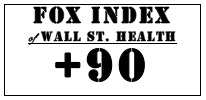
And at the same time, stocks ended a “stellar week,” with Dow up 7%, its biggest weekly gain since July 2009, the S&P 500 up 7.4%, its best weekly performance since March 2009, and the Nasdaq up 7.6%, its second-best weekly rise this year. Our FOX Index with a Dow at 12,019, an S&P of 1,244, and a NASDAQ at 2,627 has at a total of 15,890. The Index arrived back in “healthy” territory (a Dow of 12,000, an S&P of 1,300 and a NASDAQ of 2,500—total 15,800) at plus 90 (see chart), after mostly being in an “unhealthy” range since July.

Here below our look at how, with 10 months left, Obama is doing measured against his two most important employment targets: the unemployment rate and total number of jobs when he took over in January 2009:

Tuesday, November 29, 2011

ABM (Anybody but Mitt)

"I don't claim to be the perfect candidate. I just claim to be a lot more conservative than Mitt Romney and a lot more electable than anybody else."

--Newt Gingrich

As I said, the media are “joined at the hip” with government leaders who have the capacity to put in place the media agenda. And I now realize that the national media as we know it—the networks, TIME, national columnists such as Walter Lippmann and Scotty Reston, the national reach of the New York Times, Washington Post, and Los Angeles Times—all came to life and grew along with the federal government’s rise under Franklin Roosevelt and successive Democrats. It has been, from the beginning, a symbiotic relationship. And since World War II, academia and non-profits have become increasingly dependent on federal money. It’s one big, mutually-dependent family.

Today, now, that big glob no longer works. Former GOP presidential speechwriter Peggy Noonan, in the Wall Street Journal, is guessing at the reason Obama fails to see the crisis his presidency faces:
the most harmful aspect of the president's leadership style is that all of his political instincts were honed and settled before 2008, when he was rising. What he learned before he reached the presidency is what he knows. But everyone else in America knows the crash and the underlying crisis it revealed—on our current course, we are bankrupt—changed everything. Strangely, inexplicably, the president thinks the old political moves apply to the new era. They do not.
Noonan would write Obama off—the president missing in action as America’s economic crisis enters year four—except that she senses the underlying strength of the Democratic coalition, including its grip on our entertainment and arts.
The Democrats have . . . going for them [that] American culture, high and low, is governed and run by the entertainment industry. And the entertainment industry is, and has been since the New Deal, firmly rooted in the Democratic Party. It was invented by the ethnics of the East. . . who joined the Democratic Party as soon as they got here. And they let everyone in America know, and they do it to this day, that the Democratic Party is the cool party, and the Republican Party is the one [not cool], the one that seems like a character flaw to belong to. . . Democrats were, through most of the 20th century, better at propaganda.
“Propaganda.” The power of a unified media, pushing a single message.

“The ethnics.” First came the Irish, Italians, and Jews. Then other white ethnic groups, African-Americans, Hispanic Americans, other nonwhites, and women, especially those without husbands, of any color or background. The Democratic Party is their home, their family. Even though Democrats have royally screwed up, how are Republicans to beat this powerful coalition?

Noonan and her fellow media- and New York/Washington-based intellectual friends know, not think but know, that Mitt Romney is the only Republican capable of beating the mighty Democratic coalition they live with and eat among every day. Here’s Noonan on Mitt:
A big Romney virtue is the calm at his core. The word unflappable has been used[;] a nation in trouble probably wants a fatherly, or motherly, figure at the top. . . Romney’s added value is his persona. . . like the father in one of those 1950s or ‘60s sitcoms . . . Robert Young in “Father Knows Best,” or Fred MacMurray in “My Three Sons: You’d quake at telling him about the fender-bender, but after the lecture on safety and personal responsibility, he’d buck you up and throw you the keys. . . The Republican Party is going to make Mitt Romney work for it. They’re going to make him earn it. They’re going to make him suffer. Because that’s what Republicans do.
But in the end Noonan believes that if Republicans care about winning, they will nominate Mitt.

We have already recorded our objection to Romney—he’s unlikely to provide the depth of change this country requires to overcome addiction to big government. Noonan doesn’t see it our way. But we can’t win with Mitt, because he is “Democratic lite,” relatively untroubled by big government. He's the Republican mirror of Democrat John Kerry in 2004, who ran and lost as "national security lite."

People want the real thing, so if it’s big government they want, they will vote Obama, not Romney. As Stanford’s Hoover Institution conservative Thomas Sowell points out, there have been a long string of Republican presidential candidates who, like Mitt, fought for the center. They lost.

Look at the following chart. In the past, even GOP “extremists” have done better than GOP moderates such as Mitt. But the winning choice is a conservative—they do best.

Monday, November 28, 2011

Middle Way Won't Work

the best thing that the Government can do is to get out of the business of running (or subsidising, or initiating, or incentivising) things altogether – not just in the interests of saving money, but because the effects of such interference are counter-productive. What the economy is suffering from is not an insufficiency of overweening, fussy, bureaucratic initiatives that inevitably unleash an avalanche of unintended consequences, but a lack of cash in the hands of people who might spend it in ways that would actually create wealth and stimulate (in the proper sense of the word) economic growth.

--Janet Daley, Telegraph (U.K.)

In a nutshell, big government’s time is over. Not only the failed bigness of Hitler, Mao, and the Soviet Union, but the failed broad bureaucratic reach of welfare state Western Europe, of industrial Japan (no longer #1), and even of “Blue Model” America. But don’t tell our leading pundits.

Our media are wired directly to activist government. The two are “joined at the hip.” Why bother writing policy recommendations to an audience larger than a president able to execute the enlightened one’s recommendation with one shouted command? Why would these journalists opt instead for slowly winning over millions of people? Scribes prefer the efficiency of talking to the guy at the top who gets it done.

Matt Welch of the libertarian Reason has insightfully gone after the pragmatism by which our elite commentariat profess to live. Elite writers claim to sit in the middle between the small government ideologues of the right and the left’s virtual socialists (Moveon.org and public sector unions). It’s no small coincidence that pundits outside government, just like the policymakers inside, frame their recommendations to the president as a favored middle option between two deliberately undesirable extremes.

Libertarian Welch oozes contempt for America’s so-called “problem solvers” in the middle:
Do something. Is there a two-word phrase in politics more loaded with disguised ideological content? Embedded within is both an urgent call for powerful government action and an up-front declaration that the policy details don’t matter. The bigger the crisis, the more the urgency, the sparser the detail. . . American discourse is saddled with a large and influential do-something school of political punditry, a cadre of pragmatists from Meet the Press to your local editorial board who are forever seeking to solve the country’s problems by transcending ideology, demanding collective citizen sacrifice, and—always—empowering authority. . . [David] Brooks and [Thomas] Friedman [pictures] may be the most prominent practitioners, but the do-something school is evident just about anywhere the political class is talking shop.

Do-something punditry means almost never considering the possible benefits of getting the government out of the way of a given issue, since that would be “ideological” and require walking away from the world’s largest problem-solving tool. Pragmatism also means never having to say you’re sorry about the unintended consequences of well-meaning legislation, the capture by industrialists of the regulators who were supposed to constrain them, or even the basic failure of government action to produce the promised results. By the time such flaws make front-page news, there is always a new crisis requiring urgent intervention. And if all else fails, you can blame it on the competence of the government that followed your advice.
Welsh appreciates that our “non-ideological” problem-solvers do in fact have an ideology of their own:
it involves increased taxes (especially on energy), short-term spending boosts, long-term entitlement cuts, and roughly the same foreign policy commitments as today. It calls for renewed citizen engagement, a return to political civility, and a rejection of coarse cynicism. Better teachers, trained workers, and cleaner air. Although advocated by pundits from all over the traditional political spectrum, the program is remarkably uniform when it comes to giving the government more power. Just don’t call it ideological.
The middle ground is a false choice. In a time of “fish or cut bait,” those who believe in better government come down on the side of big government. They reject less government, the choice America should make in 2012.

Thursday, November 24, 2011

We coulda had an agreement.

The Congressional “supercommittee” couldn’t agree on how to cut $1.2 trillion from our national debt. In the aftermath of failure, two columnists, one from each side, are both recommending Washington go for real cuts and some revenue increase, thereby grabbing the vital middle and success.

The New York Times’ Tom Friedman believes “the best way” for Obama to win next year is by declaring he “made a mistake in spurning his own deficit reduction commission,” and “is now adopting Simpson-Bowles” as his fiscal plan. Friedman rightly notes that any Obama-like short-term “stimulus” (tax cuts) won’t work, because “nobody knows what is waiting around the corner, after the stimulus runs out.”

Obama should instead back a deficit-cutting plan “with substantial tax reform and revenue (i.e., tax) increases. . . and cutbacks to both Social Security and Medicare. . . Simpson-Bowles.” Friedman adds that in times of crisis, “leaders jump first, lay out what truly needs to be done to fix the problem, not just to win re-election.”

His pitch to a higher goal, along with Friedman’s saying “I voted for Barack Obama, and I don’t want my money back” and “the Republican Party has gone nuts” are part of his effort to win back Obama’s ear, a task he gave up on earlier when he advocated finding a third-party candidate for president. No third party? No matter. The point here is Obama should embrace Simpson-Bowles—major, long-term cuts in the budget combined with some tax increase.

Over in the Wall Street Journal, columnist Holman W. Jenkins, Jr has pushed the same line, advocating that Obama should take GOP senator Pat Toomey's tax-reform plan and “pick it up and run with it, instantly redeeming the super-committee ‘failure’ with an act of presidential leadership.” Like Simpson-Bowles, Toomey’s plan emphasized getting economic growth through budget-cutting fiscal responsibility, combined with “a big revenue hike on ‘the rich.’”

Comment:
Unfortunately, Toomey’s plan hit “the rich” by taking away $250 billion worth of their deductions, not by raising tax rates, the campaign pitch to which Democrats and Obama seem deeply wedded. Note that Simpson-Bowles similarly proposed raising revenue by closing loopholes, and specifically recommended lowering, not raising, tax rates.

Friedman talks to Democrats, so he quotes Simpson-Bowles, the commission Obama created. Jenkins talks to Republicans, so he quotes GOPer Toomey. Yet Friedman, Simpson-Bowles, Jenkins, and Toomey are all in the same place, with Obama somewhere else. I wrote earlier that Obama must advocate tax rate increases before the election, if he is to raise taxes enough on everyone after the election to keep the budget at its gigantic, current 25% of GDP.

Wednesday, November 23, 2011

Remembering JFK

"I didn't leave the Democratic Party; the Democratic Party left me."

--Ronald Reagan

My thoughts on the 48th anniversary of JFK’s assassination, and after watching Greg Kinnear’s pitch-perfect portrayal of him last night in the little-seen (Reelz TV, what?—Netflix has the episodes) miniseries, “The Kennedys.” Kennedy was a hero and in the consensus, post-war evaluation of our leaders, a “near great” president kept from greatness by his untimely death. I loved him and his brother Robert (“Bobby”).

After JFK, things went bad for Democrats. Republican Reagan is the best president we’ve had since; his really the only presidency after Kennedy’s that succeeded. Clinton was not a hero; he was blessed with post-Soviet Union peace and a dot.com prosperity bubble and he blew it anyway. Clinton’s last presidential act was pardoning international tax-cheat and fugitive Marc Rich.

I look back on the Kennedy era, “Camelot,” with nostalgia, but it was a very dangerous time. The Chinese under Liu Shaoqi (the internally-focused Mao pushed into the background) were competing with the Soviets to expand Communism throughout the newly-independent Third World, and making real headway in Southeast Asia—Vietnam, Laos, and Indonesia. The Soviets were ahead in the space race. Castro was turning Cuba into a Communist beachhead 90 miles off our shore. Eisenhower had been inept, allowing a “missile gap” to develop and a U-2 spy plane with a pilot who wouldn’t take his own life to be shot down over the Soviet Union, leading to a major summit cancellation. Bad, bad world.

Kennedy was the president to turn this world around. An authentic war hero, son of the ambassador to our most important ally, a Pulitzer-prize winning Harvard graduate who wrote Why England Slept, Kennedy was well-prepared to lead the U.S. at the height of the Cold War to “pay any price, bear any burden, meet any hardship, support any friend, oppose any foe, to assure the survival and the success of liberty.”

Kennedy made mistakes, and learned from them. In 1961, he allowed the ill-conceived and executed Bay of Pigs invasion to go forward, then publicly took responsibility for its failure while more privately reorganizing and professionalizing the CIA. He was faced down by Khrushchev at Vienna that summer and allowed the Berlin Wall to go up, but had the sophistication to appreciate that Berlin was, as Khrushchev said, a “bone in my throat,” and it was best to get the bone out.

Under Robert McNamara, the Pentagon not only closed the missile gap (which turned out to be mostly fiction), but with the rapid development and deployment of the solid-fueled Minuteman ICBMs and with Polaris missiles in nuclear submarines off the icy Soviet coast, turned the strategic balance strongly in the U.S.’s favor.

In 1961, Kennedy made the bold pledge to put a man on the moon by the end of the decade. And we met that pledge. What a different time.

By 1962, the Soviets were so worried about U.S. strategic superiority that they attempted to sneak Soviet medium-range missiles into Cuba and close their missile gap. Kennedy’s response was among America’s finest hours. He rejected the aggressive options recommended by the military and CIA, and instituted a blockade that avoided direct military action. He secretly offered to pull obsolete Jupiter medium-range missiles out of Turkey and Italy if the Soviets would pull back from Cuba, providing Khrushchev a face-saving way to back down. He avoided World War III.

In 1963, he negotiated a limited test-ban treaty with the Soviets, the first big step back from the brink of nuclear war. In 1964, Khrushchev lost his job, in part because of his failed Cuban confrontation with Kennedy, however much the defeat had been downplayed in public.

In 1962, Kennedy recommended lower tax rates, and the reduced tax rates triggered domestic prosperity that lasted throughout the 1960s.

Vietnam undid the Cold War Democrats Kennedy so ably led. We don’t know how Kennedy would have handled Vietnam after 1963, but we do know he was far more able than Lyndon Johnson to maneuver through international crises. Moreover, his assassination deprived Kennedy of the opportunity to sue for peace in Vietnam during his 1965-69 second term, when he would have no longer faced re-election. Johnson couldn't stop believing that failure in Vietnam would cost him re-election in 1968, so would not consider a real peace agreement. (In the end, Vietnam cost Johnson re-election anyway.)

I have argued that McNamara had given up on Vietnam by 1966—wouldn’t Kennedy have too? Most casualties came after 1966. I also believe the true turning point in Southeast Asia came with the failed Communist coup in Indonesia in 1965, an event the significance of which Kennedy would have appreciated far better than Johnson did.

Kennedy, Reagan. Not Johnson, Carter, Clinton. Not Obama.