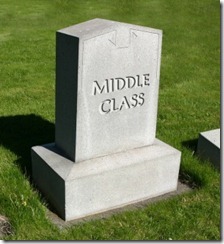
Wednesday, October 10, 2012

Propaganda: Media

"The modern press is at times sycophantic of the incumbent president and at other times trying to mimic Woodward and Bernstein; it all depends on which party is in office. With a Democratic president cut from the same cloth as they, many journalists have done everything in their power to set the national conversation in ways that favor Obama."

--Jay Cost, Weekly Standard

Our last post alluded to the fact that the establishment’s grip on the country is slipping. The “Blue Model”--the dominant coalition of big government, big business, and big labor that under Democratic leadership successfully ran America from 1933 to 1968--no longer works, and the establishment strains to hold its remaining pieces together.

Something similar is happening to the legacy media, the follow-on force that in effect ran the country as it in succession terminated the presidencies of Lyndon Johnson, Richard Nixon, Gerald Ford, and Jimmy Carter (1968-80), with CBS’s Walter Cronkite emerging at the time as our surrogate national leader. The media then were bigger than the White House, bigger than the Democrats. They were The Powers that Be, as David Halberstam described media giants at the time.

Long ago and far away. Now the legacy media are fighting for their collective lives against the immediacy of the internet and 24 hour cable news. No longer dominant, now with their continued high status dependent upon an Obama victory, the legacy media are content to serve as the establishment’s propaganda arm.

Yes, propaganda arm. From the Merriam-Webster dictionary:
pro·pa·gan·da   noun
ideas, facts, or allegations spread deliberately to further one's cause or to damage an opposing cause
Propaganda. The work of today’s media.

Listen to Matt K. Lewis, in the conservative Daily Caller:
President Barack Obama was a guest at the wedding of vice presidential debate moderator Martha Raddatz. . . The bigger story is about the incestuous relationship that exists between the elite opinion leaders in America — and Democratic politicians. The Obama/Raddatz connection simply illustrates it.
And listen to Andrew Klavan, in the conservative City Journal:
The mystery Obama. . . is not a creation of his own making. . . It emanates instead from a journalistic community that no longer in any way fulfills its designated function, that no longer even attempts the fair presentation of facts and current events aimed at helping the American electorate make up its mind according to its own lights. Rather, left-wing outlets like the New York Times, the Los Angeles Times, the Washington Post, TIME, Newsweek, NBC News, ABC News, CBS News, and the like have now devoted themselves to fashioning an image of the world they think their audiences ought to believe in—that they may guide us toward voting as they think we should. They have fallen prey to that ideological corruption that sees lies as a kind of virtue, as a noble deception in service to a greater good.
Also conservative Erick Erickson, in “RedState”:
Time and again, the media decides something is so or something is not so and reports it as the media sees it even when a sizable portion of the country disagrees with them, whether it be abortion, gay marriage, global warming, war, poverty, Hurricane Katrina, Mitt Romney’s campaign, Obamacare, and the list goes on and on and on.
Noemie Emery, writing in the conservative Washington Examiner, tells us why it’s especially difficult to separate the legacy media from liberal Obama:
It had been the real thing, not a commonplace fling with your generic Democrat, but the love of a lifetime, the genuine article, the sum of all dreams: He was not just a Democrat, he was also a liberal. He was not just a liberal, he also biracial, also multinational; also hip, cool, and clever. He was themselves as they wanted to be. Like them, he was gifted at writing and talking (and, as it turned out, not much beyond that), like them, he stood up for Metro America; like them, he viewed the people outside it with a not-very-measured disdain.
But it is Democrat Pat Caddell, a FOX News commentator, who is most upset at the legacy media’s failure to carry on the job to which the constitution in effect assigned it: question authority.  Says Caddell, in a tone of true despair:
We designed a constitutional system with many checks and balances.  The one that had no checks and balances was the press, and that was done under an implicit understanding that, somehow, the press would protect the people from the government and the power by telling—somehow allowing—people to have the truth.  That is being abrogated as we speak, and has been for some time.
The fundamental danger is this: . . .The press’s job is to stand in the ramparts and protect the liberty and freedom of all of us from a government and from organized governmental power.  When they desert those ramparts and decide that they will now become active participants, that their job is not simply to tell you who you may vote for, and who you may not, but, worse. . . what truth that you may know, as an American, and what truth you are not allowed to know,  they have, then, made themselves a fundamental threat to the democracy, and, in my opinion, made themselves the enemy of the American people.  And it is a threat to the very future of this country if we allow this stuff to go on.
Question authority. “Afflict the Comfortable”. Media, do your job.

Tuesday, October 09, 2012

Establishment = Obama

"the grandees of the universities, the foundations, the arts, the unions, and the government employees are all heavily invested in Obama — the class warrior who assures those of the upper classes that class and racial resentment will be turned against others."

--Victor Davis Hanson, “PJ Media”

“Republicans often say 'Obama and Biden want to raise taxes by a trillion dollars.' Guess what? Yes, we do.”

--Joe Biden

“the most important lesson I’ve learned is that you can’t change Washington from the inside.”

--Barack Obama

We are blessed with the way Obama and Biden unintentionally speak the truth. Obama is Washington, is the Establishment, is big government, and this picture isn’t going to change from inside big government Washington with Obama at the helm. And as Biden honestly says, our big government needs more, ever more in taxes to keep going.

Here is the Merriam-Webster definition of:
es·tab·lish·ment   noun
an established order of society: as a group of social, economic, and political leaders who form a ruling class (as of a nation)
It’s a fact. We have an establishment, and it’s represented at the top by Obama. The establishment is our most important club. Our leading universities initiate pledges into the club, which has its founding chapter in New York City, and its largest, most active chapter in Washington.

Once in the establishment, it matters not what path members followed to arrive, their most important job becomes to retain membership status and to pass it on to their children. In pursuit of that objective, all is fair; the end justifies the means.

Let me be clear. The establishment not only professes in our democracy to rule on behalf of the people, members truly, deeply believe the people’s best interests are served by their continuous rule. Do not underestimate the ruling class's sincerity.

The establishment see themselves differently than outsiders see them. They lie with the greatest of fluency because they view themselves as acting on behalf of the oppressed. Or as Leon Trotsky wrote, "The ruling class forces its ends upon society and habituates it to considering all those means which contradict its ends as immoral. That is the chief function of official morality."

Life works like this. Your perspective changes when you are welcomed inside the establishment. Your number one goal, however, remains constant: preservation.

Our current establishment is centered on government. Hence Washington’s dominant role; hence the president’s leadership. As Karl Marx was at his most effective as an outsider analyzing capitalism, so too do free market conservatives do best today at analyzing big government’s failings.

Listen to conservative Michael Barone, writing in "RealClearPolitics", “Overall, Obama stands for maintaining and expanding the welfare state that operated tolerably well in the big [blue] America of half a century ago but is coming apart in our early-stage information society today.”

Barone tells us how the establishment protects its own at the expense of the masses:
just as housing policies created a housing bubble, college loan policies have created a higher education bubble. The flood of money has been captured by colleges and universities through above-inflation tuition increases and administrative bloat. The Obama administration does not crack down on them, however, but on graduates or dropouts with thousands in college loan debt that they can't escape through bankruptcy.
Obama's policies, from Obamacare to high-speed rail, treat people as identical cogs in a very large machine, part of a mindless mass that would not be able to get along without government guidance. In the information age, these industrial age policies have prevented the vibrant economic growth which gives young people the opportunity to find work and community service that maximizes their own special talents and interests -- to shape their own world and choose their own future.
We have talked at length about the amazing phenomenon of national wealth collecting in the Washington metro area. The phenomenon underlines the fact that big government increasingly dominates our lives, and to our national detriment.

Or so says conservative Steve Huntley of the Chicago Sun-Times:
Household incomes rose in most counties around Washington last year, even as they continued to sink around the country . . .Yes, the system is rigged under Obama, rigged to favor the growth of the federal government — its bureaucrats and the lobbyists, lawyers and special-interest groups that feed off taxpayers — at the expense of reviving the private economy where taxpayers live. Perhaps nothing summarizes Obama’s failures better than this picture of government affluence funded on the backs of the middle class.

Friday, October 05, 2012

For Obama--The Job Report from Heaven

President Obama got the pre-election jobs report he could only dream of. While the number of jobs created in September--a modest 114,000--fell in line with lackluster reports earlier this year, the total number of workers employed--as measured by the separate household survey used to set the unemployment rate--surged by 873,000, the highest one-month jump in 29 years.

The total of unemployed people tumbled a dramatic 456,000, but the total labor force grew by 418,000, which kept net job growth from soaring even further. Still, the unemployment rate dropped from 8.1% to 7.8% to match precisely the pre-election target Obama wanted, since that was the exact unemployment rate when Obama took over in January 2009 (see chart below). Bullseye!

Other numbers released today were also encouraging. The Labor Department revised job gains for August up from 96,000 to 142,000, and for July from 141,000 to 181,000. The labor force participation rate, which reflects those working as well as looking for work, edged up from 63.5% to 63.6%, the average work week, which suggests future hiring, edged higher to 34.5 hours, while average hourly earnings, which measures income growth and suggests future spending, increased 7 cents to $19.81.

We have been tracking Obama’s monthly progress toward the two most obvious job creation goals--number employed and unemployment rate. As the chart below shows, he has essentially met his minimum targets--net jobs are where they were when he took office. We had not foreseen this happening, even a month ago.

Thursday, October 04, 2012

Inconvenient Middle Class Truths


“the middle class . . . has been buried the last four years”

--Joe Biden


Fact: the middle class is doing poorly under Obama/Biden.  We earlier mentioned that since the Great Recession ended in June 2009,  median household income in America has fallen 4.8% under Obama.  Here's more:
  • From MarketWatch’s Ruth Mantell:
The Census report . . . showed that inequality increased in 2011. One gauge showed that inequality increased 1.6%, the first annual gain in the almost-two-decades of available data.
  • From Jim Tankersley, National Journal:
a 40-year-old man with a high school diploma earns 5% less today, in real terms, than he did in 1980, while a college graduate who’s 40 earns 25% more than before. The jobs available to high school graduates today also offer less prospect for rising pay. Levy’s research suggests that a male high school grad in 1980 could expect his income to grow by about 75% before peaking in his mid-40s, versus just 61% today.

So you think young college grads are making out? Think again. Of course, it is even worse if you don’t make college.
  • From Jordan Weissmann, the Atlantic: “About 1.5 million, or 53.6%, of bachelor's degree-holders under the age of 25 last year were jobless or underemployed.”
  • From Robert Samuelson, Washington Post:
A study from economists at the Kansas City Federal Reserve reports: Fewer than 60% of college freshmen graduate within 6 years; student debt now totals about $1 trillion; for 25% of borrowers, annual repayments exceed $4,584; default rates are almost 9%. "Defaulted borrowers may be sued, tax refunds may be intercepted, and/or wages may be garnished," the report notes.
Only one-third of children born to the poorest fifth of Americans graduate high school with at least a 2.5 grade-point average and without having become a parent or been convicted of a crime [emphasis added]. . . Brookings Institution [] economist Isabel Sawhill notes that gaps have widened between the children of poor and well-to-do families on school test scores, college attendance and family formation.

Where will the middle class find jobs? No small business creation, no jobs.
  • From Steve Huntley, Chicago Sun-Times:
Small businesses are a prime generator of jobs, yet fewer new firms are being established. According to the Bureau of Labor Statistics, the number of startups peaked at 667,000 in 2006 and has declined ever since, reaching 548,000 in 2009 and dropping again to 505,000 in 2010, the first full year of the recovery.
“The state of entrepreneurship in the United States is, sadly, weaker than ever,” observes Tim Kane of the Hudson Institute who analyzed the numbers. He cites “anecdotal evidence that the U.S. policy environment has become inadvertently hostile to entrepreneurial employment.” That includes uncertainty over taxes and regulations, among them the looming new taxes and rules from ObamaCare.
So if “President Obama is fighting to grow the economy from the middle class out,” as his campaign website proclaims, it’s not showing in the results.

Sunday, September 30, 2012

Redistribution, No; Bushonomics, Not!

“I think the trick is figuring out, how do we structure government systems that pool resources and hence facilitate some redistribution, because I actually believe in redistribution, at least at a certain level, to make sure that everybody’s got a shot.”

--Barack Obama (1998)

Here’s the basic difference between the two parties. Republicans believe in individual freedom to make money, in capitalism; that individual pursuit of wealth generates prosperity for the larger community. Democrats justify government’s central economic role on the need to redistribute wealth from the few undeserving to the many deserving. In short, Republicans want to grow the economic pie, while Democrats want to recut the pie.

Thomas Sowell, at Stanford’s Hoover Institution, is upset the president and others would so late in history attempt to sell the virtues of redistribution:
the 20th century is full of examples of countries that set out to redistribute wealth and ended up redistributing poverty. The communist nations were a classic example. . . You can only confiscate the wealth that exists at a given moment. You cannot confiscate future wealth -- and that future wealth is less likely to be produced when people see that it is going to be confiscated.
[The Bible says] giving a man a fish feeds him only for a day, while teaching him to fish feeds him for a lifetime. Redistributionists give him a fish and leave him dependent on the government for more fish in the future. . . Knowledge . . . can be distributed to people without reducing the amount held by others. That would . . . serve . . . the poor, but it would not serve the. . . politicians who want to exercise power, and to get the votes of people who are dependent on them.

“They want us to go back to the same old policies that got us into this mess in the first place.”

--Barack Obama, Bill Clinton, and others at the Democratic National Convention

What caused the 2008 financial meltdown that led to the Great Recession? Answer: not proprietary trading, and not the Bush tax cuts of 2001 and 2003, which lowered marginal tax rates and those on capital gains, triggering years of job growth. Not “Bushonomics.”

According to Caroline Baum at Bloomberg.com, our financial meltdown stemmed from bad government-backed housing loans; subprime and substandard mortgages that were bundled, packaged into securities, sliced, diced, squared, and sold to investors as AAA-rated securities. Baum says it began with housing’s taxed-advantaged status:
Mortgage interest and real-estate taxes are deductible. The first $250,000 of capital gains ($500,000 for a married couple) from the sale of a home is exempt from taxation . . . The tax laws on capital gains were relaxed in 1997, when Clinton was in the White House. [emphasis added]
Why is housing tax-advantaged? Because the folks who write the laws . . .decided it should be. The government [encouraged] lending to minorities and low-income households. [emphasis added] It established affordable-housing goals for Fannie Mae and Freddie Mac. And it closed its eyes to financial chicanery at [both institutions,] now wards of the state.
[O]ther actors in this saga [include] lenders, who had no incentive to perform due diligence since they sold the loans as soon as the ink was dry; compliant rating companies that failed to understand that over-collateralized junk is still junk; Wall Street investment banks, which were only too happy to satisfy investor demand by feeding them high-yielding, AAA-rated securities; the Federal Reserve, which kept interest rates too low for too long; regulators, who were asleep at the wheel; and . . . homebuyers, who heard there was a free lunch and wanted a bite.
It’s untrue to say Republicans want a return to any of these policies. In fact, Bush and Republicans tried and failed to rein in Fannie’s and Freddie’s dangerous lending practices in 2001 and 2005, but were foiled by Democrats and some Republicans whose pockets corrupt Fannie and Freddie and their corrupt mortgage lending buddies had already lined.

Thursday, September 27, 2012

Public No Longer Trusts Media

“There is not really any free press anymore, but instead a Ministry of Truth, in which PBS, NPR, the New York Times, the Washington Post, CBS, ABC, NBC, MSNBC, CNN, Newsweek, TIME, AP, McClatchy, and Reuters are de facto extensions of the Obama campaign.”

--Victor Davis Hanson, “PJ Media” 


This is a remarkable chart. It shows how rapidly confidence in media accuracy is deteriorating. And according to the Gallup report where the chart appeared, “independents are sharply more negative compared with 2008,” meaning, Gallup says, those most up in the air about who to vote for are “quite dissatisfied” about lack of access to fair coverage.

Pew Research has compiled similar data on the public's declining belief in the media, with more specific information on how people view different news sources. Note that FOX News and the New York Times are the least believed (see chart below); many (not me) would be shocked to find both (not one or the other) at the bottom.

Seems to me that FOX News has had a strong influence on the legacy media, including the New York Times. Because FOX presents the conservative side with such vigor, mainstream liberal outlets ever more openly push the progressive view, showing less and less concern about bias. As a consequence, the public is now wary of all news sources, with a majority no longer believing the New York Times.

Don’t get me wrong. I see FOX as a net positive, and relatively balanced in its news coverage (outside of Sean Hannity and other openly conservative shows). But to the dominant legacy media, FOX is alien, very wrong, and liberals must fight fire with fire.

Monday, September 24, 2012

The True Divide: Washington v. Rest of Us

The Washington region, as the chart shows (click to enlarge), since the Great Recession is now more sharply separated than ever from rest of the U.S. Seven of the 10 counties with the highest household incomes in the nation surround Washington D.C.

America’s three wealthiest counties--Loudoun, Fairfax, and Arlington--are all Virginia suburbs of D.C. Other Washington area counties in the top 10 are Howard, Prince William, Fauquier and Montgomery (see map--click to enlarge).

And among states, Maryland--not Connecticut, not New Jersey, certainly not Massachusetts nor California--has the nation’s highest household income level. The above chart and related information are from a Washington Post local news article by Carol Morello and Ted Mellnik. The authors also point out that the Washington region
is rife with the kind of residents that have thrived even in tough times. The area has the nation’s highest level of adults with college degrees. It also is high in shares of households that have two incomes and married couples who postpone having children until they establish themselves professionally.
“A big sliver of American society that generally does well tends to cluster in Washington,” said William Frey, a demographer with the Brookings Institution. “When people make the argument that $250,000 is middle income, that’s way higher than most of the country regards as middle income. But here in Washington, your next-door neighbor has that kind of income.”
“It’s to the Capitol’s advantage to have us divided among ourselves.”

--Attributed to Gale Hawthorne, character in Suzanne Collins' The Hunger Games

Hawthorne's words come from an earlier post about how our ruling class--concentrated in Washington--divides the rest of nation to retain the spoils for itself. I am surprised and pleased that Ross Douthat, the conservative New York Times columnist, looked at the same chart I reproduce above, and drew remarkably similar conclusions, even down to the Hunger Games lesson:
like the ruthless Capital in “The Hunger Games,” the wealth of Washington is ultimately extracted from taxpayers more than it is earned. And over the last five years especially, D.C.’s gains have coincided with the country’s losses. There aren’t tributes from Michigan and New Mexico fighting to the death in Dupont Circle just yet. But it doesn’t seem like a sign of national health that America’s political capital is suddenly richer than our capitals of manufacturing and technology and finance, or that our leaders are more insulated than ever from the trends buffeting the people they’re supposed to serve.
Douthat understands how wrong this picture is, and how it must change:
For Mitt Romney and the Republican Party, what’s happened in Washington these last 10 years should be a natural part of the case against Obamanomics. Our gilded District is a case study in how federal spending often finds its way to the well connected rather than the people it’s supposed to help, how every new program spawns an array of influence peddlers, and how easily corporations and government become corrupt allies rather than opponents.
The state of life inside the Beltway also points to the broader story of our spending problem, which [is less about spending] on the poor [and more about] subsidies for highly inefficient economic sectors, from health care to higher education, and on entitlements for people who aren’t supposed to need a safety net — affluent retirees, well-heeled homeowners, agribusiness owners, and so on.
this president’s policies have made [our] problems worse, sluicing more borrowed dollars into programs that need structural reform, and privileging favored industries and constituencies over the common good. . . our government [is] running those deficits because too many powerful interest groups have a stake in making sure the party doesn’t stop. When you look around the richest precincts of today’s Washington, you don’t see a city running on paternalism or dependency. You see a city running on exploitation.
For more of this blog’s take on Washington v. the nation, please see:  

David Brooks: conservative, Democrat, why not?

“Over the past half–century, a more diverse and meritocratic elite has replaced the Protestant Establishment. People are more likely to rise on the basis of grades, test scores, effort and performance. . . 

“I want to keep [this] social order, but I want [it to] believe in restraint, reticence and service.”

--David Brooks, New York Times

David Brooks is an elitist who believes in noblesse oblige, in “restraint, reticence and service.” Brooks’ meritocracy knows it is important to get education right. If education isn’t providing equal opportunity to all, if the privileged can game a system that disadvantages those who have less, then our rulers have lost their noblesse, their justification to rule based upon educational achievement.

Brooks sounds like a Republican when he writes:
In 1960, Americans spent roughly $2,800 per student, in today’s dollars. Now we spend roughly $11,000 per student. This spending binge has not produced comparable gains in student outcomes. Education productivity is down. [Business] is great at generating output without generating employment, [government] is great at generating employment without generating output. Republicans [say to reform government] so it looks more like [business]. Introduce vouchers and other consumer driven market mechanisms to . . . education.
Brooks, however, has found a way to support education reform and the Democratic Party: just endorse reform as practiced by Chicago mayor Rahm Emanuel, Obama’s former chief of staff:
Democrats reject [the GOP] approach[, arguing government can] control costs using its own internal means. Strong mayors, governors and presidents can make these systems work. Emanuel’s willingness to hang tough and accept a [teachers] strike [means] some Democrats are hardy enough to take on interests aligned with their own party. . . Chicago will move toward . . . reform. . . a national credibility booster for Emanuel’s party [and] a sign that Democrats may be able to successfully reform ailing public institutions, so that the nation as a whole can prosper.
Most conservatives, to put it mildly, have little faith in Democrats’ ability to “take on interests aligned with their own party,” i.e., the teachers’ unions. But Brooks believes in Emanuel and fellow meritocratic Democrats.

Brooks' “restraint, reticence and service” could mean form over substance.

Conservatives are appalled by what seems to be Obama’s and the legacy media’s willingness to lie.  They see Democrats lying about what actually caused the Great Recession, about the unprecedented lack of economic recovery, about the private sector’s prime role in job creation, about the deficit-busting threat of Obamacare, about the sheer phoniness of reducing the deficit by raising taxes on those earning over $250,000, about the vacuousness of Obama-centered foreign policy, about Obama’s abuse of executive power to change energy policy, welfare policy, immigration policy, birth control and abortion policy, and to advertise national security successes.

I think the Democrats' loose connection to the truth stems from one fundamental fact. Our national elite must fake it; they hide feelings of innate superiority under a cloak of acting on behalf of the less fortunate. This “burden of democracy"--minority rule over a majority--keeps them insecure, and seems to require deceit, fraud, lies.

Brooks sails along the elite’s sea of deception, concentrating on how those who fail to act with propriety threaten the elite’s grip on the rudder. This form of noblesse oblige enables the substance of unimpeded rule.

Brooks can sound like a Republican, as when he writes, “entitlement transfers to individuals have grown by more than 700% over the last 50 years. . . You could say that the entitlement state is growing at an unsustainable rate and will bankrupt the country.”

But spending is not what upsets Brooks. Instead, he is astounded that at a fund-raiser earlier this year, Mitt Romney “who criticizes President Obama for dividing the nation, divided the nation into two groups: the makers and the moochers.”

Bad form, Mitt. You should show “restraint" and  "reticence."  You don’t call moochers moochers.  And Brooks is right--elitist Romney did use bad form.

But Brooks continues:
Romney’s comments also reveal that he has lost any sense of the social compact. In 1987, during Ronald Reagan’s second term, 62% of Republicans believed that the government has a responsibility to help those who can’t help themselves. Now . . . only 40% of Republicans believe that.
The Republican Party, and apparently Mitt Romney, too, has shifted [to] a . . . hyperindividualistic and atomistic social view — from the Reaganesque language of common citizenship to the libertarian language of makers and takers. There’s no way the country will trust the Republican Party to reform the welfare state if that party doesn’t . . . provide a safety net for those who suffer for no fault of their own.
The truth is that Mitt Romney, for all his faults, lives a life of helping those “who can’t help themselves” and providing “a safety net for those who suffer for no fault of their own.” Brooks knows this. Brooks knows better.

David Brooks is committed to the Democratic Party and its rule by a meritocratic minority, will work to make their meritocracy one of “restraint, reticence and service,” and will pursuing that goal manage his sail along the Democrats' sea of deception.

Monday, September 17, 2012

Optimism, Business, not Dependency, not Government

“technological developments are laying the foundation for the greatest and most transformative global boom anybody’s ever seen.”

 --Walter Russell Mead, American Interest  

"If you think you can do a thing or think you can't do a thing, you're right." 

--Henry Ford

Are you optimistic? Then you may be destined for success in the market economy. Small business persons have to be optimists. Or would you out of fear rather prolong your childhood, and have the nanny state care for you cradle to grave? Then, my son, you will be a Democrat.

Within the national elite that through government runs the nation, many are optimists. But they are a relatively small group atop a meritocracy pyramid, perched above masses who don't share in the elite’s education-driven success and spoils. It’s Plato’s anti-democratic, philosopher king structure, and it’s as old as the Parthenon. Few share, most serve, those below are asked to trust the wise, to welcome the small rewards sent their way.

It's a world where a few brains uneasily rule over vast, less wise masses.

The Platonic order is built on fear. As Obama’s campaign is now saying, “better the devil you know than the devil you don’t.”

My preferred alternative is political and economic democracy, spreading individual decision-making as widely as possible, in the belief that tens of millions of optimists pursuing their dreams will generate job growth, produce a booming economy, and reignite the prosperity that marked most American history.

We need a market-based economic system.  We need freedom and individual responsibility.  We need set, well understood, simple rules insuring a level playing field, delivering fair competition and progress.

Government gets in the way of a successful market economy.  Here, from Washington Post house conservative George Will:
“People,” [Kansas City Federal Reserve Bank president Esther] George says, “will figure out a way to make a buck if they know what the rules are.” [H]iring. . . is a wager on the future. [But] government makes the future . . . opaque. Stanford’s John Taylor notes that “over the past 12 years, the number of provisions of the tax code expiring annually has increased tenfold,” the number of federal regulators has grown 25% in five years, and Obamacare and Dodd-Frank expand uncertainty by enlarging the government’s discretion.
Business optimism is up against fear-based government.

Unfortunately Mitt Romney, addressing a closed-door group of donors recently (time and place unidentified), spoke far too candidly for his own good about the electorate’s fear-based half--Obama’s coalition of government workers, youth, unmarried women, and minorities--the people inclined to side with government against business:
There are 47% of the people who will vote for the president no matter what. All right, there are 47% who are with him, who are dependent upon government, who believe that they are victims, who believe the government has a responsibility to care of them, who believe that they are entitled to healthcare, to food, to housing, to you name it. That's an entitlement. And the government should give it to them. And they will vote for this president no matter what. … These are people who pay no income tax. [M]y job is not to worry about those people. I'll never convince them they should take personal responsibility and care for their lives.
Not so. Romney’s job, as an optimistic businessman, is to win over as many of the fear-driven dependents as possible, since they along with the rest of the nation benefit from the wealth a working, vibrant market economy produces. Optimism, Mr. Romney. Optimism.

Sunday, September 16, 2012

Obama’s 9.11?

“Islamic supremacists see themselves in a civilizational war with us. When we submit on a major point, we grow weaker and they grow stronger.”

--Roger Kimbell, “PJ Media” 

It is too early to say conclusively what happened in Cairo and Benghazi on September 11, 2012. But the Obama administration says otherwise, maintaining the attacks on the U.S. Embassy in Cairo and the U.S. Consulate in Benghazi--an attack that murdered four American officials, including the U.S. Ambassador--were a spontaneous reaction to a U.S.-made anti-Islam video.

For the argument that both attacks were premeditated and coordinated, engineered by al-Qaeda, and deliberately timed to honor the 9.11 destruction of the World Trade Center’s twin towers, we turn to American-born and -educated Israeli Caroline Glick, Jerusalem Post deputy managing editor. Glick writes:

  • The Islamic ideology of jihad is the predominant ideology in the Muslim world today. The rallying cry of al-Qaeda--the shehada--is the cry of Muslim faith. Jihadist Islam is the predominant form of Islam worshiped in mosques throughout the world. And the ideology of jihad is an ideology of war against the non-Islamic world led by the US. 

  • the much mentioned film about Muhammad . . . was apparently released about a year ago. It received little notice until last month when a Salafi television station in Egypt broadcast it. In light of the response, the purpose of the broadcast was self-evident. The broadcasters screened the film to incite anti-American violence. Had they not been interested in attacking the US, they would not have screened the film. [The Salafis] sought a pretext for attacking America. If the film had never been created, they would have found another--equally ridiculous--pretext. 

  • And here we come to the nature of the attacks against America that occurred on the 11th anniversary of the September 11 jihadist attacks. A cursory consideration of the events that took place--and are still taking place--makes clear that these were not acts of spontaneous rage about an amateur Internet movie. They were premeditated. 

  • In Egypt, the mob attack on the embassy followed the screening of the anti-Islam flick on jihadist television. [The mob] was led by Muhammad al-Zawahiri - the brother of al-Qaeda chief Ayman al-Zawahiri. The US's first official response to the assault on its embassy in Cairo came in the form of a Twitter feed from the embassy apologizing to Muslims for the film. 

  • The day before the attacks, al-Qaeda released a video of Ayman al-Zawahiri in which he called for his co-religionists to attack the US in retribution for the killing--in June--of his second in command Abu Al Yahya al-Libi by a US drone in Pakistan. Zawahiri specifically asked for the strongest act of retribution to be carried out in Libya. 

  • As for the attack in Libya, it apparently came as no surprise to some US officials on the ground. In an online posting the night before he was killed, US Foreign Service information management officer Sean Smith warned of the impending strike. Smith wrote, "Assuming we don't die tonight. We saw one of our 'police' that guard the compound taking pictures." 

  • The coordinated, premeditated nature of the attack was self-evident. The assailants were armed with rocket-propelled grenades and machine guns. They knew the location of the secret safe house to which the US consular officials fled. They laid ambush to a Marine force sent to rescue the 37 Americans hiding at the safe house. 

We should await more facts before rendering final judgment. But Obama doesn’t wait, because he cannot afford to be labeled the second consecutive president caught napping on 9.11.

Tuesday, September 11, 2012

Democrats Win Convention War

“Did Obama’s convention go better than Romney’s? Probably. Will it make a difference? No.”

--John Podhoretz, New York Post 

Podhoretz, a conservative, got the first two sentences right. At this point, almost nobody argues the Republican convention turned out better than the Democrats’ a week later. Obama’s speech and the slick movie introducing him wildly outperformed Clint Eastwood and his empty chair. So the polls have moved Obama from a dead heat to a real lead.

As for Podhoretz’s last two sentences--of course Obama’s lead makes a difference. With only 56 days until the election, any kind of lead makes a difference. Romney (not Obama) . . . has. . . to . . . play. . . catch-up.

Republicans love the question, “Are you better off than you were four years ago?” Unbelievable. What are they thinking? As the liberal Froma Harrop writes:
Let's see. Four years ago ... four years ago. That was September 2008. Oh yes, I remember it well. It was a time of white-knuckled panic that a new Great Depression was upon us. . . I'd say [“better off”]. And so would most of us, if we really thought back to September 2008.
Or October 2008. Or November 2008. Unbelievable. What are Republicans thinking? Republicans have to benchmark from January 20, 2009 when Obama entered the White House (as have we), or from June 2009, when the recession actually ended, but not from four years ago!!

Obama wins (we repeatedly say) if he brings most of his natural base home. And when it comes to high unemployment and the Democratic base, Walter Russell Mead of the American Interest may be correct to write:
the jobs numbers pose less of a threat to Democratic president than they would to a Republican. Unemployment is heavily concentrated among people who are not very likely to vote for a Republican no matter what the economy is doing: unemployment is heavily concentrated among African Americans, Hispanics and the young. Those groups aren’t likely to vote Republican and are less likely than the general population to blame their problems on a Democratic president.
Republicans seem to face an uphill climb. I believe it’s in that context that former Reagan-Bush 41 speechwriter Peggy Noonan has offered her latest calming words, reassuring conservatives with these points:

1. Three debates lie ahead, and actually, Obama’s not a great debater (he only just held his own against McCain).

2. Obama’s disadvantage is that he is surrounded by “yes” men in awe of the presidency, so he will be thrown by harsh, pointed Romney attacks (unless Obama’s preppers are reading Noonan and therefore getting 44 ready for such attacks).

3. “Romney [is] likable enough.  He needs people to see certainty, guts, ability and heft.  Americans are tired of trying to like these guys, they want to respect them.” 

Friday, September 07, 2012

Where ARE the jobs?

The stock market’s at historic highs. Boosted by news of European Central Bank President Mario Draghi’s large bond-buying plan to protect the euro, which sent Thursday’s market sharply higher, the S&P 500 is now at 1,438, its highest level since January 2008, the Dow’s at 13,307, where it hasn’t been since December 2007, and the NASDAQ, at 3,136, is higher than it’s been in 12 years, or since November 2000.

The FOX Index (chart), which tracks the distance from 15,800, a “healthy” market minimum total from a Dow of 12,000, an S&P 500 of 1,300, and a NASDAQ of 2,500, has never been higher, and never before above +2,000. (The FOX Index has just passed its fifth birthday.)

Though it’s at new highs, the market hardly moved today because of yet another weak jobs report. Nonfarm payrolls increased only 96,000 last month. Also, the government revised downward the June and July numbers by 41,000.

Economists--who say jobs must grow at least 125,000 a month to cut the unemployment rate--had expected payrolls to rise at least 125,000, with some even pushing their forecasts higher Thursday.

While the unemployment rate did drop to 8.1% from 8.3% in July, that was also bad news, because the lower rate came from 368,000 people giving up their search for work. Temporary employment, a sign of future permanent hiring, declined for the first time since March, and average hourly earnings fell one cent, which could hurt future consumer spending. And worst of all, the labor force participation rate, or the percentage of Americans who either have a job or are looking for one, fell to 63.5% in August, its lowest level since September 1981.

We follow two key metrics on Obama’s job creation since he took office in January 2009--the unemployment rate and the actual number of jobs. As the chart below shows, with two months remaining until the final pre-election jobs report, he seems unlikely to show net job gains on both measurements, and may fail to exceed either.

Wednesday, September 05, 2012

Some facts, as we pass the Labor Day campaign marker.


“The president . . . took office without the basic qualification that most Americans have and one that was essential to his task. He had almost no experience working in a business. Jobs to him are about government.”

--Mitt Romney

The parties both profess to help the middle class, but differ over whether to enlarge the pie or recut it. They differ over whether to grow the government at the expense of the private sector, or cut government to help growth. And the voters. Are they hostile to business, or do they appreciate where jobs come from?

 What are the facts?

  •  Fate of the Middle Class 

It’s ironic Democrats talk so much about the “middle class.” And this chatter isn’t new. Mike Dorning, at Bloomberg.com, notes that
in 2008, Obama blamed [middle class] reversals largely on the policies of Bush and other Republicans. He cited census figures showing that median income for working-age households -- those headed by someone younger than 65 -- had dropped more than $2,000 after inflation during [Bush’s] first seven years.
Democrats emphasized middle class decline 4 years ago, as today they emphasize uplifting the middle class. So what are the facts? Well, as San Francisco Chronicle house conservative Debra Saunders points out:
During the three years since [Obama’s] economy began to expand in June 2009, median household income in America fell 4.8%. . . median household income had fallen from $54,916 in December 2007 to $53,508 in June 2009. . . Under the Obama recovery, that figure dropped to $50,964 by June 2012.
And, as a Wall Street Journal editorial added,
Obama consistently labels the American families’ financial decline during his time as part of a decades-long trend.  Yet the facts are that real income for middle income households from 1983 to 2005 didn’t decline at all; it rose by roughly 30%.
Middle class income down $2000 in Bush’s first 7 years, and down over $3500 in just 3 Obama years. Real income growing 30% from 1983 through 2005, but falling since Democrats captured Congress in 2006. These are facts.

  •  Pie cutting, not growth 

Government doesn’t create jobs. Business does. Economic growth comes from the free market. Government is a kleptocracy; it sucks at the tit of the private sector. You want to raise government revenue? Enlarge the pie instead. Don’t cut the share going to job creation.

Amazingly we still don’t grasp that which conservative Louis Woodhill writes in Forbes, “If famed football coach Vince Lombardi had been an economist, he would have said, ‘Economic growth isn’t the most important thing, it’s the only thing.’”

According to Woodhill:
America’s 2011 GDP was the result of an average real economic growth rate of 3.73% over the 221 years from 1790 to 2011.  If, during this period, our economy had grown at 1.47% real, which is what we have averaged for the first 3.5 years of Obama’s presidency, our 2011 GDP would have been about $116 billion, which is about the same as that of Bangladesh.
Woodhall concludes, “The only thing that can truly benefit the middle class is more private sector jobs at higher wages.”

  •  Pie for the big government beast 

How can we afford Obamacare, a gigantic, new entitlement program? John McCormack writes in the conservative Weekly Standard:
during the first decade when it’s in full effect (2014 to 2023), Obamacare will cost about $2 trillion. That’s a lot of money. A decade of Obamacare will cost five times more than [Bush’s] Medicare prescription-drug benefit or two-and-a-half times the financial cost of the Iraq war. . . And the $2 trillion estimate is likely much too low. Because of the Supreme Court’s ruling that the federal government can’t deny states all Medicaid funds if they refuse to expand Medicaid, “up to 17 million people will go on Obama-care instead of Medicaid,” says House Budget Committee chairman Paul Ryan. “We haven’t begun to quantify the cost-explosion that’s going to happen.”
How do we possibly pay for Obama’s spending, or “investment,” as he calls it? Currently, we borrow over 40 cents of every dollar we spend.

As Michael Tanner of the conservative Cato Institute tells us, Obama will raise taxes, even if it threatens economic growth:
In January 2013, the Bush tax cuts will expire, leading to the largest tax hike in U.S. history unless Congress can reach an agreement. If reelected, President Obama seems determined to use this potential "fiscal cliff" to push for higher taxes on the wealthy, businesses, and investors. The president's insistence, in particular, on raising capital-gains taxes will discourage business investment and expansion, while the hike in federal income taxes will fall especially hard on small businesses and Subchapter S corporations, which often file taxes as individuals.
At root, Obama’s inability to expand the economy relates to his love of big government and lack of  business experience (see Romney quote, above). The president in his own words:
The truth of the matter is that, as I said, we’ve created 4.3 million jobs over the last 27 months, over 800,000 just this year alone. The private sector is doing fine. Where we’re seeing weaknesses in our economy have to do with state and local government—oftentimes, cuts initiated by governors or mayors who are not getting the kind of help that they have in the past from the federal government and who don’t have the same kind of flexibility as the federal government in dealing with fewer revenues coming in. And so, if Republicans want to be helpful, if they really want to move forward and put people back to work, what they should be thinking about is, how do we help state and local governments.
The response from Commentary’s Peter Wehner:
What the president is arguing, then, isn’t simply that the private sector is doing fine; he’s also making the case that the federal government right now is not spending enough, that it’s too frugal, that our trillion-dollar-a-year-deficit is evidence of parsimony, and that creating post-World War II records in federal spending as a percentage of GDP, the federal debt as a percentage of GDP, and the budget deficit as a percentage of GDP hasn’t quite satisfied his spending ambitions. By his own logic, President Obama believes the path to prosperity is for the federal government to spend more, and more, and more – and that the GOP, if it was a responsible political party, would help him do just that.
But it won’t work to spend our way to prosperity. We know. It hasn’t worked in Mediterranean Europe. And it hasn’t worked in the U.S., though it's been tried since 2009.

  •  Democrats will win anyway 

Facts are, as John Adams said, stubborn things. Yet Democrats ignore the facts presented here; the party depends on feeding the big government beast, not cutting it off. And they may have the votes to prevail--as we have repeatedly noted--if they successfully unite their big government coalition.

One who thinks Democrats will win is liberal Ronald Brownstein, writing in the National Journal:
[In polls,] Obama [is] running near the 52% he won among those upscale white women in 2008, and also remaining very close to his 80% showing among all minorities. If Obama can hold that level of support from those two groups, Romney could amass a national majority only by winning nearly two-thirds of all other whites—the men with college degrees, and the men and women without them. To put that challenge in perspective, Reagan, while winning his historic landslide, carried a combined 66.5% of those three groups. To defeat Obama, in other words, Romney may need to equal Reagan.
It’s possible that for Romney to prevail, people will have to see the downside of Obama’s hostility to business. As conservative Robert Tracinski says,
his is not just a negative campaign against Romney. It is a negative campaign against capitalism and against success. And it's not just that the Obama campaign overreaching with their negative attacks on Romney. They are also overreaching with their negative attacks on success.
Or listen to Clive Crook, in the liberal Atlantic. Crook pointedly asks, “is Obama quite sure voters prefer a future of high public spending and high taxes to one of low public spending and low taxes?”

Two months to go.

Tuesday, September 04, 2012

Obama's “new city” coalition: Uppies + Minorities

Urban development expert Joel Kotkin, a conservative Democrat by background, has watched the drift of his party with concern:
The gentrification of the Democratic Party has gone too far to be reversed in this election. After decades of fighting to win over white working- and middle-class families, Democrats under Obama have set them aside.
Kotkin believes that Democrats are no longer interested in “white, largely Catholic working-class voters, the self-employed, and people involved in blue-collar industries,” families whose goals center around “achieving home ownership, basic essentials, and the occasional luxury”--folks moving to the suburbs. After all, Kotkin writes, Obama owes his success to
the urban “creative class” made up mostly of highly-educated professionals, academics, gays, single people, and childless couples. It’s a group [University of Chicago’s Terry Nichols] Clark once called “the slimmer family” [that views] “the city as entertainment machine,” where citizens are preoccupied with quality-of-life issues, “treating their own urban location as if tourists, emphasizing aesthetic concerns.”
This “new city” focuses on recreation, arts, culture, and restaurants, emphasizing jobs done by social-media sector and traditional entertainment professionals, or else service providers— waiters, toenail painters, dog-walkers—jobs “that cater to the gentry of the urban core.” In this “new city,” Kotkin says, the family, “long the basic unit of society, becomes peripheral”:
With more than half of all American women now single and more than half of all births to women under 30 now occurring outside marriage—both historic developments—Obama has targeted “single women” as a core constituency second only to African Americans. Democratic pollster Stanley Greenberg has dubbed them “the largest progressive voting bloc in the country.”
The “new city” dominant group are “Uppies" (my term)--urban professionals. They are no longer “Yuppies,” young urban professionals of the baby boomer-dominated 1980s.

Of course, the other main prop of Obama’s “new city”-based coalition are the generally poorer, urban-centered minorites, who account for 80% of urban area population growth. Ironically, Kotkin notes, they support Obama even though black unemployment (with blacks 12% of the population) accounts for 21% of the nation’s jobless, even though black net worth has fallen 53% since 2005 as against a white drop of 16%, and even though Latino net worth has fallen a staggering 66% of their pre-crash wealth.

Yuval Levin, in the conservative National Review, has his own take on Uppie separation from traditional blue collar values. Levin writes:
The Left’s disdain for civil society is . . . driven . . . by a deeply held concern that the mediating institutions in society — emphatically including the family, the church, and private enterprise — are instruments of prejudice, selfishness, backwardness, and resistance to change, and that in order to establish our national life on more rational grounds, the government needs to weaken and counteract them.
Live large in an American metropolis where most are in or near poverty, and feel morally righteous about it at the same time.

Tuesday, August 28, 2012

The(ir) Capital

Gene Healy is a vice president at the Cato Institute, author of The Cult of the Presidency, and a Washington Examiner columnist. Along the lines fellow D.C. resident Robert Tracinski earlier expressed, Healy holds a jaundiced view of our nation’s capital:
  • outside [the Beltway], you'll see a lot of boarded-up storefronts[, but not] headlines like "D.C. Leads List of Most Shopaholic Cities in America." 
  • [Or,] "Beltway Earnings Make U.S. Capital Richer Than Silicon Valley," as the Bloomberg News headline put it. [But] Silicon Valley "creates" wealth, while we—smart as we are— mostly shuffle it around. 
  • [Bloomberg says D.C. generates wealth via] massive defense contracts, "federal employees whose compensation averages more than $126,000," "the nation's greatest concentration of lawyers," and record-high lobbying expenditures. "Wall Street has moved to K Street," comments Barbara Lang, head of the DC Chamber of Commerce.
  • The District is "not exactly the nation's entrepreneurial capital," the Washington Post's Steven Pearlstein observes. "Other than goods and services sold to government, only 12% of the region's output is sold to people and businesses outside the region, a number that has fallen in recent years."
Healy draws on an article by New York Times D.C. bureau chief David Leonhardt, who wrote, “Washington may have the healthiest economy of any major metropolitan area in the country. You can actually see the prosperity.”

But Healy is put off by Leonhardt’s claiming D.C. prosperity is because the capital gobbled up "more stimulus dollars per capita than any state," showing that "a Keynesian response to an economic crisis really can make a difference." Healy harrumphs, “if everyone got more than their fair share of the fixed pie of federal boodle, then all the municipalities could be above average.”

Leonhardt also links the Captial’s prosperity to the fact that "education matters," noting D.C. boasts more college degrees than any other major metropolitan area in America. "If you wanted to imagine what the economy might look like if the country were much better educated, you can look at Washington."

Healy’s response, “it's one thing to use brainpower to build new products, and another thing entirely when it's employed to redistribute wealth that other smart people have created.”

Luigi Zingales, a University of Chicago professor talking to the Economist, went after the K Street lobbyists at the center of Washington D.C.’s crony capitalism prosperity. Though Zingales zings Bush-era lobbyist shenanigans, he is also telling us how today's Capital helps insiders suck up national wealth:
Companies with a lot of money abroad sponsored a bill in 2004/5 that allowed them to repatriate their profits at a low tax rate. Thus $1 produced $220 of tax savings. The Bush-approved drug and Medicare act was a huge bonanza for the drug industry.
So the Capital prospers. As for the rest of us?

Monday, August 27, 2012

Health Care: Statism or Competition?

"A government with all this mass of favours to give or to withhold, however free in name, wields a power of bribery scarcely surpassed by an avowed autocracy, rendering it master of the elections in almost any circumstances but those of rare and extraordinary public excitement."

 --John Stuart Mill  

“[W]e're moving from a society where the goal of government is not to equalize opportunity but to equalize the results of our lives. ... The more we ask government to do for us, the more government can take from us. ... Government is doing so much in our lives that we have less freedom to govern ourselves."

 --Paul Ryan

Obamacare is the key path to government take-over of American society. Stanford economist Victor Fuchs said, in a 1976 statement repeatedly quoted here, a “most effective” way to build “allegiance to the state is through national health insurance.” It’s certainly worked in Europe’s top-down social democracies, beginning with Otto von Bismark’s autocratic German state in 1883.

Obamacare’s not just about a loss of freedom. It’s about the well-understood inefficiencies of any big government program. As Harvard conservative Niall Ferguson wrote recently:
[Obamacare] did nothing to address the core defects of [health care]: the long-run explosion of Medicare costs as the baby boomers retire, the “fee for service” model that drives health-care inflation, the link from employment to insurance that explains why so many Americans lack coverage, and the excessive costs of the liability insurance that our doctors need to protect them from our lawyers.
Obamacare doesn’t fix the big problems with our health care system. It primarily expands ponderous, big government coverage to 30 million more people.

Here’s another health care warning, this about Medicare from the National Review’s conservative Yuval Levin:
Democrats want to test the idea that yet more price controls and central planning will make [Medicare] more efficient while Republicans want to test the idea that intense competition for customers among providers will make the system more efficient. The Democrats’ idea has been tried for decades, it is the organizing principle of Medicare’s fiscal design, and it has gotten us to our current predicament. The Republican idea . . . — as Medicare’s chief actuary, who works for President Obama, has said [—] “can get you to the lowest cost consistent with good quality of care.”
Scott W. Atlas, MD, is a senior fellow at Stanford’s conservative Hoover Institution. He defends the Romney-Ryan Medicare reform plan as one that
would present American seniors with the option of private insurance, instead of traditional Medicare – and voters of all ages should contemplate this next phrase very seriously – giving seniors the choice is an idea that President Obama and his supporters find unacceptable and threatening.
Atlas is worried Obama is transforming America’s health care system into a Western European one, where waiting lists and technology shortages have already moved citizens in Denmark, England, Finland, Ireland, Italy, the Netherlands, New Zealand, Norway, Spain, and Sweden to move toward privatization.

Grace-Marie Turner, a market-based health care reform advocate who heads the Galen Institute, recently took apart the president’s August 25 radio address on Medicare. She first quotes Obama saying that as part of Obamacare’s reforms, “we gave seniors deeper discounts on prescription drugs, and made sure preventive care like mammograms are free without a co-pay.”

Turner’s response:
Does he believe that seniors aren’t going to understand that $4 billion worth of drugs and free mammograms can’t begin to equate with the $716 billion that will be taken [from Medicare]?
Why is the pro-con debate so even on Obamacare and Medicare reform, when the contrast between what works in the competitive private sector and big government inefficiencies is so stark? Isn’t it because such a large portion of the electorate is already dependent upon government?

With this administration, there is another reason. Advocates for our free enterprise system are--to an historically unprecedented degree (see below chart)--almost wholly absent from the Obama leadership team.  J.P. Morgan examined the prior private sector experience of 432 cabinet members in presidential administrations since 1900, including secretaries of Commerce, Treasury, State, Interior, Agriculture, Transportation, Housing and Urban Development, Labor, and Energy (and excluding Navy, Postmaster General, War, Homeland Security, Veterans Affairs, and Health, Education and Welfare).

The results:

Tuesday, August 21, 2012

Better or badder, it’s different inside the Beltway.


“The Intellectual Activist’s” conservative Robert Tracinski is bothered by life in our nation’s capital:
Washington has sucked an extra trillion dollars out of the economy and sent it through the conduits of the federal bureaucracy, employing tens of thousands of college-educated, middle-class functionaries to process all of the stimulus checks and write all of the new regulations. . . [The] New York Times [reports] "the District of Columbia's [has] received more stimulus dollars per capita than any state."
Tracinski quotes New York’s liberal writer Jonathan Chait on how life really is in D.C.:
I live in a Washington neighborhood almost entirely filled with college-educated professionals, and it occurred to me not long ago that, when my children grow up, they'll have no personal memory of having lived through the greatest economic crisis in eighty years. It is more akin to a famine in Africa. For millions and millions of Americans, the economic crisis is the worst event of their lives. They have lost jobs, homes, health insurance, opportunities for their children, seen their skills deteriorate, and lost their sense of self-worth. But from the perspective of those in a position to alleviate their suffering, the crisis is merely a sad and distant tragedy.
But Tracinski faults Chait for not adding that big government has
become its own entrenched interest, responding to the special pleading of its lobbyists and hangers-on, without being able or willing to respond to . . . the millions . . . outside the capital.
Tracinski feels Washington’s elite possesses “an unchallenged belief in the morality of welfare-state altruism,” that within this context, supporting oneself and one’s own needs has no moral significance, but providing for the needs of others makes you virtuous. It’s the best position of all. As the middleman distributing handouts from the haves to the have-nots, you don’t sacrifice your own prosperity, but you gain the moral high ground that comes with playing Robin Hood. Government ends up the answer to every problem because it supports the little guy.

Tracinski believes Chait and his Washington elite encourage people to outsource responsibility for their own lives, and to depend instead on distant bureaucrats who 1) are not necessarily benevolent, 2) are living off of an unlimited stream of free money-tax money, and 3) prosper regardless of whether their work actually helps anyone.

Tracinski advocates “a totally different moral and economic model” summed up by Adam Smith’s "It is not from the benevolence of the butcher, the brewer, or the baker, that we can expect our dinner, but from their regard to their own interest."

The businessman or investor may, like Chait's neighbors, live in a comfortable suburb among upper-middle-class professionals, and may not know or care what happens outside. But here’s the difference: he doesn't have to care. All he has to do is follow his own interests. If he hires you, it is because he thinks he can profit by expanding his business. If he reduces the price of your goods, or if he creates some valuable new product or service, it’s a manifestation of his self-interest. He merely offers value for value.

Do you truly prefer Chait’s way: sitting around waiting for comfortable upper-middle-class types to feel sorry for you and enact a government program that has a strong chance of failure? Or would you rather take destiny into your own hands?

Washington or Main Street. 

Thursday, August 16, 2012

It’s about the money, money, money.

“Reagan will raise taxes, and so will I. He won't tell you. I just did.”

 --Walter Mondale (1984)

The fundamental economics problem is unlimited wants set against limited resources.

Conservatives are classical liberals, believers in “negative liberty.” Provide people the freedom to pursue wealth through hard work, according to predictable and fixed rules, and prosperity will result. Our founding fathers, who escaped the tyranny of the British monarchy at the exact moment (1776) Adam Smith spelled out the virtues of a market economy, thought this way. As Gary Sorman says in the conservative City Journal, “rules reinforce the power of the people.”

Today’s liberals or progressives are in the tradition of Jean Jacques Rousseau and the French Revolution, of Marx’s critique of capitalism as modified to West European social democracy, believing in “positive liberty,” government’s need to rectify the capitalist imbalance in the direction of “égalité,” wanting freedom and equality.

In practical terms, liberals fear capitalism and embrace government. Conservatives fear government and embrace market growth.

In policy terms, liberals raise taxes to pay for more government, conservatives lower taxes or hold them steady to keep resources in the private sector. Liberals think government spending spurs growth, conservatives think private sector growth will finance more social good.

The Democratic Party is a coalition of special interests tied to government power. Republicans are a coalition that mistrusts big government. The 2012 election is a zero-sum game; one side will win at the expense of the other. These are basic truths.

Democrats, however, are up against two gigantic problems: 1) their big government has failed to get the economy going, and 2) voters don’t want the tax increases Democrats need. So Democrats are operating a smokescreen campaign, even as insiders know a Democratic victory means higher middle class taxes.

Yet behind the smokescreen, one can see the outlines of Democrats’ ultimate objective, as Walter Mondale so honestly said in 1984 on his way to crushing defeat--raise taxes on the middle class.

Here is the liberal Washington Post, in a recent editorial:
it’s impossible to tackle the federal debt by taxing only the wealthy. As the cost of retirement and health care for an aging population rises, the middle class is going to have to pay more, and federal benefits are going to have to be adjusted.
And here is Timothy Noah, in the liberal New Republic:
income tax rates need to return across the board to the Clinton-era levels. "I don't want to raise taxes on the middle class," Obama says. But if he doesn't, he can forget about achieving meaningful deficit reduction. . . It would be political suicide for Obama to say any of this right now, because voters think taxes are already too high. . . Taxes . . . need to rise on the middle class. . .if Obama gets a second term, he'll have to get over his aversion to raising taxes on the middle class. The past three decades have been rough on the middle class in all sorts of ways—but not when it comes to taxation. Their taxes have fallen and now the country is broke. [emphasis added]
William Voegeli, in the conservative National Review, pounced on Noah’s words, adding, “In other words, tell lies during the campaign and face reality after the election.”

I would say, “of course.” The facts are simple and and they are stark. As Voegeli notes, total (federal, state, and local) government spending had already increased from 26.5% of GDP in 1965, the year the Great Society began, to 32.6% in 2008, and that before Obama began his massive spending.

The current revenue-expenditure gap--at 7% of GDP--is unsustainable. Republicans will cut big government, Democrats will raise taxes on the middle class. The choice is yours, in the unlikely event you aren’t already tied to one side or the other.