Friday, August 31, 2007

Another "Sicko" Anti-U.S. Health Report

John Stossel, who took apart the World Health Organization’s lowballing of U.S. health care, similarly registers his low opinion of another health ranking, this by the Commonwealth Fund. The Commonwealth Fund compares the U.S. medical system with five other wealthy nations' systems—Australia, Canada, Germany, New Zealand and Great Britain—and concludes, "Despite having the most costly health system in the world, the United States consistently underperforms."

Stossel notes:

 The report concedes that if insured, “patients in the U.S. have rapid access to specialized health care services." That helps explain why U.S. outcomes for such diseases as prostate and breast cancer are markedly better than in Canada's and Britain's socialized systems. The U.S. is the center of medical innovation for the world. When internists ranked the world's top 10 medical innovations, eight were developed thanks to American innovations. The Commonwealth Fund ignores this, focusing on the problems of the U.S. uninsured.

 The study divides "quality" into right care, safe care, coordinated care and patient-centered care. While the U.S. was 5th or 6th in the last three, it ranked first in "right care.” "Right care" is the most important because it includes things like how often women have mammograms and whether diabetics get proper treatment.

 Based on telephone interviews with patients and doctors, the study grades nations on people's perceptions. Yet patients who live in a country with long waits for medical care and bureaucratic inefficiency likely have lower expectations.

 The study's authors consider having high administrative costs and spending the largest share of GDP on health care worse than having the highest share of patients who wait four months or more for surgery—a bias designed to hurt the U.S.

Thursday, August 30, 2007

Not your father's Vietnam lesson.


Libertarian blogger Robert Tracinski has a provocative piece defending Bush’s worry that any premature pull-out from Iraq will be like Vietnam. Conventional wisdom from Iraq War defenders (including The Observer’s Christopher Hitchens and me) is that Vietnam and Iraq are entirely different animals. It’s the media’s storyline that Iraq is Vietnam redux [see cartoon of press bugging Rumsfeld]. So Tracinski certainly has found a new wrinkle.

Here are Tracinski's key points:
  • While America's defeat in Vietnam was seemingly a triumph for the anti-war left, which had long proclaimed the war unwinnable, the years following that defeat--the era of American retreat and "national malaise"--proved so traumatic that the American people have never wanted to repeat them. The left won the political battle over the war--but lost the peace.
  • Bush’s citing Vietnam as an analogy to Iraq has caught the left by surprise, since the history of the Vietnam War is territory they thought they controlled. That’s why they have attempted to fit every conflict since 1975 into the Vietnam template: dishonest leaders starting a war of imperialist aggression doomed by incompetent leadership and tainted by American "war crimes" guaranteed to end in humiliating defeat.
  • Now come books by Mark Moyar, who had access to facts that the conventional history of Vietnam, written in the 1970s and 1980s, could not have taken into account: the archives in Hanoi and Moscow. His thesis in an upcoming book, according to the New York Sun, "the North Vietnamese only attempted their 1975 attack when convinced that America would not counter this violation of the Paris Agreement." And what gave the North this confidence? Congressional resolutions passed after 1972 sharply limiting assistance to South Vietnam.
  • This new view of how the Vietnam War ended is summed up by Max Boot, “By 1972 most of the south was judged secure and the South Vietnamese armed forces were able to throw back the Easter Offensive with help from lots of American aircraft but few American soldiers. If the US had continued to support Saigon with a small troop presence and substantial supplies, there is every reason to believe that South Vietnam could have survived....”
  • The Democrats knocked the remaining props out from under South Vietnam. The result was the collapse of American power and credibility, combined with the "Vietnam Syndrome" that enshrined timidity as the cornerstone of American foreign policy, emboldened the Soviet Union to invade Afghanistan --which gave birth to the "mujahadeen," the movement that gave Osama bin Laden his start. It also led to President Carter to stop supporting the shah of Iran, which assured the success of the Ayatollah Khomeini's Islamic Revolution.

Wednesday, August 29, 2007

What Housing Crisis?

Is the housing crisis over, at the very time the stock market goes wobbly over financial market weakness stemming from falling housing prices? Bloomberg’s Kevin Hassett thinks the crisis is nearly behind us, and prices will soon start back up.

Hassett’s reasoning:

 new home sales rose 2.8% in July, and the inventory of unsold homes fell to 7.5 months.

 in 4th quarter 2005, household investment in new homes and repairs peaked at an annual rate of $711.8 billion in 2006 dollars, according to the Federal Reserve. By 1st quarter 2007, it had dropped to $549.3 billion (2006 dollars). That 23% decrease is enormous: in the 1990-1991 recession, residential investment dropped 10%, and during the worst housing recession, 1980, the decline was only 17%.

 outside of recessions, the per capita growth of housing has been 1.1 percent since 1952, according to Federal Reserve statistics. During recessions, it drops not to zero, but to an average level of about 0.8 percent.

 housing capital “decays" at a rate of about 1.1% per year. Adjusting for population growth, the existing stock of residential real estate is now growing at about 0.3% per year, or 1% below where it was in 2005, and 0.5% below the average level experienced in postwar U.S. recessions. Because housing capital actually decays a bit faster, the stock of housing in the U.S. isn't growing at all, and may even be shrinking. That is exactly the response to overbuilding that economics would predict.

So, Hassett concludes, the drag from the housing industry is mostly gone.

Sunday, August 26, 2007

Be careful what you wish for. . .

Jonathan Martin has a piece in the online magazine for politics junkies called Politico that says Republicans are delighted at the prospect of running against Clinton. To be clear, Republicans aren’t happy about having to contest Democrats in 2008, period. But since they must, Hillary offers Republicans the best prospect that they might actually win. It’s because she’s been around, because her negatives are so high, and because her polarizing style fires up dispirited Republicans.

To me, Clinton is the Democrats’ Nixon of 1968, and the Democrats’ Reagan of 1980. Nixon and Reagan carried with them so much baggage from their previous lives (in Reagan’s case, being an actor-spokesman for right-wing causes) that Democrats in those two very bad years for incumbent Democrats thought they might actually beat the damaged-goods Nixon or Reagan.

But Republicans, working from the same evidence in each of those elections, reached a different conclusion. A Republican was going to win. So why not nominate the Republican they wanted, rather than some compromised Republican whose main virtue was helping them win? Go for the real thing!

As we know in both 1968 and 1980, the Republicans' gamble paid off. Their true-blue Republican captured the White House. By that same token, in 2008 Democrats (the Pink Party) will be delighted to nominate and help elect Hillary.

Saturday, August 25, 2007

Clinton's Secretary of State: Richard Holbrooke

Bloomberg News’ Janine Zacharia, sheds light, indirectly, on the likelihood Richard Holbrooke [pictured] will be Clinton’s Secretary of State. Bloomberg interviewed Zbigniew Brzezinski, now 79 and well past the age when Zbig himself could aspire to the position. Zbig hit Zbig's big time in the Carter administration (1977-81) as Carter’s national security advisor, when he engaged in an often-petty battle to control foreign policy with Secretary of State Cyrus Vance, Holbrooke’s boss at the time.

Zbig tells Bloomberg that—gasp!—Barack Obama has a better global grasp than his chief rival, Hillary Clinton. According to Brzezinski,
Obama “recognizes that the challenge is a new face, a new sense of direction, a new definition of America's role in the world,'' and
“Obama is clearly more effective and has the upper hand.'' So, Zbig says, he is supporting Obama. Zbig goes on to dismiss the notion that Clinton is more seasoned than Obama. “Being a former first lady doesn't prepare you to be president.”

Yeah. Like being an Illinois state senator does.

Here’s what’s going on. Zacharia says Clinton relies on Holbrooke, an old “Friend of Bill,” for foreign policy advice. Since Holbrooke knows Zbig all too well, Brzezinski grasps there will be no place for him in a Clinton administration—even as an unpaid advisor. That makes Obama the best remaining shot Zbig has for influence in the next Democratic administration. It’s as good a signal as you’ll get 15 months out that Holbrooke’s already won the Secretary of State sweepstakes.

Is "World Health Report" "Sicko"?

ABC’s resident conservative John Stossel takes on a 2000 World Health Organization (WHO) rating of 191 nations that “Sicko” used to document the low state of U.S. health care. In the WHO rankings, the U.S. finished 37th, behind nations like Morocco, Cyprus and Costa Rica. Finishing first and second were France and Italy.

According to Stossel:

 U.S. medical system problems stem from departures from free-market principles. The system is riddled with tax manipulation, costly insurance mandates and bureaucratic interference. And 86% of health-care dollars are spent by third parties, which means that most consumers exercise no cost-consciousness.

 WHO judged a country's quality of health on life expectancy. But we have far more fatal transportation accidents than other countries. Similarly, our homicide rate is 10 times higher than in the U.K., eight times higher than in France, and five times greater than in Canada. Adjusted for these "fatal injury" rates, U.S. life expectancy is actually higher than in nearly every other industrialized nation.

 Diet and lack of exercise bring down average life expectancy.

 We are downgraded for being less socialistic than other nations. WHO judged countries not on the absolute quality of health care, but on how "fairly" health care of any quality is "distributed." That means a country with high-quality care overall but "unequal distribution" would rank below a country with lower quality care but equal distribution.

 The U.S. ranking is influenced heavily by the 45 million without medical insurance. Yet the figure is misleading: According to the Census Bureau, 37% live in households making more than $50,000 a year; 19% are in households making more than $75,000 a year; 20% are not citizens, and 33% are eligible for existing government programs but are not enrolled. The U.S. ranks at the top for quality of care and innovation, including of life-saving drugs, and people come here for care, not the reverse.

Wednesday, August 22, 2007

Can Friedman Let Iraq Go? Maybe not.

Tom Friedman, appearing on “Charlie Rose” August 16, downplayed prospects for the surge working, saying it’s just “too late.” Friedman stuck by his position, articulated for the first time a year ago, that we “can’t throw more good lives after good lives.” He wants to set a date certain for withdrawal (thought he would leave forces in Kurdistan and along the border in some areas).

Friedman, defended, in response to Rose’s probing, his earlier support of going into Iraq, saying he makes no apology for hope, apologizing only for ranking hope above the knowledge he did have that putting Iraq together after Saddam would be hellishly difficult. Oddly, Friedman added he doesn’t take back anything he wrote. Odd, because one thing commentators can count on is publishing lots of stuff that will come back to bite them.

On the surface, Friedman has given up on Iraq. Yet he hasn’t, really. He laid out a plan for Iraq’s having a future: 1) establish a monopoly of force; 2) build on the success of Kurdistan, and; 3) wait out a resolution of the Kurdish, Sunni, and Shia divisions, something, one imagines, that might take decades. Like the more famous Middle East problem.

Monday, August 20, 2007

Melting Pot Good

Robert Putnam, the Harvard political scientist whose Bowling Alone documented Americans as non-joiners, has a new, shocking study about diversity’s not working. His researchers did 30,000 interviews in 41 U.S. communities, and found that people in ethnically diverse settings don't want to have much of anything to do with each other.

According to Putnam:

 "Inhabitants of diverse communities tend to withdraw from collective life, to distrust their neighbors, regardless of the color of their skin, to withdraw even from close friends, to expect the worst from their community and its leaders, to volunteer less, give less to charity and work on community projects less often, to register to vote less, to agitate for social reform more, but have less faith that they can actually make a difference, and to huddle unhappily in front of the television." Yet they have little confidence in the "local news media."

 Diverse communities may be yeasty and even creative, but trust, altruism and community cooperation fall. Putnam calls it "hunkering down."

 Diversity is working in a surprising place: Christian evangelical megachurches. "In many large evangelical congregations," he writes, "the participants constituted the largest thoroughly integrated gatherings we have ever witnessed." The churches do it with low entry barriers and by offering lots of little groups to join inside the larger "shared identity" of the church.

The Wall Street Journal’s Daniel Henninger, in writing about Putnam’s study, notes that in the past, diversity's advocates gave short shrift to assimilation, even arguing that assimilation into the American mainstream was oppressive and coercive. Henninger wants some young minority writer to recast diversity in a way that restores the worth and utility of assimilation, the old “melting pot” ideal.

Sunday, August 19, 2007

February 2008


We are less than six months from the start of the longest ever general election campaign. After Super Tuesday February 5, America should know both parties’ candidates; the two who will fight it out over the subsequent nine months.

It looks to be an uneven battle. This blog’s past few posts reviewed evidence Democrats are likely to win:

1. The Iraq war and Katrina have cost Bush and Republicans the competency issue. GOP guru Karl Rove himself said Republicans are hurting with independents and Hispanics.

2. Democrats have a big fundraising lead.

3. The media are extraordinarily determined to bring the GOP down.

4. Polls document strong voter preference for Democrats over Republicans.

5. The strongest GOP pair of Giuliani and Fred Thompson doesn’t begin to match up to Clinton-Obama. The first Italian-American president lacks the pizzazz of either the first woman or the first black.

Six months from the beginning of the general election campaign, our baseline projection remains Clinton-Obama in 2008. We’ll concentrate on evidence that moves the baseline in some new direction.

Not Fred

Six months ago, this blog dismissed Edwards as a serious candidate for president. If Fred Thompson's priorities truly are the agenda he offered the Washington Post’s David Broder—and not just his pandering to the #1 Washington insider journalist—then Fred too should be out as a serious candidate.

Here’s why:

 He would have opposed adding the prescription drug benefit to Medicare, calling it "a $17 trillion add-on to a program that's going bankrupt."

 He attacks the FBI as perhaps incapable of morphing itself into the smart domestic security agency the country needs.

 He warns that unless action is taken soon to improve both sides of the government's fiscal ledger—spending and revenue—the next generation will suffer. "Nobody in Congress or on either side in the presidential race wants to deal with it."

Thompson’s bible isn’t the old and new testaments. Rather, Broder notes, it's two texts: 1) "Government at the Brink," a two-volume report he issued as chairman of the Senate Governmental Affairs Committee in 2001, and; 2) several reports from Comptroller General David Walker, the head of the Government Accountability Office, on the long-term fiscal crisis spawned by the aging of the American population and the runaway costs of health care.

Comment: Thompson’s search for “revenue” (taxes) and a balanced budget may excite inside-the–beltway types, but not the typical Republican or even the average American. He’s hardly moving to Giuliani’s right by preaching more efficient government. Fred’s nearly in the race because of his Southern accent and his Southern-drawl acting fame, but seems to lack a program in tune with a Southern-fried social agenda. Seems that, like Edwards, Fred’s forgotten his roots.

Friday, August 17, 2007

Pew Research: Country Increasingly Democratic

Several reporters are quoting Pew research from last March that found the country turning more Democratic. Pew concluded, “increased public support for the social safety net, signs of growing public concern about income inequality, and a diminished appetite for assertive national security policies have improved the political landscape for the Democrats as the 2008 presidential campaign gets underway.”

Here are some specific Pew findings that encourage Democrats:

 In 2002, the country was equally divided along partisan lines: 43% identified with the Republican Party or leaned to the GOP, while an identical proportion said they were Democrats. Today, 50% either identifies as a Democrat or says they lean to the Democratic Party, compared with 35% who align with the GOP.

 Support is rising for government action to help disadvantaged Americans. 54% say the government should help more needy people, even if it adds to the nation's debt, up from just 41% in 1994.

 Also helping Democrats, 44% say they "don't have enough money to make ends meet," up from 35% in 2002. The number "pretty well satisfied" with their personal financial situation is lower than it has been in more than a decade. And 73% concur with the sentiment "today it's really true that the rich just get richer while the poor get poorer," up from 65% five years ago.

 In 2002, less than a year after the Sept. 11 terrorist attacks, more than 60% agreed with the statement, "The best way to ensure peace is through military strength." Today, about half express similar confidence in military power.

 In Pew surveys since the beginning of 2006, 12% identified themselves as unaffiliated with a religious tradition. That compares with 8% in the Pew values survey in 1987. The change appears to be generational.

Pew found, however, that in spite of the Democrats' growing advantage in party identification, its standing with the public is no better than it was when Bush was inaugurated in 2001. What’s happened is the Republican Party’s rapid loss of public support, particularly among independents. The proportion of Americans holding a favorable view of Republicans stands at 41%, down 15 points since January 2001. But during that time, the positive view of Democrats has declined by six points, to 54%.

And Americans feel estranged from government, period. Just 34% agree with the statement, "most elected officials care what people like me think," a 10-point drop since 2002.

Wednesday, August 15, 2007

Just the slant, Ma’am.

We now live in a docudrama world in which techniques of fiction and nonfiction are starting to blur. Many reporters think objectivity is a myth. They see journalism as inherently a subjective exercise in which the feelings and the will of the journalist function to reveal the truth of what has occurred. Two results are the emotional commitment to powerful but untrue story lines, and a further loss of credibility for the press.

--John Leo, New York Sun

Leo made his comment after unearthing this gem from Newsweek’s Evan Thomas about his magazine's dubious reporting on the Duke non-rape case — "The narrative was right but the facts were wrong." Oops, but who cares?

I would make these points about the media:

1. The heavyweights are under real pressure: newspapers from internet competition, network news from cable, entertainment TV, even YouTube.
2. Media proliferation has freed the big guys from a former obligation to be objective.
3. Media got used to running the country during Vietnam-Watergate, 1967-74, and explained away previous Republican victories in 1980 (Reagan) and 1994 (Gingrich) as caused by media pummeling of Carter (1977-80) and Clinton (1993-94).
4. In any case, media by 1995 shifted to partisan cheerleading, openly backing Clinton during the impeachment process.
5. Bush’s triumph in 2000, turning Washington into a Republican city (the GOP also controlled Congress) in the face of full-on media opposition, directly threatened media control of the national agenda.
6. In the media’s view, Bush blew it when he invaded Iraq and handed media the club needed to end his power.
7. The GOP triumph in 2004 made the task of ridding the nation of Republicans more urgent than ever; Democrats’ winning in 2006 vindicates media’s partisan warfare against Republicans.

Republicans share responsibility for media warfare. They could have caved to the media’s agenda-setting power, rather than fighting it head-on and ultimately losing.

Here are some media successes in playing with the truth:

1. Treating Iraq as a daily story of Americans dying and being maimed when we’ve lost fewer soldiers in Iraq than in any major U.S. military action save the War of 1812 and Gulf War I.
2. Selling the “Bush lied” Iraq story when the world—not just Bush—thought Saddam had WMDs, when Iraq did try to buy yellowcake from Niger, and when Bush never blamed Saddam for 9.11.
3. Downplaying American prosperity since 2002; obsessing on gas prices when they go up, not down.
4. Marketing Bush’s prescription drug plan as a failure.
5. Scaring seniors about social security cuts when Bush tried linking payments to stock market gains (“privatization”).
6. Making “Brownie, you’re doing a heck of a job!” the most famous eight words coming out of the Katrina natural disaster.

Other media successes overplay actual GOP failures:

1. Educating the country on Tom DeLay, Jack Abramoff, Duke Cunningham, Bob Ney, and especially Mark Foley (all punished or removed from power before the 2006 elections).
2. Taking out Sen. George Allen (R-Va.) with the “macaca” story (Washington Post).
3. Providing the megaphone, now that Democrats have Congress, for nonstop investigations of Bush administration foibles.

Tuesday, August 14, 2007

Rove Gone, Who’s Responsible?

Karl Rove is brilliant, and his time at the top is over. Bush rightly called him “the architect.” Rove, more than anyone, was responsible for 1) pulling Bush through in 2000 when the country was peaceful and prosperous under Clinton-Gore and could have expected the White House to remain in Democrats’ hands; 2) nationalizing the 2002 mid-term election, thereby growing Republican numbers that year, and; 3) out ground-gaming the Democrats in 2004.

Byron York argues, persuasively to me, that Patrick Fitzgerald’s investigation of Rove in the Plame affair brought Rove down. York credits Democrats for mounting the drum beat that kept Fitzgerald going, but to me it’s obvious the Plame business owed its punch to an obsessed media, not Democrats. Whoever, whatever, Fitzgerald’s 2003-06 investigation knocked Rove off his game, and helped Democrats defeat Republicans in 2006 (Rove of course attributed the GOP’s defeat that year to factors beyond White House control). Fitzgerald’s dogged pursuit of Rove seemed unfair to me; Rove didn’t initiate the Plame leak, and remained unindicted because unlike Libby, he hadn’t committed perjury. But harassing Rove in 2005-06 certainly worked to Democrats’ advantage.

And now Rove returns to Texas. His triumphs are so closely associated with the personal relationship built with Bush in Texas in the 1990’s that they can’t be repeated.

Rove is avuncular. I think he’ll end up a political commentator instead of working for a GOP that badly needs him.

Saturday, August 04, 2007

Iraq: American KIA Surpass 9.11 Total


Here’s our latest monthly, highly abbreviated version of the Iraq Index, published and updated twice a week by Michael O'Hanlon of the Brookings Institution:


Americans Killed in Action, Iraq (monthly average)
2003: 32
2004: 59
2005: 56
2006: 58
2007: 84
July: 63

Americans Killed in Action, Vietnam (monthly average)
1965: 128*
1966: 420
1967: 767
1968: 1140
1969: 785
____
* = First U.S. combat troops arrived in Vietnam, 5.3.65
Vietnam table compiled by Galen Fox using Defense Department sources.

Crude Oil Production (m. bbls./day)

Prewar Peak: 2.50
Goal: 2.10 (Revised downward, 1/07)
actual: 2.06 (7/07)

Electricity (megawatts)

Prewar: 3,958
Goal: 6,000
actual: 4,250 (7/07)

Since our last monthly report, the American KIA total dropped from June's 99 down to 63. This represents a significant decline from the KIA total for April-June, which averaged 104 a month. [Please note: the number of KIA is almost always lower than the media-reported total of American deaths, which covers all causes, including non-hostile. Our Iraq and Vietnam figures are KIA only.] Still, the American KIA in July passed a milestone of sorts; at 3000, the KIA total now surpasses the total of 2,974 innocent people killed in one morning on September 11, 2001.

Oil output rose slightly from June to July, yet remains below the target revised downward in January. In the case of electricity, output during the heat of summer rose to another 2007 high, but remained below July 2006's average output of 4,400 megawatts.

In his current report, O’Hanlon adds, “On balance, Iraq at the end of July is showing significant signs of battlefield momentum in favor of U.S./coalition military forces, but there is nonetheless little good to report on the political front and only modest progress on the economic side of things.”

O’Hanlon, together with his Brookings colleague Kenneth Pollack, has also written a New York Times op-ed that generated quite a stir, especially among war critics who expected a more sober evaluation of conditions in Iraq from the Brookings team. According to O’Hanlon and Pollack:

the administration’s critics seem unaware of the significant changes taking place [in Iraq]. Here is the most important thing Americans need to understand: We are finally getting somewhere in Iraq, at least in military terms. As two analysts who have harshly criticized the Bush administration’s miserable handling of Iraq, we were surprised by the gains we saw and the potential to produce not necessarily “victory” but a sustainable stability that both we and the Iraqis could live with.

Friday, August 03, 2007

Democrats Lead Money Race

The Democrats’ lead in fundraising offers powerful evidence the party is ready to repeat its 2006 election triumph, this time by holding congress and electing a president. As noted here earlier, Democrats are becoming the party of the wealthy. True, Republicans are the party of tax cuts, and tax cuts appeal to rich people. But so too does access to power—an asset Democrats look likely to have at their disposal after November 2008.

In the Wall Street Journal, Mary Jacoby and Brody Mullins lay out facts about the Democrats’ fundraising advantage:

 Through June 30, Democratic candidates for the White House and congress, along with the Democratic National Committee (DNC) and other party committees, raised $388.8 million, compared with $287.3 million for Republicans—a $100 million advantage. The disparity is particularly sharp in the presidential race, where eight Democratic presidential candidates raised $179.3 million, compared with just $118 million for nine Republicans.

 So Democrats will have more resources for advertising, organization building and voter outreach next November to buttress their edge in the polls. Moreover, the Democrats' focus on small donors leaves them room to raise cash from the many contributors have yet to hit the legal limit of $2,300 per candidate. Democrats led by Terry McAuliffe, former DNC chairman, have invested heavily in databases and Internet fund-raising tools to reach out to smaller donors. McAuliffe touts his "Demzilla" database, with detailed profiles of over 150 million potential voters

 Money pours in because the political environment strongly favors Democrats. Bush's low popularity not only energizes the Democratic base, it also dumps morale among Republican voters and donors. Like compounding interest, the Democrats' chances for success next year encourages special interests to give even more money, in hopes of winning influence with those expected to be in power.

 That’s why Democrats are gaining among large donors with business and regulatory interests who need to be on the winning side. Blackstone Group, Carlyle Group and other members of the Private Equity Council trade group gave 69% of their $3.4 million in campaign donations to Democrats last year, up from 51% of $2.7 million in 2000 (Center for Responsive Politics data). Large hedge funds show a similar pattern of giving. And ex-American Express CEO James D. Robinson III, a lifelong Republican, says he is backing Clinton.

Monday, July 30, 2007

Bush’s Brain on Why GOP Lost in 2006

From those who attended private sessions in January, the Washington Post’s “Capitol Briefing” has obtained Karl Rove’s inside view of what went wrong for Republicans last November.

Rove believes Republicans lost their majority mostly because of corruption- tinged Republicans in Congress. One page of the presentation is headlined: "Corruption" Voters' Top Issue. It then highlights, according to exit polls, 41 percent of voters who considered corruption an "extremely important" issue. Another chart indicates the number of "corrupt" lawmakers and "complacent incumbents" ousted from their seats.

Rove won’t blame losses on the Iraq war. Another chart, Dems Won Corruption, Econ., Iraq Voters, spreads the blame among those 3 issues, highlighting the percentage margin Democrats won in November from the electorate on each issue—21% on Iraq, but 20% on corruption and the economy, a small difference between Iraq and the domestic issues.

Rove contends that the Democratic gains in Congress came because middle-of-the-road independents fled the Republican Party. The presentation also notes Republicans suffered a 31-point drop in Latino voters, a net loss of 8 points among suburban voters, and a 14-point drop among self-identified moderates.

According to exit polls in still another Rove chart, the percent of the electorate identifying itself as Democrats stayed roughly the same over four elections from 2000 to 2006, 39 percent in 2000 and 38 percent in 2006, while the liberal percentage was 20 percent in 2000 and 20 percent in 2006.

Sunday, July 29, 2007

Resilient Hong Kong

The Economist’s special section on Hong Kong may not describe the “greatest city the world has ever seen,” a future the Economist once projected for Hong Kong, but the magazine still views Hong Kong as a pretty impressive place.

The worst thing about Hong Kong is smog. In 1974, the year I left Hong Kong, the city had less than 200 hours a year when smog reduced visibility. That figure is now 3000 hours, a fifteen-fold increase. Local emissions ruin the air 192 days a year, mainland- sourced pollution another 132 days, leaving only 41 days when Hong Kong is low on pollution. Awful. Pollution—along with a shortage of places in international schools and the exorbitant price of housing—is one of the three major factors driving expatriates away (their numbers have dropped by a third since 2001).

Predictably, Hong Kong is also suffering from the mainland’s unwillingness to deliver the democracy China promised the city. China’s Basic Law for Hong Kong allowed for a freely-elected Legislative Council by 2007. While that development is nowhere in sight, once the British decided to leave Hong Kong undemocratic, that pretty much sealed the former colony’s fate under China’s rule.

Another Hong Kong downside is its disadvantaged competition with Shanghai, the mainland’s very own rising financial center. Hong Kong retains an edge over Shanghai because the Hong Kong dollar, as opposed to the yuan, is fully convertible. But that advantage will disappear once China decides to take it away. Time and the Chinese government are on Shanghai’s side.

Still, Hong Kong has a lot going for it:

 Hong Kong ranks ahead of Singapore on the Economist’s democracy index. It has a free press, operates a competitive economy governed by the rule of law, and its judicial system works. The Chinese have largely kept their promise to allow these freedoms to continue.

 While China’s rapid growth has reduced Hong Kong’s once-dominant entrepôt role in the China trade from 60% in the 1980s to 20% now, Hong Kong in absolute terms exports two times more from China than it did a decade ago, $300 billion a year. China’s prosperity benefits Hong Kong.

 Hong Kong is at the center of China’s Pearl River Delta (PRD), a region that includes Guangzhou, Macau, and the special economic zones of Shenzhen and Zhuhai, an area with 65 million people [see map]. Over the last 25 years, the PRD’s mainland region year after year has delivered the astounding growth rate of 17% a year[!]. Hong Kong firms employ 11 million in the PRD, and provide two-thirds of the area’s foreign direct investment. Collectively, the PRD’s mainland portion has attracted 22% of China’s foreign direct investment, and accounts for a third of China’s total foreign trade.

 The PRD is so successful, some PRD local governments are sending potential investors on to Vietnam and Bangladesh. Also, Hong Kong is part of a “pan-PRD initiative” aimed at bringing China’s nine southern provinces into a super PRD, to the benefit of 474 million people with a combined GDP the size of all ASEAN’s ten members.

As the Economist says, “Eat your heart out, Lee Kuan Yew.”

Thursday, July 26, 2007

Is America the 1930s France?


Thomas Sowell sees parallels between France pre-war and America pre-nuclearized Iran. It’s a point I made earlier this month regarding Iran and al-Qaeda winning in Iraq.

Here are Sowell’s parallels:

"Moral paralysis" is a term that has been used to describe the inaction of France, England and other European democracies in the 1930s, as they watched Hitler build up the military forces that he later used to attack them. Winston Churchill later said, "There was never a war in all history easier to prevent by timely action." In 1936, when Hitler sent troops into the Rhineland, France was so much more powerful than Germany that the German generals had secret orders to retreat immediately at the first sign of French intervention.

The French had the means but not the will. "Moral paralysis" came from the death of a million French soldiers in the First World War . . . Pacifism became vogue among the intelligentsia and spread into educational institutions. As early as 1932, Winston Churchill said: "France, though armed to the teeth, is pacifist to the core."

Is America today the France of yesterday? We know that Iran is moving swiftly toward nuclear weapons . . .The Iranian leaders are not going to stop unless they get stopped. And, like Hitler, they don't think we have the guts to stop them. [Iran,] one of the biggest oil-producing countries in the world. . . has no need for nuclear power to generate electricity. Nuclear weapons in the hands of Iran and its international terrorist allies will be a worst threat than Hitler ever was. But, before that happens, the big question is: Are we France? Are we morally paralyzed, perhaps fatally?

Tuesday, July 24, 2007

To Change France


Jurgen Reinhoudt tells us that Nicholas Sarkozy’s reforms are underway in France:

 one key component of his promises—a significant package of tax cuts—will be passed into law. The French House approved a 10 to 13 billion Euro per year tax cut package on July 16th, while the Senate is set to review it starting the 25th. Sarkozy’s finance minister, Christine Lagarde, could not have been more blunt when she told Parliament that “France is a country that thinks. There is hardly an ideology we don't have a theory on. That's why I would like to tell you: that's enough thinking, enough prevaricating. Let's just roll up our sleeves.”

 proposals designed to crack down on massive strikes—the favored pressure tool by unions to stop reforms—are in store as well. A Senate measure would force workers, on an individual basis, to declare themselves in favor of a strike to their employers 48 hours before beginning any strike. And if employers so wish, a secret ballot vote must be held among workers on whether or not to continue a strike beyond an 8-day period. Also, a minimum level of ground transport (rail and other) service be maintained throughout the duration of a strike. The House is set to review this set of reforms starting July 30th.

As Reinhoudt writes, Sarkozy’s cabinet and his Parliamentary majority want to remove the de facto veto that unions have long held over decisions taken by democratically elected legislators. The right to strike is one thing, but bringing the country—including those who are not striking—to a standstill is quite another.

Sunday, July 22, 2007

We Must Fight Terror


America [has] a special job to do for mankind and the world . . . because America is the world in miniature and the world is America writ large.

--Martin Luther King (1965)


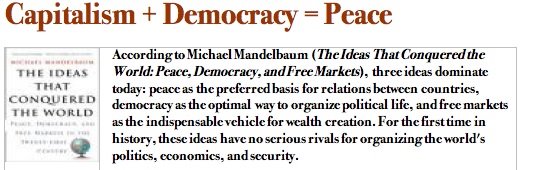
Robert Kagan has written a long article, published in Policy Review, called, “End of Dreams, Return of History.” The piece seems to push back at the pre-9.11 American optimism one finds reflected in the bible of this blog, Mandelbaum’s The Ideas that Conquered the World: Peace, Democracy, and Free Markets. Yet Kagan defends, without so branding it, American exceptionalism, our desire to spread to the rest of humankind the good fortune equal opportunity has brought us. While today exceptionalism is associated with Bush, conservatives, and Republicans, Martin Luther King’s quotation above shows how basic exceptionalism is to the ideals of America.

Kagan becomes more “realist” when he defends the nation-state system as securely in place today with Russia, China, Japan, India, and Brazil as major actors (though Kagan somewhat contrarily tends to treat the supernational EU as a single entity). An idealist such as Mandelbaum believes democracy is the inevitable final form of national government, even in Russia and China. Kagan defends autocracy as an accepted way to run a country, the normal way to govern until the 20th Century. By challenging autocracy, we unnecessarily threaten Russia, China, and other nations we should be seeking to get along with. Kagan feels we should rally the democracies to our side, and with the autocracies, work on détente (not his word, but his parallels to Kissingerism are too strong to ignore).

Here’s a big reason we need to get along with Russia and China. Kagan wants to promote democracy in the Middle East, a big job that means we have to minimize our battles elsewhere in the world. We should promote Middle East democracy, Kagan writes, “as part of a larger effort to address the issue of Islamic radicalism by accelerating and intensifying its confrontation with the modern, globalized world.”

Kagan believes the Islamists' struggle “poses by far the greatest threat of a catastrophic attack on the mainland of the United States. . . the radical proponents of Islamic traditionalism. . . have deployed the weapons of the modern world against it. Modernization and globalization inflamed their rebellion and also armed them for the fight."

Kagan recognizes that the great powers won’t turn over control of the Middle East to Islamic fundamentalist forces, “if only because the region is of such vital strategic importance to the rest of the world.” So the world faces a protracted struggle in which the goals of the extreme Islamists can never be satisfied because “neither the United States nor anyone else has the ability to give them what they want.”

That means the best course for the West is to “hasten the process of modernization in the Islamic world: more modernization, more globalization, faster. This would require greater efforts to support and expand capitalism and the free market in Arab countries, [and] increase public access to the modern world through television and the internet.” Also, the West should “promote political modernization and liberalization; support human rights, including the rights of women; and use its influence to support repeated elections that may, if nothing else, continually shift power from the few to the many.” In other words, promote democracy.

According to Kagan, “the United States and others will have to persist in fighting what is, in fact, quite accurately called ‘the war on terrorism.’ . . . [G]iven the high stakes, it must be prosecuted ruthlessly, effectively, and for as long as the threat persists. . . One need only contemplate the American popular response should a terrorist group explode a nuclear weapon on American soil. . .Nor, one suspects, will the American people disapprove when a president takes preemptive action to forestall such a possibility -- assuming the action is not bungled.”