Thursday, February 08, 2007

The Poor Get Richer

According to the Heritage Foundation/The Wall Street Journal 2007 Index of Economic Freedom, economic freedom is increasing worldwide, and so are incomes. The index’s average freedom score is the second highest in its 13 years of existence, only slightly behind last year’s, and every global region has expanded freedom in the last decade. The report finds that the higher GDP rates that come with economic freedom "seem to create a virtuous cycle, triggering further improvements in economic freedom. . .[C]ountries that increase their levels of freedom experience faster growth rates."

Two reports accompanying the findings make the case for expanded freedoms. Columbia University professor of economics Xavier Sala-i-Martin destroys the myth that the income gap is widening:

when population weights are factored into the equation, the evidence shows that "individual income inequality declined substantially during the past two decades. The main reason is that incomes of some of the world's poorest and most populated countries (most notably China and India. . .) converged rapidly with the incomes of OECD citizens."


And Swedish economist Johnny Munkhammar notes that while Europe’s more advanced economies restrict labor freedom at the cost of low growth and high unemployment,

"many Eastern and Middle European countries experiment successfully with freedom." Contrary to socialist views, labor freedom and improving social conditions actually go together. . . "If the world wants to achieve both more jobs and better living standards, [labor] freedom is essential."

Tuesday, February 06, 2007

Not Edwards

Here is how John Edwards proposes to stop Iran from building nuclear weapons:

we ought to put an offer of both sticks and carrots on the table. We ought to make it clear that there are things that America and the Europeans are willing to do [including] making the nuclear fuel available to them, . . . combining that with a set of economic incentives that will be very attractive to the people in, in Iran who’re already feeling an isolation from [Ahmadinejhad]. And then on the stick side say, “But there will be consequences if you don’t give up your nuclear program. And the consequences are the economic decline that you’re seeing within your own country will be accelerated, . . . because the bank—the banks in Europe and the European governments will not continue to do economic business with Iran.”


Edwards cannot be taken seriously as a possible president.

During his Sunday “Meet the Press” apppearance, Edwards also came out strongly for raising taxes to finance universal health coverage—in effect, socialized medicine. Edwards is the same person who ran in 2004 as the senator from North Carolina, the only moderate in that year’s field of liberals. Since he couldn’t even carry North Carolina (or South Carolina, the state of his birth) for Kerry-Edwards, he has now gone completely to the far left, trying to outflank Obama, a genuine, committed progressive, and Hillary, who has always been a progressive at her core. Edwards’ trial lawyer background makes him suspect to begin with. So his open pandering to the Democrats’ leftist primary base on Iran and national health insurance raises even deeper questions about Edwards’ core beliefs.

Hillary will win if she can run ahead of Giuliani and McCain in the polls; that takes care of the only strike against her. That’s how it was with Nixon in 1968. Once polls showed Nixon could be elected president, party faithful were only too happy to nominate him.

Obama? He’s running successfully for Vice President.

Monday, February 05, 2007

Iraq: Oil Production Target Lowered


Here’s our latest monthly, highly abbreviated version of the Iraq Index, published and updated twice a week by Michael O'Hanlon of the Brookings Institution:


Americans Killed in Action, Iraq (monthly average)
2003: 32
2004: 59
2005: 56
2006: 58
Jan. 2007: 73

Americans Killed in Action, Vietnam (monthly average)
1965: 128*
1966: 420
1967: 767
1968: 1140
1969: 785
____
* = First U.S. combat troops arrived in Vietnam, 5.3.65
Vietnam table compiled by Galen Fox using Defense Department sources.

Crude Oil Production (m. bbls./day)

Prewar Peak: 2.50
Goal: 2.10 (Revised downward, 1/07)
actual: 1.66 (1/07)

Electricity (megawatts)

Prewar: 3,958
Goal: 6,000
actual: 3,590 (12/06)

Since our last monthly report, American KIA's dropped from December's 91. But 73 KIAs is well above the average for last year, or any year. The mainstream media closely covered the sharp rise in KIA's in December, but has unsurprisingly made little reference to the monthly total for January.

Authorities dropped the oil production target substantially in January, from 2.5 million barrels a day, the prewar peak, to just 2.1 million barrels a day. December's output was above that target, but January production dropped to only 1.66 million barrels a day.

Electricity output remains low during the winter, though it rose slightly in January from December's level of 3,500 megawatts.

Saturday, February 03, 2007

Games People Play

As I’ve suggested, it’s alarming how little the West notices the serious threat to our way of life.

Some person named Barry Casselman thinks the way I do:

the West is in denial of what is truly happening in the world. This self-delusion is the most dangerous response possible to the intense and rapid change all over the planet. This self-denial takes many forms, including obsessions with abstract issues of little real consequence, e.g., animal rights, capital punishment, celebrity gossip, political correctness, etc. It is accompanied by the rise of secular mandates and the suppression of spiritual values. It exhibits excesses of greed that threaten both capitalism and representative government. The malign forces that conspire against the West, however, are not paralyzed. They are moving and growing at great speed.

Friday, February 02, 2007

Global Warming: The Tyranny of "No Debate"

Clive Crook, writing in the National Journal, wants a rational look at global warming solutions, which he views as impossible in the current “poisoned atmosphere (forgive the expression).” To even begin the discussion, Crook goes through a ritual denunciation of Bush, saying his “ill-founded and appallingly executed war has discredited all of the administration's foreign-policy,” and “by skewing his [tax] reforms so outlandishly in favor of the rich -- when the incomes of the highest earners were leaping ahead in any case, and when middle-income households were doing much less well -- Bush has discredited that whole line of thinking.”

But most of all, Bush has made calm discussion of global warming impossible. Crook writes:

there is no such clarity on the costs of climate change -- not even on the costs of the warming experienced so far (that question, in fact, get surprisingly little attention). As for future warming, it seems close to certain that it will happen, but determining how much is very difficult. . .My point is this. The awesome obtuseness of the administration on the issue has created a falsely confident and passionate opposing consensus. . .

Focused on opposing Bush, the global-warming consensus has no appetite for complications and doubts of any sort, about how big a problem this is going to be, or about the best ways of addressing it, even though some of those ways might be immensely expensive. . .For instance, some experts have credibly criticized the economic forecasts underlying the IPCC's simulations on technical grounds. That is apparently impermissible: The critics were immediately dismissed as climate-change deniers.

Another example: In thinking intelligently about how to respond to climate change, policies aimed at adaptation should be weighed alongside steps to slow the rate of warming. Some mixture of the two is sure to make the best sense. Again, however, to talk of adaptation -- to talk of weighing costs against benefits in any methodical way -- is to be regarded as an ally of the White House.

Thursday, February 01, 2007

Relax. We're a Superpower.

although Islamist extremists can certainly do huge amounts of harm around the world, it is quite different to suggest that they can threaten the existence of the United States.

Prof. David A. Bell, John Hopkins University
Los Angeles Times 1.28.07


Here are some reasons liberals oppose the Iraq war:

• “Pre-emptive” wars are wrong, making us the bad guys.

• War undermines efforts to redistribute resources at home.

• War is a Republican tool for retaining power.

• War is unnecessary, since Islamic extremists don’t threaten our way of life.

While pre-emptive war is suspect, we learned with World War II that it’s better to go after aggressors sooner rather than later. While war takes resources from worthy programs at home, war’s worth it if we face a genuine threat. On the other hand, while Republicans are serious about protecting America, if the threat isn’t real, Republican warriors do look suspiciously political.

So it comes down to “How real is the Islamic extremist threat, anyway?” It seems that millions of Americans, and most of the rest of the world, believe America is a superpower fully capable of defending itself against any small band of terrorists. They believe this, even though the combination of 9/11’s success and the portability of weapons of mass destruction suggests otherwise. Their belief sets aside what we know about terrorism’s asymmetry. Small groups of people willing to lose their lives are able to inflict incredible damage on a society.

Can Islamic terrorists threaten the existence of the world’s superpower, to put the danger in its most extreme form? A few nuclear weapons, or a coordinated chemical or biological attack on our major cities, could cripple the world’s leading democracy, and yes, it could transform America as we know it. Are we right to organize against this threat, and carry our defense to Islamic extremism’s homeland?

Here’s an easy way to answer the question. Do you feel America is run by rational people who have our nation’s and the world’s best interests at heart? Or do you feel irrational people have captured America who will do anything, especially exaggerating a foreign threat, to hang on to power?

If you don’t trust our leaders, then I guess the right battle to fight is the one for political control at home. Forget going overseas.

Trouble is, the leaders are rational. The threat is all too real.

Tuesday, January 30, 2007

The Answer Is More Democracy

Fouad Ajami, writing in the Wall Street Journal, offers yet another penetrating analysis of where things are going in the Middle East. All commentators are unequal in their insight, and Ajami on this subject has no rival.

For one thing, Ajami is right about how our Middle East allies help generate external conflict to stave off internal reform:

We should not be apologetic, in Arab lands seething with bigotry and rage, about our expedition into Iraq. We shouldn't fall for Arab rulers who tell us that they would have had the ability to call off the furies had we had in place a "process" for resolving the claims of the Palestinians, and had we been able to "deliver" Israel. Those furies have a life of their own: In truth, they are aided and abetted by these same rulers in the hope of tranquilizing their own domains and buying off the embittered in their midst.


So I listen to Ajami when he says success in Iraq rests significantly on one act—sharing oil revenue with the Sunnis—that may soon take place:

Against all dire expectations, the all-important question of the distribution of oil wealth appears close to a resolution.

Baker-Hamilton Support Iraq Troop Surge

National Security Advisor Stephen Hadley, writing in the Washington Post, stresses how important securing Baghdad is to our success in fighting Islamic extremism. In doing so, Hadley points out something of which I was unaware—the Baker-Hamilton report not only supported such a goal, it also supported a troop surge to reach that goal. Hadley writes:

The Baker-Hamilton report supports . . . “a short-term redeployment or surge of American combat forces [emphasis added] to stabilize Baghdad . . . if the U.S. commander in Iraq determines that such steps would be effective." Our military commanders, and the president, have determined just that.

Thursday, January 25, 2007

“Can’t we all get along?”

Just as I pronounce Democrats stuck in a ‘60s time-warp, along comes Mort Kondracke to make the same point as he pleads for the “beyond partisanship” politics the people are demanding, and that Schwartzenegger and especially Obama are (thankfully) offering:

Obama had it exactly right in announcing his presidential exploratory committee last week. “America has faced big problems before,” he said. “But today, our leaders in Washington seem incapable of working together in a practical, common-sense way. . .Obama represents a new generational sensibility — a pragmatic post-boomer attitude trying to bypass the ideological hang-ups of boomer veterans of the Vietnam and cultural struggles of the 1960s [emphasis added]. . .[T]he new politics is coming because the public wants it. It will just take courage and vision to give it life.

Wednesday, January 24, 2007

Democrats’ State of the Union

Responding to Bush’s State of the Union address, James Webb said, “not one step back from the war against international terrorism, [but] allow our combat forces to leave Iraq." Huh? Steny Hoyer said we ought to get out of Iraq so we can battle terrorism in Afghanistan. What?

Here’s why I believe Democrats aren’t the party of hope. First, they don’t have a serious foreign policy. Second, their domestic policy is stuck in a ‘60s time warp.

An unserious foreign policy. Democrats admire Kissinger’s strategy for exiting Vietnam—hold peace talks with the opposition, and use some variation of the words “peace with honor” to substitute for surrender. Kissinger’s realpolitik, like that of Austria’s Metternich whom Kissinger admired, used diplomatic skills to cover a weak hand.

In 2007, the U.S. is hardly weak. Instead, the Democrats’ haste to retreat from the difficult struggle against Islamic extremism is more like our position at the end of World War I, when a party anxious for the White House played on isolationist sentiment to force a powerful U.S. off the world stage. The world paid a heavy price for that shortsighted American bout with isolationism.

If you are serious about foreign policy today, serious about organizing globally to combat Islamic extremism including its Shia Iranian variant, you belong with Bush, Rice, Gates, Hadley, Petraeus. If you are an aspiring foreign policy consigliere for Democrats, you must accommodate yourself to that party’s domestic-driven agenda, and preach peace talks. Democrats believe someone else will take care of Islamic extremists. . . or at least should.

An outdated domestic policy
. History moves forward in surges. Years go by with no major changes, then major events change everything. The two searing events of the ‘60s were the civil rights revolution exactly 100 years after the Civil War, and the struggle to get us out of Vietnam. Democrats led both, won both, and can’t get past their victories, which combined to say America’s business is living equality at home, not dying to support capitalism abroad.

Democrats reordered American society, with the feminist revolution following the one that ended segregation. Democrats also gave us big government, inflation, unemployment, high taxes, affirmative action, and an unfinished campaign for single-payer national health insurance. As a result, Republicans under Reagan, Gingrich, and Bush captured power, reduced taxes, fired up the economy, and recharged a global drive for freedom that protects and enhances our way of life.

The choice. Business people are by nature optimistic. They must believe in the future to invest hard-earned money in hope. Our economy improves because people dare to risk. The genius of capitalism is leaving economic decisions to the people, millions, billions of them, enabling us all to reach our full potential.

Government people are pessimists who look for problems to justify government programs, including residual inequalities facing minorities and women. In the ‘70s, we learned government messes up the economy. In the ‘80s, we learned government messes up public education. Yet the Democrats’ policy agenda remains where it was in 1968: more government, higher taxes, smart people deciding what’s best for the rest.

Hope means hoping we don’t go back a generation. Hope means faith in the individual, in expanding opportunities for ordinary people to best handle their own future.

More freedom, more capitalism, peace at last.

Monday, January 22, 2007

Did Our Vietnam Intervention Save Southeast Asia?

Mark Moyar, writing in the Christian Science Monitor, argues that U.S. support for South Vietnam was far more successful than portrayed by journalist-historians such as Neil Sheehan. For one thing, says Moyar, U.S. involvement kept Indonesia from going Communist:

The military leaders of Indonesia, the most important Southeast Asian domino, informed the US in February 1965 that their future willingness to stand up to the pro-Communist President Sukarno and the massive Indonesian Communist Party would depend upon America's actions in Vietnam.

"President Johnson should learn to use his power and should hit North Vietnam hard," said General Marjadi in explaining why American inaction was discouraging the generals from taking a firm anticommunist position. "The prize for victory in Vietnam is all of Asia. Asia respects power, and has no respect for weakness or for strong people afraid to act." Indonesian generals later said that US intervention inspired them to oust Sukarno [pictured] and work to destroy the Indonesian Communist Party in late 1965.

Thursday, January 18, 2007

Blog at One: Still Preaching Hope

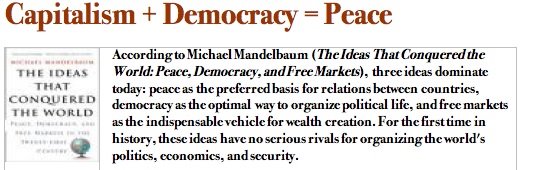
This blog, one year later, still believes the combination of capitalism and democracy, leading to peace, will bring us a better world.

There’s nothing wrong with Tories--those who defend established institutions. We’ll always have Tories. But it helps to be clear just who the Tories are.

In 2007, the Democrats are defenders of the present, and the Republicans are the force for change. How can this be? Don’t Democrats stand for égalité, which we hardly have, and Republicans for liberté, a word used to justify capitalist oppression? Yes, but liberty, freedom, is about each person having their own ideas, making their own way in life, and for most of the world, this is our as yet unrealized dream.

The irony of “equality,” and the irony is rich indeed in the whole history of Marxism, is that somebody has to make life equal. Enter government, to “level the playing field.” The idea of someone else making our life better is as ancient as Plato's Republic. In the 20th Century, it's the Big Idea that failed.

In the Democrats’ ideal world, the “levelers” are the best and brightest. They graduate from the best schools. They win top jobs on merit. They gain power in the battle against capitalists by acting on behalf of the masses, i.e., they are “the vanguard of the proletariat.” They are academics, government servants, journalists, lawyers, NPO executives, Hollywood writers, actual mass leaders including union leaders, leaders of minority groups, women leaders of the Democratic Party. They rule on our behalf, a national elite, operating under the motto of the National Honor Society, noblesse oblige. They are Tories, protecting the status quo, threatened by independent-acting masses.

The Democrats are Tories not only in being our elite, but also in giving their affection to Europe. European elite education. European sophistication that has moved beyond Christianity. European socialism; European welfare statism. European love of small or non-existent families. European abhorrence of war and killing. European disgust with common Americans. Most of all, Europe’s sense that the elite has earned its leading role, and must either civilize or otherwise bend under those who threaten it. There is entitlement, and there are illegitimate pretenders to power.

So little of this description fits Republicans like Reagan, Bush, or Giuliani. But for Democrats, it works—Democrats like Kerry, Gore, Edward Kennedy, Howard Dean, Hillary Rodham Clinton, Barbara Boxer.

Republicans were the dominant party in America when America was a string of small towns (Main Street, Sinclair Lewis, 1920). Towns had a hierarchy, but everybody went to the same church, the same school, the same socials. They talked to each other. They helped each other. Farmers were freemen, they weren’t tenant farmers like those who farmed for Tories. No, this was America, the land of the free!

Democrats are associated with cities, and the party grew with the importance of cities, the industrial revolution, immigration. Today, immigrants find it hard to relate to small-town, homogeneous Republicanism. They are more comfortable with cities. Cities are bigger, more impersonal, seemingly more in need of government and elite rule disconnected from the masses. Cities are European.

The suburbs are America’s political battleground. Suburbs’ link to central cities is obvious. But people move to suburbs because they yearn for the intimacy and caring of small town America.

The media and the entertainment industry are so city, so Tory, that to them, America’s Republican base is invisible. It's "fly-over country." I believe the Tories fear their loss of power, fight change, and feel despair where Republicans see hope.

Since Reagan’s election in 1980, Republicans have stood for hope, for the better life that comes from free economic competition, free choice in education, less government, increased individual responsibility. And Republicans support the hopeful world that comes from spreading democracy abroad. Since Reagan arrived in 1980, Republicans have had two bad elections—1992, when Bush 41 failed to make the economy work, and last year, when Bush 43 failed to win in Iraq. Otherwise, because Republicans offer hope to Tory cynicism and fear, and because Americans remain a hopeful people, Republicans have once again become America’s party.

Obama is right. The people want hope.
Monday, January 15, 2007

The China Century

TIME’s cover article on China treats the emerging giant as the dominant 21st Century power, a potential threat to a declining U.S. The article also notes that:

China is still a poor country whose leaders face so many problems that it is reasonable to wonder how they ever sleep. The country's urban labor market recently exceeded by 20% the number of new jobs created. Its pension system is nonexistent. China is an environmental dystopia, its cities' air foul beyond imagination and its clean water scarce. Corruption is endemic and growing. Protests and riots by rural workers are measured in the tens of thousands each year. The most immediate priority for China's leadership is less how to project itself internationally than how to maintain stability in a society that is going through the sort of social and economic change that, in the past, has led to chaos and violence.


To repeat myself, we can’t be certain about China’s future, but “China’s leadership” more easily manages the country’s “social and economic change” because of the rapid, yearly growth capitalism has brought to China.

More on Berger and the Media

Former Boston University Law School Dean Ronald Cass asks hard questions here about the media’s failure to ask why former Clinton National Security Advisor Sandy Berger destroyed classified documents relating to Al Qaeda. Is the media protecting Hillary’s future?

The definition of the end of civilization is when you can’t separate the police from the criminals. By that logic, the definition of the end of democracy is when you can’t separate the governing party from the media.

In Washington today, the media aren’t doing their job.

Saturday, January 13, 2007

Media MIA

I said earlier we need to pounce on documented evidence the media aren’t doing their job. Here are two such examples.

1. Joel Mowbray indicts media for ignoring former National Security Advisor Sandy Berger's unbelievable record of document destruction:

While Berger's "punishment" was a pittance of a fine, former Pentagon analyst Larry Franklin has been financially ruined and sentenced to 12 and a half years for passing along far less-classified information to unauthorized third parties. . .[W]hat excuse is there for the wildly different media coverage of the two cases, both of which came to public attention in the summer of 2004?

. . . One man verbally disclosed classified information devoid of sources or methods. The other snuck five different versions of a top-secret document out of a secure facility. One was a low-level career bureaucrat, while the other was just a few years removed from being the president's national security advisor. One man cooperated with authorities and didn't even retain a lawyer before being interrogated, while the other lied to investigators and then intentionally destroyed evidence. . .

Of all the articles about Berger's case . . . only one made it to the front page of either The Washington Post or the New York Times. Coverage of Franklin's case, however, earned that distinction more than a half-dozen times. . . The mainstream media's palpable disinterest in the Berger case is hardly justified. Many questions remain unanswered. Of the few explanations Berger and his defenders have actually provided, none passes the laugh test.


2. Sydney J. Freedberg Jr., writing in the National Journal about American war heroes in Iraq, discovered the media ignore the living:

3,463 Bronze Stars with V have been awarded since September 11, 2001. That's about the same figure as the total number of U.S. troops killed since then in the wars in Afghanistan and Iraq. Every dead warrior leaves behind a story of tragedy and loss. Every medal winner leaves behind a story of dedication and courage. Sometimes the two are the same: A soldier is killed in action and is decorated posthumously. But the vast majority of these heroes, like Sgt. Stone, are still alive; many, like him, are still in uniform. It is much harder, however, to learn about the valorous living than about the valorous dead. Major media outlets such as The Washington Post, The New York Times, and PBS's NewsHour regularly display photos of those killed but rarely of those decorated.

Wednesday, January 10, 2007

Pelosi Power

Linda P. Campbell, writing in the Fort Worth Star-Telegram,
underlines pretty heavily the point made here that Democrats aren’t red or blue, they are the party of Pink Power:

Nancy Pelosi has campaigned as "A Voice That Will Be Heard." And anyone who's had a strong mother—or been one—can attest to the true meaning of that slogan. . . Pelosi told CBS' 60 Minutes that being speaker would enable her to "show the American people that women know how to use power" . . . The new Congress will include 71 women in the House (50 Democrats, 21 Republicans) and 16 in the Senate (11 Democrats, five Republicans). . .


So Pelosi ranks third in the U.S. leadership structure, the highest a woman has ever ranked, and 22% of House and Senate Democrats are women—44% of the way in each house to 50:50 parity!

Then there’s the obvious. In a presidential election Democrats will be favored to win, the most likely winning ticket—Clinton/Obama—is headed by a woman.

Pink Power.

Tuesday, January 09, 2007

Iraq War Loss is Democrats' Gain

In his piece titled “The 2008 Election is the Democrats' to Lose,” Washington political guru Stu Rothenberg makes the point that Iraq will help Democrats capture the White House next year:

[Even a] dramatic improvement in Bush's standing in national polls . . . wouldn't erase all the baggage that the president and his party have picked up. . . [g]iven that few people believe that U.S. forces will be entirely out of Iraq by 2008. . .


Democrats really, really know how a bad war can sink a party. Vietnam turned America in 1968 from a Democratic-dominated nation to one where Republicans held the White House for all but 12 of the next 40 years. Americans don’t like to lose wars. But for the party that's not responsible, a losing war can be a big winner.

Democrats don't believe Iraq’s the central issue facing America. Yet Iraq is the central issue Democrats will use to separate Republicans from the White House.

Monday, January 08, 2007

Iraq: Is Winning that Hard?

Johns Hopkins Professor Eliot A. Cohen and Reagan-era Defense official Bing West have jointly written an article that offers a prescription for success in Iraq so difficult to achieve as to imply the Bush-led effort is doomed:

President Bush . . . can opt for an offensive, nonsectarian strategy. Its core operational concepts must be neutralizing criminals -- which include the Sunni insurgents, the Shiite death squads and the criminal gangs -- by imprisonment, deterrence, or death; and constructing Iraqi security institutions [free] of sectarian taint.

Iraq is now a police war and we need to treat it as such. . .Our weakest links are leaving the Mahdi Army off-limits, not selecting [our own] Iraqi security leaders and refusing to arrest and incarcerate the criminals (insurgents, death squads and thugs). If the president's new strategy does not aggressively rectify these three defects, then surging more American troops will buy time but not alter a war we are losing because we are not winning.

The threat is real. We can't wish it away.

Generally, things are going well in 2007. The common person, who had little to do with most of the world’s progress since time began, is a history-shaping factor now like never before. Democracy is ordinary people holding power. Capitalism is people, not government, making the economy hum. People with political and economic power don’t want war. They want peace. The common person would rather live and enjoy life.

The extremists who hate Western culture and idealize 632 CE Arabia don't fit this brighter picture. To them, life was rightside up in the 7th Century, when Islam was sweeping through the known world. Muslim extremists are willing to die and kill for their better world. The West had to wage bloody war to defeat Fascist extremism, and Cold War against Communism involved several wars over forty years. Now once again, extremists who value ideas over life know they will defeat a soft West.

We must stand up to Islamic extremism. After 9-11, America as a nation understood the need to defeat this new enemy. We chose to make our stand in Iraq for good reason. The civilized world condemned Saddam because of his brutal rule, his aggression against Iran and Kuwait, his use of WMD in warfare, and his refusal to allow UN inspectors access to Iraqi facilities. Saddam had the large oil reserves needed to finance his mischief, and ruled from an Iraq strategically located at the heart of the Arab world. If the West could liberate Iraq and help its Muslim population become prosperous, Iraq could help lead the Islamic world away from extremism.

Because of Saddam’s real threat, because we liberated Iraq from Saddam’s tyranny, Iraq seems the right place to take on Islamic extremism and replace it with popular rule underpinned by economic prosperity. In 2007, we are responding to a clash of civilizations that others launched against us. We have chosen to fight back in Iraq. If we lose in Iraq, we will have to battle Islamic extremism again in a location closer to home, at greater cost.

Do Western people see the urgency of our current fight, or do we wish the problem away? The two choices we face are to fight now, or to fight later at greater cost. Wishing the problem away, going back to life as we knew it before 9-11, is not a choice.

I think we wish terrorism away because we believe that most humans value life; most seek prosperity that gives children a better future. Just as these values prevail elsewhere, so too will they prevail in the Muslim world, given time. War is unnecessary.

Unfortunately, war is necessary. Those who believe terrorism can defeat the West aren't going away.

Thursday, January 04, 2007

Iraq: December a Bad Month; 2006 a Bad Year


Here’s our latest monthly, highly abbreviated version of the Iraq Index, published and updated twice a week by Michael O'Hanlon of the Brookings Institution:

Americans Killed in Action, Iraq (monthly average)

2003: 32
2004: 59
2005: 56
2006: 58
December: 91

Americans Killed in Action, Vietnam (monthly average)
1965:* 128
1966: 420
1967: 767
1968: 1140
1969: 785
____
* = First U.S. combat troops arrived in Vietnam, 5.3.65
Vietnam table compiled by Galen Fox using Defense Department sources.

Crude Oil Production (m. bbls./day)

Prewar: 2.50
Goal: 2.50
actual: 2.15 (12/06)

Electricity (megawatts)

Prewar: 3,958
Goal: 6,000
actual: 3,500 (12/06)

Since our last monthly Iraq report, American KIA's rose significantly above November's 57; high enough to make 2006 the war's second w0rst year. The mainstream media closely covered the sharp rise in KIA's, suggeting that the deadly trend might make December 2006's worst month (in the end, October was worse). December was a bad month, and 2006 a bad year.

Oil production in December rose slightly, yet remains below pre-war levels. Electricity output declined, but that drop is partly seasonal; December electricity production was higher than in December 2005.

Al Qaeda's February bombing of the Shiite Al Askari Mosque set off a wave of sectarian bloodshed that proved to be Iraq 2006's major story.

Wednesday, January 03, 2007

Liberal Echo Chamber

Like many businessmen of genius he learned that free competition was wasteful, monopoly efficient. And so he simply set about achieving that efficient monopoly.

--Mario Puzo


Democracy and capitalism permit individuals, famous or unknown, privileged or immigrant-poor, to make life better through competition. Competition allows for the best ideas and the hardest workers to move forward. But where there are winners, there are losers, so winners will always strive to fix the competition and avoid becoming tomorrow’s losers.

Change is inevitable. So too is fighting change. The mainstream media are in power today; they logically strive to hold onto their paramount position. Here are some ways the media’s efforts to fight change hurt the common person:

1. The media protect their friends and mobilize against their enemies, with truth the casualty. Instead of encouraging the competition for new ideas, the media constantly strive to defend the coalition that made them powerful: the permanent government and its friends in academia and non-profits; the Democratic Party/organized labor, organized women and organized minorities; the legal profession, which defends institutions including the media enshrined by the Constitution, and; the media’s close cousin, the entertainment industry. The media favor higher taxes, which bring resources to government and its allies. The media are anti-business, since media folks sincerely view capitalists as America’s first circle of power; anti-Christian, an alternate source of power with a different agenda; and anti-military, the institution that raises the sword above the pen.

2. Believing truth to be relative, the media push their version with great intensity.
By nature, media are biased toward the sensational, the visual, the newest over the new. It is about now, now, now, not about reflection, perspective, balance. Voraciously hungry for new material, media end up being unimaginative about the world they cover, plugging new evidence into preconceived belief structures, rather than threatening these beliefs by reexamining them through new eyes. So here we are in 2007, treating Iraq as if it were Vietnam, Bush as if he were Johnson, Muqtada al-Sadr as Ho Chi-minh, and the all-volunteer professional military as losers who couldn’t dodge the Vietnam draft. Media also see Bush as Nixon, the illegitimate president who should be driven from office. Meanwhile, the big stories—capitalism’s ability to transform the lives of ordinary people, capitalism's spread throughout Eastern Europe and most of Asia, the rise of democracy and freedom worldwide, and the decline of war and violence as the way to settle conflicts—are largely ignored.

3. By fighting to retain power, the media fight change.
The media’s central power position is wrong for America. Media could referee the battle for better ideas, not side with one of democracy’s contending coalitions against the other. Perhaps we best move toward neutrality by encouraging alternative media to emerge that reflect the views of those outside the media’s power coalition—more talk-radio, more Fox, additional conservative bloggers, more Wall Street Journals. Alas, too few people understand how thoroughly the media fixes the news to keep a coalition in power: another story most media choose not to cover.

The media belong near the center of power. Events change history today as they always have—it's the message, not just the messenger. Nevertheless, one should challenge, wherever proof makes challenge possible, the media’s role in setting the national agenda, driving it between elections, and finally, seeking to win elections.

Gore's Running Mate: More Troops in Iraq

Sen. Joseph Lieberman makes his case here for adding troops to Iraq, rather than taking them out:

I strongly believe that additional U.S. troops must be deployed to Baghdad and Anbar province -- an increase that will at last allow us to establish security throughout the Iraqi capital, hold critical central neighborhoods in the city, clamp down on the insurgency and defeat al-Qaeda in [Anbar]. . .

More U.S. forces might not be a guarantee of success in this fight, but they are certainly its prerequisite. Just as the continuing carnage in Baghdad empowers extremists on all sides, establishing security there will open possibilities for compromise and cooperation on the Iraqi political front . . .

The addition of more troops must be linked to a comprehensive new military, political and economic strategy that provides security for the population so that training of Iraqi troops and the development of a democratic government can move forward.

Saturday, December 30, 2006

Ford’s National Nightmare

The U.S. entered its dark period in Spring 1965. Confronted with the impending collapse of the South Vietnamese government at the hands of North Vietnam/Vietcong forces, the U.S. under President Johnson responded by sending American combat troops to carry on the fight. From that point on, life turned bleak in America. Events and the media drove Johnson from office three years later. Johnson’s successor Nixon was also a failed president; he got us out of Vietnam, but committed the Watergate-related crimes.

Both Johnson and Nixon wrongly played economic policy for short-term gain. Their economic decisions generated inflation, recession, or stagflation—a combination of both—for most every year from 1967 to 1983. In foreign affairs, we were driven from Vietnam in 1973, and South Vietnam and neutralist Cambodia collapsed in 1975. By mid-1979, President Carter was indicating a “national malaise,” not his administration, was responsible for America’s continuing economic and foreign problems. In late 1979, Iranians seized the American embassy in Tehran, and the subsequent hostage crisis, including Carter’s aborted effort to rescue the hostages, dominated the remaining days of his failed administration. It took Ronald Reagan in the early 1980s to pull us finally out of our national funk.

Gerald Ford was an accidental president in the midst of this bleak period. He was appointed Vice President in late 1973, after evidence of Spiro Agnew’s corruption forced the elected Vice President to resign. Nixon knew Ford, popular in Congress, would receive easy confirmation. Nixon also thought Ford’s well-known limitations, including his total lack of charisma, might cause Congress to hesitate before removing Nixon from office.

In his two and a half years as president, Ford brought the nation badly needed decency and calmness, symbolized by the good feelings surrounding 1976's Bicentennial celebration of American independance. But Ford did little to solve America’s economic and foreign problems—to end our real national nightmare. The November 1974 mid-term elections, three months after Ford took over, were a Republican disaster. Ford, though personally honest, made it worse for Republicans by tying himself to Watergate when he granted Nixon an unconditional pardon from Watergate crimes, an effort to dispose of Watergate that blew up in Ford's hands.

Ford committed another major blunder when in 1976, he denied to a national audience in America's first presidential debates since 1960 that Poland and Eastern Europe were under Soviet domination. His mistakes helped make Ford the third president in a row forced to leave office before reaching his constitutional limit.

Tuesday, December 26, 2006

China 2007

Gordon G. Chang has a lengthy Commentary article on why trouble is brewing in China:

Every society changes from one day to the next. But the economic and social transformation in China, especially since the beginning of the reform era in December 1978, has been particularly startling. Mao regimented the Chinese people, oppressed them, clothed them in totalitarian garb, and denied them their individuality. Today, they may not be free, but they are assertive, dynamic, and sassy. A mall-shopping, Internet-connected, trend-crazy people, they are remaking their country at breakneck speed. Deprived for decades, they do not only want more, they want everything.


Undoubtedly, the Chinese leadership knows it’s riding a tiger. It stays upright by surging China forward economically, moving fast enough to keep a potentially-restive population in line. Everything about governing is easier, including moves toward freedom and democracy, when the economy grows. Lessons learned in Japan, Taiwan, Hong Kong, and South Korea may—actually, should—work for China.

Sunday, December 24, 2006

Paul and Faith

Christianity is the world’s largest religion. Christians believe in the New Testament, the oldest part of which is letters Paul wrote to Greek-speaking Christian communities in the mid-1st century. Luke’s nativity story came decades later.

Paul had a clear idea of his faith, and he wrote clearly. In Paul’s time, Jesus Christ’s time, life for most was nasty, brutish, and short. Stoicism was one popular response to brutal lives. Stoics taught that people who committed themselves to matters beyond their control such as wealth, health, careers, or lovers were set up for having bad fortune ruin their well-being. Better for people to redirect their efforts toward things that cannot be taken away, such as one’s freedom to think whatever one wants, one’s honor, and one’s sense of duty.

Christianity is certainly about personal freedom, honor, and a sense of duty. But Christianity adds the hope of triumph over death. Christians believe Jesus died for our sins, and will return, in Paul’s words, to “rescue us from the wrath that is coming” (I Thess 1:10). Jesus died for us, asking that we believe in him. If we believe, we will have eternal life. In exchange for faith, we get more than the Stoics’ sense of well-being.

Paul understood believers want instruction in how to live in faith. Paul offered that help. Most powerfully, he taught us how to love. Yet Paul believed in justification by faith, not works. We don’t love, we don’t do good, in order to get to heaven. Rather, by believing in Christ, by embracing an innocent, itinerant rabbi who sacrificed his life on a wooden cross—for Jews like Paul, the most degrading way one could die—to atone for our sins, we gain a faith that makes us want to reciprocate by becoming loving, giving individuals.

The Christian world is an alternate world, one where the weak become strong, where the poor come first, and where giving is greater than receiving. It is, however, a faith that is very much of this world. Believers live in the here and now. Belief, love—they work both on earth and for eternity.

Today, we know much more about how the human mind works than people did in Paul’s time. Yet there is so much we still don’t know. That means we’re still asked to take the same “leap of faith” Paul challenged us to make 2000 years ago.

Saturday, December 23, 2006

Marine Corps: Massacre Occurred at Haditha

I earlier recommended caution regarding what actually happened at Haditha. We now have official charges against Staff Sgt. Frank D. Wuterich and seven other marines. Wuterich seems to have gone berserk after an IED killed one of his marines, reacting by killing twelve innocent people, including women and children, and inciting three others under his command to “shoot first and ask questions later.”

So the mainstream media was right about a crime, but probably shouldn’t have condemned the entire system as a result. Among other facts, the Marine Corps has charged four officers who weren’t even on the scene with dereliction of duty in connection with Haditha.

Friday, December 22, 2006

Oprah, Tiger, Barack, Beyoncé

Just so you know, I don’t think much of TIME.

The last time TIME picked an African-American Person of the Year, he was the chief symbol of the Negro race's drive for equality. Decades have passed since 1964, when TIME made the Rev. Dr. Martin Luther King, Jr. its Man of the Year.

In 2006, it’s no longer about being black. It’s about being dominant and incidentally black. For we surely live in a completely different world.

And is this world big enough to contain Beyoncé? OK, so “Dreamgirls’” Jennifer Hudson may have better pipes (she certainly got the better part and the better songs), but Beyoncé is unquestionably the “It” woman of 2007. It’s been coming on for years, and now it’s move aside Britney, sorry Christina, and bye-bye Madonna. You're all hardly "Irreplacable." Nobody is bigger than Beyoncé. Color? Being non-white in a non-white world hardly hurts. But with Beyoncé, it’s beyond color; it’s the overwhelming power of the total package. Beyoncé, at 25, is Entertainer of the Year. Worldwide.

And yet she’s fourth on our list. The top spot goes to Oprah, the single most powerful influence on Western culture today. How could Oprah not have been TIME’s Person of the Year years ago? Is she a competitor to TIME? Actually, I don’t think TIME is any longer in Oprah’s league. Really, in this era of money buying not happiness, but rather big hips, who speaks more directly to our needs than Oprah? If you ask American women who they most admire, Oprah is #1. Oprah—way, way, beyond being a successful black woman.

Not a surprise, Oprah’s power. And does anybody dominate any single sport with such grace, such intelligence, such articulateness as Tiger? Such an upper class, once lily-white activity. Because golf is an individual sport, person against the elements, because it is played everywhere, because normal sized people play it well into their 50’s and 60’s, golf has incredible appeal. And Tiger is golf, the symbol of golf’s worldwide growth, bigger than any golfer ever.

Barack, unlike the other three, is still mostly potential. But the job he seeks, President of the United States, is the world’s biggest. And look. No president has ever been a Harvard Law Review editor. Barack was not only an editor, he was President of the Law Review. Now, Barack is perfecting his skills at appealing to moderation, to consensus, to working together at a time when the country is crying for an end to the bitter, partisan divisiveness that has dominated American politics almost continuously since 1988, and maybe since 1966. Yes Barack is black. He’s white too. Bringing us together.

Oprah, Tiger, Barack, and Beyoncé. Four amazing Americans, four outstanding citizens of the emerging, 21st Century world.

Tuesday, December 19, 2006

Please, No Protectionists!


In an editorial, the San Diego Union expresses concerns about Barack Obama’s economic views:

With his opposition to many trade deals and his Wal-Mart bashing, Obama has tentatively allied himself with [protectionists], all the while depicting himself as a thoughtful centrist. But there is nothing thoughtful about ignoring the vast evidence that free trade and relatively unfettered capitalism have made America prosperous—or arguing that a company whose low prices help millions of families make ends meet and which has no trouble filling jobs should abandon its business model and become an adjunct welfare agency.


The two parties shouldn’t be dividing over the worth of free trade or capitalism. But Republicans ruled and Democrats were scrambling for a role to play when the Great Depression hit in 1929. The Democrats’ rise to power—the party dominated America from 1932 to 1968, and continued to dominate Congress for an additional 26 years—stemmed from its identification with government as a force to counter capitalism’s failings. So Democrats have a tough time with capitalism. Government is good; business is bad.

Now that Democrats are back in power because Bush failed to fight the Iraq war effectively, the heart of the party wants to return to its anti-business roots. Any free trader will struggle in the Democratic primaries. Meaning it’s quite possible than whoever wins the Democratic presidential nomination will be—in contrast to Bill Clinton in 1992 (pictured)—unqualified to manage the U.S. economy.

Monday, December 18, 2006

Helping the Middle Class

Economist and ex-Harvard president Larry Summers has an LA Times piece on how to play “win-win” with the middle class:

If the new Congress sees itself as having any kind of economic mandate, it is for policies that "stand up" for ordinary Americans against the perceived threat from corporate and moneyed interests. . .

Although workers have normally received about three-quarters of corporate income, with the remainder going to profits and interest, labor has received only about one-quarter of the increase in corporate income since 2001. . . ordinary American families do not feel like they are in the same boat as corporations and their chief executives, or even able to benefit from the same rising tides.

. . . populist economic policies . . . rarely achieve their objectives but incur huge collateral costs. Policymakers forget at their peril that globalization has enabled the U.S. economy to enjoy the very favorable combination of low unemployment and low inflation, and that without open markets, product prices would be rising much faster than they are, making living standards even worse for middle-class families.

[Find] policies that complement the market system while responding to fairness concerns. [Restore] the progressivity of the tax system — where much can be accomplished without changing the rate structure.

[Don’t] audit disproportionately the tax returns of those in the bottom half of the income scale at a time when most of the $500-billion tax gap comes from those with high incomes.

There is no policy justification for allowing the corporate income tax to be eroded through the pervasive use of tax shelters and the manipulation of transfer-price rules. Not only does this cost the government revenue, it puts unfair competitive pressure on firms that try to meet their obligations to their workers and their country.

[Also:] disclosing executive compensation, leveraging the volume of government purchases, making the financing of education more equitable, finding ways to assure that businesses continue to take responsibility for the healthcare costs of their workers . . .

President Kennedy famously challenged Americans: "Ask not what your country can do for you. Ask what you can do for your country." In the years ahead, this question will be put with increasing force to American corporations.

Friday, December 15, 2006

Global Warming: The Audacity of Hope


The New York Times’ Steve Lohr has a lengthy piece about the gains from pricing the cost of carbon creation more accurately:

Global warming can be seen as a classic “market failure,” and many economists, environmental experts and policy makers agree that the single largest cause of that failure is that in most of the world, there is no price placed on spewing carbon dioxide into the atmosphere. . .

“Setting a real price on carbon emissions is the single most important policy step to take,” said Robert N. Stavins, director of the environmental economics program at Harvard University. “Pricing is the way you get both the short-term gains through efficiency and the longer-term gains from investments in research and switching to cleaner fuels.”

. . . only with some sort of federal policy in place . . .will it become clear what carbon cleanup or fuel-switching moves [utilities] may have to make, and on what sort of timetable.

Combating global warming. . . will require over-the-horizon breakthroughs involving safe nuclear energy, hydrogen power and advanced carbon sequestration — or technologies that have not yet been imagined.

But even today, there are sizable opportunities, by insisting on more efficient energy use, that are not being seized, according to the McKinsey Global Institute. In a new report, the institute. . . estimated that the yearly growth in worldwide energy demand could be cut by more than half through 2020 — to an annual rate of 0.6 percent from a forecast 2.2 percent, using current technology alone.

Available steps that would yield a more productive, and efficient, use of energy include compact fluorescent lighting, improved insulation on new buildings, reduced standby power requirements and an accelerated push for appliance-efficiency standards.

[One way] of pricing carbon [is] to place a cap on total emissions and then let polluters trade permits to emit a ton of carbon dioxide. . .Then, companies able to go below their emission targets would be allowed to sell their unused “permits to pollute” to companies that could not. . .

China and India, energy specialists say, would certainly avoid joining any international effort on global warming without an emphatic move by the United States. “Every year we delay, we contribute to another year of delay in China, India and elsewhere,” said Jason S. Grumet, executive director of the National Commission on Energy Policy, a bipartisan group of energy experts.

Tuesday, December 12, 2006

Hey, Look, Patton!

Tony Blankley, writing in the Washington Times:

Official Washington, the media and much of the public have fallen under the unconscionable thrall of defeatism. Which is to say that they cannot conceive of a set of policies -- for a nation of 300 million with an annual GDP of over $12 trillion and all the skills and technologies known to man -- to subdue the city of Baghdad and environs. Do you think Gen. Patton [bold added] or Abe Lincoln or Winston Churchill or Joseph Stalin would have thrown their hands up and said, "I give up, there's nothing we can do"?

Monday, December 11, 2006

Did Rahm Emanuel lie about his knowledge of Mark Foley? Yes.

Glenn Greenwood, on his blog, goes after Democratic Congressional Campaign Committee Chair Rahm Emanuel for lying about his 2005 foreknowledge of the Mark Foley scandal:

[ABC's “This Week”’s George] Stephanopoulos explicitly asked Emanuel: "I just want to ask you plainly -- did you or your staff know anything about these emails or instant messages before they came out?"

Emanuel interrupted the question with an emphatic "no." Then, once Stephanopoulos was done with the question, this is what Emanuel replied: "George, never saw 'em . . . . " A moment later, Stephanopoulos said to Emanuel: "So you were not aware of them, had no involvement?" Emanuel replied: "No. Never saw them. No involvement. . . ." [Later,] Emanuel replied: "No. Never saw them. The first time I ever saw these things, right here was when Brian Ross broke the story."

When summarizing the reasons why he believed that the GOP House Leadership was guilty of poor judgment and a cover-up in the Foley scandal, this is what Emanuel said: ". . . In 2005, [Mark Foley]'s appointed to head the Missing and Abused Children Caucus for the Congress. When he wants to retire, they ask him to run for re-election in 2006, even knowing -- clearly -- that there is something amiss and wrong here.”

On Friday, the House Ethics Committee released its Report [which] found that "the Communications Director for both the House Democratic Caucus and the Democratic Congressional Campaign Committee also had copies of the emails in the Fall of 2005" (p. 76). . . .It is now being reported by CNN that not only was the DCCC's Burton aware of the e-mails in 2005, but so, too, was Emanuel.

Did Rahm Emanuel explicitly and clearly lie during his October appearance on ABC?

Emanuel would likely say that he did not "lie," because each time he was asked whether he was "aware" of the e-mails -- which he plainly was -- he never denied being "aware" of them. Instead -- he would likely argue -- he changed the subject by denying that he ever "saw" the e-mails. . . But that argument, ultimately, is nonsense. If you listen to the video, there is little doubt that Emanuel was lying in every meaningful sense of that word. He not only denied having "seen" the e-mails, but also interrupted Stephanapolous's first question about whether he was "aware" of the e-mails with an emphatic "no," and at least on one other occasion, denied not only having seen the e-mails, but also having been aware of them. Those denials were just outright false (i.e., "lies").

[And when] Emanuel emphasized how inappropriate it was for Republican House Leadership to allow Foley, in 2005, to become the Chair of the Missing and Abused Children Caucus despite what Emanuel called the "warning signs" about Foley's behavior[, he] was aware of at least some of these same "warning signs" in 2005, and he said nothing about them at the time. He was guilty of doing exactly what he was piously and indignantly accusing the GOP House Leaders of doing -- namely, knowing about the Foley e-mails to pages and taking no action.

Sunday, December 10, 2006

Do We Need to Win?

Bush asked [Archbishop Pietro] Sambi,
[papal nuncio to Washington,] whether he had any ideas for winning the war. According to Catholic sources, the papal nuncio responded that the Vatican did not fight but only prayed.

--Robert Novak, Columnist


Those who believe the West faces a growing struggle against Islamic extremism see Iraq as the battle’s crucial front. To the rest, other issues are more important, more immediate.

There seem three views on U.S. involvement in Iraq:

1. We never should have gone in; we should be out yesterday. Vietnam already taught us this! What’s left to learn? The soul of the Democratic Party is wrapped around such a view. To progressives, the U.S. has far better priorities. Elective wars overseas steal food out of the mouths of children and the elderly, and play to a military-industrial complex that in order to thrive, despoils the environment and kills people. Elective wars are so wrong that it is right to root for U.S. military defeat.

2. There are no permanent enemies, only permanent interests.
Considering what truly mattered to the U.S., the cost of Vietnam was out of proportion to any possible gain. Kissinger covered our retreat by re-ordering priorities away from Southeast Asia. If we could get along with China, why worry if Saigon went Communist? Kissinger’s realpolitik finds its current face in the Iraq Study Commission’s James Baker, who would have courting Iran and Syria be the 2007 version of Kissinger’s wooing of Mao and Brezhnev.

3. If we cave to extremism now, it will get worse later. This is how FDR and Churchill saw World War II, and how Reagan viewed the Cold War. It’s Bush’s view of Iraq today. Now fighting to win is much in disfavor. Yet some military historians argue that the U.S. Army under Gen. Abrams turned the Vietnam war around after Tet 1968, only to be undermined by politicians and media-shaped public opinion. And today, it’s not the U.S. military’s fault that Baghdad remains insecure. Two recent arguments for having the U.S. military take over Iraq come from the Hoover Institution’s Shelby Steele, and the American Enterprise Institute’s Reuel Marc Gerecht.

We once had generals who fought to win (George S. Patton, pictured). Now diplomats help us retreat with honor.

Friday, December 08, 2006

Who Gives. . .And Who Doesn't


ABC’s John Stossel has a report about who really gives to charity:

the idea that liberals give more is a myth. Of the top 25 states where people give an above-average percentage of their income, all but one (Maryland) were red -- conservative -- states in the last presidential election.

"When you look at the data," says Syracuse University professor Arthur Brooks, "it turns out the conservatives give about 30 percent more. And incidentally, conservative-headed families make slightly less money."

Researching his book, Who Really Cares, Brooks found that the conservative/liberal difference goes beyond money:

"The people who give one thing tend to be the people who give everything in America. You find that people who believe it's the government's job to make incomes more equal, are far less likely to give their money away." Conservatives are even 18 percent more likely to donate blood.

. . . while the rich give more in total dollars, low-income people give almost 30 percent more as a share of their income. Says Brooks: "The most charitable people in America today are the working poor". . . Note that Brooks said the "working" poor. The nonworking poor -- people on welfare -- are very different, even though they have the same income. The nonworking poor don't give much at all.

What about the middle class? Well, while middle-income Americans are generous compared to people in other countries, when compared to both the rich and working poor in America, Brooks says, "They give less." . . .

Brooks says one thing stands out as the biggest predictor of whether someone will be charitable: "their religious participation." Religious people are more likely to give to charity, and when they give, they give more money -- four times as much.

[And,] says Brooks, "Religious Americans are more likely to give to every kind of cause and charity, including explicitly nonreligious charities. Religious people give more blood; religious people give more to homeless people on the street."

Tuesday, December 05, 2006

Iraq: November Better for Americans


Here’s our latest monthly, highly abbreviated version of the Iraq Index, published and updated twice a week by Michael O'Hanlon of the Brookings Institution:

Americans Killed in Action, Iraq (monthly average)

2003: 32
2004: 59
2005: 56
2006: 55
November: 57

Americans Killed in Action, Vietnam (weekly average)
1965:* 30
1966: 97
1967: 177
1968: 263
____
* = First U.S. combat troops arrived in Vietnam, 5.3.65
Vietnam table compiled by Galen Fox using Defense Department sources.

Note please—the Vietnam KIAs are weekly, not monthly, averages.


Crude Oil Production (m. bbls./day)

Prewar: 2.50
Goal: 2.50
actual: 2.04 (11/06)

Electricity (megawatts)

Prewar: 3,958
Goal: 6,000
actual: 3,600 (11/06)

Since our last monthly Iraq report, American KIA's are down significantly, 40 below the year's October high. The 40-person drop in American KIA's to near the yearly 55-a-month average is information the mainstream media chooses not to report. Instead, the media now gives only daily figures of Iraqis and Americans killed. The U.S. KIA for November dropped because U.S. Baghdad-area combat activity declined, not because Iraq suddenly became more stable. But the media, having avoided the true explanation for October's high figures, can't now explain away the November drop. So now it just ignores the monthly death toll it was all over last month, when October's election-eve totals were so high.

At the same time combat deaths were down, oil production in November continued to fall, and is now significantly below pre-war levels. Electricity output also declined, but that drop is seasonal; power demands go down in the winter.

Monday, December 04, 2006

Moderation and Democrcy

Moderation in all things.

--Terence, Roman Comic Dramatist (185-159 BC)


I am intrigued by the fact that almost every person I am familiar with believes s/he is a relative moderate. No matter what the level of extremism, each finds someone who is more extreme. Which, I suppose, is theoretically so. It’s a simple, comforting thought. I’m here, the meat in the sandwich, and I’ve got at least one breaded cover on each side of me.

Anyway, it’s nice to know moderation gets lip-service at least. Moderation’s why democracy is such an important system of governance. Moderation is about not having a corner on the truth. Democracy lets ideas contend for influence. We can believe we are entirely right, and maybe we are. After all, look at those wrong people on each of our wings. But none of us are all right, all of the time.

So the Big Idea, the right idea, is democracy, the idea that lets all ideas contend for power. Told this year (links to related blog entries, below) that Isaiah Berlin (pictured)’s essay on “Two Concepts of Liberty” is one of the 20th Century’s most important, I’ve become a Berlin convert, Berlin escaped Nazism and Communism to proclaim mid-century at Oxford the profound importance of allowing individuals to pursue truth on their own, and the necessity of protecting them from the “truths” of others.

Please see these entries:

Freedom (July 4, 2006)

Socialism Lives (May 13, 2006)

Final Thoughts on "Two Liberties" (May 6, 2006)

"Positive Liberty" Plagues Both Parties (May 5, 2006)

Or is It "Positive Liberty"? (May 4, 2006)

Is It "Negative Liberty" We Value Most? (May 4, 2006)

"Two Concepts of Liberty" (May 1, 2006)

Friday, December 01, 2006

Can't Push Democracy Toothpaste Back In

Johns Hopkins Prof. Fouad Ajami, writing in U.S. News, makes the case for sticking by the Bush Doctrine:

In Iraq and in Lebanon, the furies of sectarianism are on the loose; and in that greater Middle East stretching from Pakistan to Morocco, the forces of freedom and reform appear chastened. Autocracy is fashionable once again, and that bet on freedom made in the aftermath of the American venture into Iraq now seems, to the skeptics, fatally compromised. For decades, we had lived with Arab autocracies, befriended them, taken their rule as the age-old dominion in lands unfit for freedom. Then came this Wilsonian moment proclaimed in the course of the war on Iraq.

To the "realists," it had been naive and foolhardy to hold out to the Arabs the promise of freedom. We had bet on the Cedar Revolution in Lebanon, thrilled to these young people in Beirut's plazas reclaiming their country from Syrian tyranny. But that promise, too, has been battered, and in the shadows, the old policy of ceding Lebanon to the rule of Syria's informers and policemen now claims a measure of vindication. On the surface of things, it is the moment of the "realists," then: They speak with greater confidence. The world had lived down, as it were, to their expectations. And now they wish to return history to its old rhythm.

But in truth . . [w]e can't shy away from the very history we unleashed. We had demonstrated to the Arabs that the rulers are not deities; we had given birth to the principle of political accountability. In the same vein. . . the Shiite stepchildren of the Arab world have been given a new claim on the Arab political order of primacy and power. . .The Sunni Arab regimes have a dread of the emancipation of the Shiites. But . . . we ought to remember that the road to . . . the terrors of 9/11 had led through Sunni movements that originated in Egypt and Saudi Arabia. Terror and ruin can come in Sunni and Shiite drapings alike.

. . . The American project in Iraq has been unimaginably difficult, its heartbreak a grim daily affair. But the impulse that gave rise to the war was shrewd and justified.


Siding with democracy is siding with the future.