Friday, December 01, 2006

Can't Push Democracy Toothpaste Back In

Johns Hopkins Prof. Fouad Ajami, writing in U.S. News, makes the case for sticking by the Bush Doctrine:

In Iraq and in Lebanon, the furies of sectarianism are on the loose; and in that greater Middle East stretching from Pakistan to Morocco, the forces of freedom and reform appear chastened. Autocracy is fashionable once again, and that bet on freedom made in the aftermath of the American venture into Iraq now seems, to the skeptics, fatally compromised. For decades, we had lived with Arab autocracies, befriended them, taken their rule as the age-old dominion in lands unfit for freedom. Then came this Wilsonian moment proclaimed in the course of the war on Iraq.

To the "realists," it had been naive and foolhardy to hold out to the Arabs the promise of freedom. We had bet on the Cedar Revolution in Lebanon, thrilled to these young people in Beirut's plazas reclaiming their country from Syrian tyranny. But that promise, too, has been battered, and in the shadows, the old policy of ceding Lebanon to the rule of Syria's informers and policemen now claims a measure of vindication. On the surface of things, it is the moment of the "realists," then: They speak with greater confidence. The world had lived down, as it were, to their expectations. And now they wish to return history to its old rhythm.

But in truth . . [w]e can't shy away from the very history we unleashed. We had demonstrated to the Arabs that the rulers are not deities; we had given birth to the principle of political accountability. In the same vein. . . the Shiite stepchildren of the Arab world have been given a new claim on the Arab political order of primacy and power. . .The Sunni Arab regimes have a dread of the emancipation of the Shiites. But . . . we ought to remember that the road to . . . the terrors of 9/11 had led through Sunni movements that originated in Egypt and Saudi Arabia. Terror and ruin can come in Sunni and Shiite drapings alike.

. . . The American project in Iraq has been unimaginably difficult, its heartbreak a grim daily affair. But the impulse that gave rise to the war was shrewd and justified.


Siding with democracy is siding with the future.

Wednesday, November 29, 2006

Uncle Sadr

Woops, Iraq’s Uncle Ho does exist.

He is Muqtada al-Sadr, as one can see from flamingly anti-war CBS News correspondent Elizabeth Palmer’s recent report:

Al-Sadr is the thirtysomething heir to a religious dynasty. His grandfather's picture is pasted all over the Shiite neighborhood in Baghdad that bears the family name: Sadr City. . .

Muqtada al-Sadr himself has only basic religious training. He is married, but childless, and keeps his private life away from the camera. But he flaunts his ferociously anti-American message, which boils down to "Get your troops out."

But it's not only that message that appeals to many of Iraq's Shiite majority, many of whom are poor and powerless. When bombs in Sadr City killed more than 200 people last Thursday, al-Sadr's organization raced to the rescue with first aid, crowd control, and the next day, compensation.


So there it is. Al-Sadr, protector of innocent women and children, and anti-American to boot, which remember, is the right thing to be if you are an anti-(American) war correspondent like Elizabeth Palmer, and anti-war like CBS’s Vietnam correspondents—Palmer’s heroes—were in the early 1970’s.

Monday, November 27, 2006

If Iraq is Vietnam, Where is Uncle Ho?


ap·pease

Etymology: Middle English appesen, from Anglo-French apeser, apaiser, from a- (from Latin ad-) + pais peace -- more at PEACE
1 : to bring to a state of peace or quiet : CALM
2 : to cause to subside : ALLAY
3 : PACIFY, CONCILIATE; especially : to buy off (an aggressor) by concessions usually at the sacrifice of principles

Before “appeasement” acquired its undesirable third meaning, it was a respectable word used by pacifists who wanted to prevent a second world war. In the end, pacifists were done in by Hitler, a human being so evil he made war necessary.

In the 1960’s, U.S. foreign policy leaders justified going into Vietnam by saying the U.S. needed to avoid “another Munich.” We saw giving into Communism’s rising influence over South Vietnam as analogous to the West’s conceding Czechoslovakia to Hitler in 1938, and forcing ourselves to go to war later at much greater cost.

The analogy was faulty. Vietnam was a civil war, not another domino in Communism’s drive for world domination. The Soviet Union, China, and Vietnam all had their separate interests; their leaders turned out to be nationalists more than Communists.

One could actually see Vietnamese nationalism in the person of its ruthless Comunist leader, Ho Chi-Minh. For decades, Ho fought to get the French out of Vietnam. He didn’t do so to have the Americans take their place.

One fact struck me in James Q. Wilson’s article about the media’s parallel efforts to get us out of Vietnam and Iraq. In the early 1970’s, Wilson found, “Of 164 references to North Vietnamese policy and behavior, 57 percent were supportive.”

Today, the hate-fueled speeches of Ahmadinejad, Bashar Assad, Hezbollah’s Nasrallah, and others the media wants America to “talk peace with” are remarkably similar to Hitler’s—they're about eliminating Zionists from the face of the earth. At least so far, the enemies of the U.S. seem too radioactive for the media to attempt to market as garden-variety nationalists.

And that makes “appeasement”, in its third meaning, the right word for Western talk of giving up territory in exchange for peace.

Saturday, November 25, 2006

Pink Party Rules!

Ellen Goodman, your party, the Pink Party, has control. So be my guest,it's your time,it's your agenda:

Speaker-elect Pelosi has broken the "marble ceiling" and has the bruises to show for it. Yes, there will be more women in Congress than ever before, but so far the percentage has only gone up from 15.4 to 16.4485981. Hold the applause.

This was, however, the year women provided the Democratic margin of victory. If men had been the only voters in Missouri, Montana or Virginia, we'd have a Republican Senate. This is also the year in which women drove the agenda.

Pollster Celinda Lake, who coined the terms "soccer mom" and "security mom," hasn't found the right moniker yet for women in 2006. She tries out two of them — "change moms" and "had-enough women" — and then settles for an explanation, "Women solidified around change a year ago and didn't budge."

They were the first to think the war was going sour and first to believe the economy was going downhill. And, at the family heart of the matter, a majority of women unhappily concurred that their children were going to be worse off than they are. . .

So if women drove the agenda, what will make things "better"?

At the top of everyone's mind is Iraq. . .Beyond that, women voters . . . are looking for a broad, overlapping domestic agenda. . .The post-election survey done by Ms. Magazine and the Women Donor Network showed surprisingly that a majority of women listed rebuilding after Katrina as a top priority for the next Congress. Katrina was a turning point for women who saw the government's reaction as cold indifference. "Katrina" also became a stand-in for the issues of poverty and division.

. . .for many, the biggest concern still is health care. As Rep. Debbie Wasserman Schultz of Florida, one of the new breed of young moms in Congress, says, "I don't want the next generation of moms hand-wringing over how to deal with the sniffles and waiting until it turns into pneumonia." It's past time to make health care available to all kids.

As for education, especially early education and child care? The desire to truly "leave no child behind" tops terrorism on the female list. And for women who share a family-table view of the world, economic security includes the increasingly elusive retirement security. . .

[More] good news from one of the post-election surveys[:] voters are three times more likely to see female politicians as trustworthy.

Friday, November 24, 2006

To gain peace, we have to fight, not run.

The hard work of building a new Middle East will be done by the Arabs, or it won't happen.


--David Ignatius
Washington Post


the anti-Bush wave . . . is a new force. Powerful technologies--the Web, TV and newspaper front pages--combine to amplify ancient human barbarities every day from the Sunni Triangle. . .Baghdad has become the blood-soaked, psychological equal of the Somme or Gettysburg. The sense grows daily among the American public that helping "them" is hopeless and "we" should pull back to our shores.

--Daniel Henninger
Wall Street Journal


As Daniel Henniger says, the U.S. is full of David Ignatius-types who say we have no business striving for democracy in the Middle East. Thomas Paine:

THESE are the times that try men's souls. The summer soldier and the sunshine patriot will, in this crisis, shrink from the service of their country; but he that stands by it now, deserves the love and thanks of man and woman. Tyranny, like hell, is not easily conquered; yet we have this consolation with us, that the harder the conflict, the more glorious the triumph.

Why is militant Islam posing such a problem for today’s world? Among the several answers: 1) the humiliation Israel inflicted on Arabs in the wars of 1948, 1956, and 1967; 2) Israel’s efforts to frustrate creation of a viable Palestinian state; 3) the contrast between Israeli prosperity and high unemployment in the surrounding Arab countries; 4) the unrestrained assault of libertine Western culture, via television, movies, music, magazines, and the internet, on traditional Muslim values; 5) the vast and growing oil wealth of the Middle East, and the determination of the authorities who control that wealth to deflect hostility away from them and toward non-Muslims; 6) the asymmetrical ability of terrorists to wreak havoc on those who have much to lose, and who unlike terrorists are not willing to sacrifice their lives; 7) terrorism’s growing successes, beginning with Algeria in 1954-62, airline hijackings from 1968, the Munich Olympics in 1972, the virtual destruction of Lebanon in 1975-90, the Iranian revolution and occupation of U.S. Embassy Tehran in 1979, the successful effort to drive the U.S.S.R. from Afghanistan in 1979-89, assassination of Anwar Sadat in 1981, Hezbollah’s creation and subsequent destruction of the Beirut U.S. marine barracks in 1983, PLO hijacking the Achille Lauro cruise ship in 1985, the rise of Hamas, its control in Gaza and use of suicide bombers starting in 1987, the rise of Al-Qaeda in 1993-2001, Al-Qaeda’s success in Iraq, especially with IEDs, from 2003, the radicalization of Iran and its pursuit of nuclear weapons under Ahmadinejad from 2005, Hezbollah’s renewed attacks on Israel in 2006.

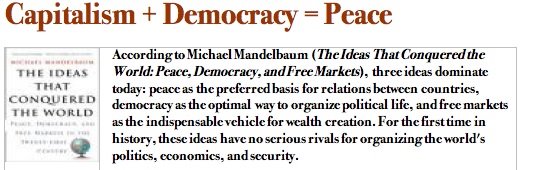
The answer to all this would seem to be U.S. support of more democracy, not less, more free market successes, not less, with both generating peace, not killing, peace that benefits Muslims more than the rest of us.

Tuesday, November 21, 2006

Media on Iraq: Losing is Winning

Former Harvard government professor James Q. Wilson has written a very long City Journal article about the media’s hostility to war and professional military. Here are highly selective excerpts:

When the Center for Media and Public Affairs made a nonpartisan evaluation of network news broadcasts, it found that during the active war against Saddam Hussein, 51 percent of the reports about the conflict were negative. Six months after the land battle ended, 77 percent were negative; in the 2004 general election, 89 percent were negative; by the spring of 2006, 94 percent were negative. This decline in media support was much faster than during Korea or Vietnam. . . People who oppose the entire War on Terror run much of the national press, and they go to great lengths to make waging it difficult. . .

[Of course, it began in Vietnam.] When Douglas Kinnard questioned more than 100 American generals who served in Vietnam, 92 percent said that newspaper coverage was often irresponsible or disruptive, and 96 percent said that television coverage on balance lacked context and was sensational or counterproductive.

An analysis of CBS’s Vietnam coverage in 1972 and 1973 supports their views. The Institute for American Strategy found that, of about 800 references to American policy and behavior, 81 percent were critical. Of 164 references to North Vietnamese policy and behavior, 57 percent were supportive. . .

Sociologist James D. Wright directly measured the impact of press coverage by comparing the support for the war among white people of various social classes who read newspapers and news magazines with the support found among those who did not look at these periodicals very much. By 1968, when most news magazines and newspapers had changed from supporting the war to opposing it, backing for the war collapsed among upper-middle-class readers of news stories, from about two-thirds who supported it in 1964 to about one-third who supported it in 1968. Strikingly, opinion did not shift much among working-class voters, no matter whether they read these press accounts or not. . .

But in the Vietnam era, an important restraint on sectarian partisanship still operated: the mass media catered to a mass audience and hence had an economic interest in appealing to as broad a public as possible. Today, however, we are in the midst of a fierce competition among media outlets, with newspapers trying, not very successfully, to survive against 24/7 TV and radio news coverage and the Internet. As a consequence of this struggle, radio, magazines, and newspapers are engaged in niche marketing, seeking to mobilize not a broad market but a specialized one, either liberal or conservative. . .

Focusing ever more sharply on the mostly bicoastal, mostly liberal elites, and with their more conservative audience lost to Fox News or Rush Limbaugh, mainstream outlets like the New York Times have become more nakedly partisan. And in the Iraq War, they have kept up a drumbeat of negativity that has had a big effect on elite and public opinion alike. Thanks to the power of these media organs, reduced but still enormous, many Americans are coming to see the Iraq War as Vietnam redux. . .

[A deep] suspicion, fueled in part by the Vietnam and Watergate controversies, means that the government, especially if it is a conservative one, is surrounded by journalists who doubt almost all it says. One obvious result is that since World War II there have been few reports of military heroes; indeed, there have been scarcely any reports of military victories. . .

The mainstream media’s adversarial stance, both here and abroad, means that whenever a foreign enemy challenges us, he will know that his objective will be to win the battle not on some faraway bit of land but among the people who determine what we read and watch. We won the Second World War in Europe and Japan, but we lost in Vietnam and are in danger of losing in Iraq and Lebanon in the newspapers, magazines, and television programs we enjoy.

Sunday, November 19, 2006

Democrats Achieve Landscape-Changing Victory

Pew has done a major poll post-election that is the first good look at how much the Democrats’ victory has altered the political terrain. Here are some of the survey’s major points:

• Reactions to the Democratic victory are as positive as they were to the GOP's electoral sweep of Congress a dozen years ago. Six-in-ten Americans say they are happy that the Democratic Party won control of Congress; in December 1994, roughly the same percentage (57%) expressed a positive opinion of the GOP's takeover.

• Half of Americans approve of the Democrats' plans and policies for the future, which also is comparable to approval of the GOP's proposed agenda in 1994.

• By 51%-29%, more Americans want Democratic leaders—rather than President Bush—to take the lead in solving the nation's problems. Twelve years ago, the public was divided over whether GOP congressional leaders (43%), or President Clinton (39%), should take the lead in addressing national problems.

• Roughly six-in-ten (59%) say Democratic leaders will be successful in getting their programs passed into law; again, this is on par with the confidence that Americans voiced about GOP legislative prospects in December 1994.

• The public is dubious that the election will lead to increased bipartisanship on Capitol Hill—just 29% think that relations between Republicans and Democrats will get better in the year ahead.

• The broad opposition to President Bush among independents is reflected in their strong preference (53%-25%) that Democratic leaders, rather than the president, take the lead in solving the nation's problems.

• Sen. Barack Obama has emerged as the leading rival to Sen. Hillary Clinton for the Democratic Party's nomination—39% of party voters back her, compared with 23% for Obama.

• Regarding Iraq, the public remains divided over whether the U.S. should bring its troops home as soon as possible (48%) or keep troops in Iraq until the situation has stabilized (46%).

• Roughly seven-in-ten voters (69%) say they got most of their campaign news from television, and more voters relied on cable news (30%) than either network news (24%) or local news (22%).

Friday, November 17, 2006

Super-racist?

This from the AP’s Stephen Ohlemacher (11.14.06):

Decades after the civil rights movement, racial disparities in income, education and home ownership persist and, by some measurements, are growing.

White households had incomes that were two-thirds higher than blacks and 40 percent higher than Hispanics last year, according to. . .the Census Bureau. . .

“Race is so associated with class in the United States that it may not be direct discrimination, but it still matters indirectly,” said Dalton Conley, a sociology professor at New York University and author of Being Black, Living in the Red.


When will those white people stop discriminating against poor blacks and Hispanics? Hasn’t it been almost 400 years already? Enough is enough, I say.

Except for one inconvenient fact, dropped in the same story, but not explained or in any way related to discrimination, direct or indirect:

Asian household incomes were 19 percent higher than whites’ and almost double the income of black households.

Thursday, November 16, 2006

Fact I Didn’t Know

We [Democrats] are a civil bunch, owing to our contentious upbringings. With a smart well-spoken woman for Speaker instead of the lumbering mumbling galoot who covered for the Current Occupant. . .

--Garrison Keillor


Lake Wobegon, a place "where all the women are strong, the men are good looking, and all the children are above average" is led by a man who is openly a Democrat. In fact, Garrison Keillor, whose work is based upon poking gentle fun at solid, Midwestern values, has even authored a book—timed for the 2004 effort to bring Bush down—titled Homegrown Democrat. Keillor begins his book by saying he can be excused for being a Democrat because he was born that way. Yet the thrice-married Keillor was also born a Christian Fundamentalist, which he, equally openly, no longer is.

Surprise but no surprise: Public Radio’s most famous entertainer and hayseed is a declared Democrat.

Tuesday, November 14, 2006

MSM Returns to Power

[T]his is not the first time Democrats have tried to personalize their message around an unpopular Republican figure. Starting in 1996, the poster child was Newt Gingrich. . . And Democrats have tried this tack before against Mr. Bush, in the 2004 election. . .But what [Bush] had going for him in [2004] was Sen. John Kerry. . .In 2006, there was no way for Mr. Bush to turn the questions and doubts about him into a comparative question.

--Todd Lindberg, Washington Times


The mainstream media (MSM) can’t win an election on its own. But make a mistake, and the MSM will get you. Particularly if you are a Republican playing to a conservative base. Particularly if you took us into an elective war.

The modern “politics of personal destruction” seemed to begin in 1988, with Lee Atwater’s Willie Horton commercials against Michael Dukakis. But the MSM had by 1988 already brought down Johnson, Nixon, and, somewhat without thinking, Jimmy Carter as well. 9-11 briefly threw the MSM off-stride, but when Bush went into Iraq, the MSM started an uninterrupted effort to drive down Bush’s poll numbers, and drive him from office unless he left Iraq first.

Success in Iraq would have pushed the MSM off-stride again. And that was (and remains) Bush’s most urgent task—succeed in Iraq. Iraq success would have overcome the absence of WMD, the Plame Affair, the failure to kill Osama bin Laden, Abu Ghraib, delays in building an Iraqi government, stillborn privatization of social security, Katrina, increased Iraqi sectarian violence, and the rise of Iran extremism. Lack of success in Iraq enabled the MSM to pound into the public consciousness an image of Bush as an incompetent failure, an image that combined with Mark Foley’s, did cost Republicans control of Congress.

For the MSM, however, it’s not enough just to break Bush’s power. Measured against the media giants of a generation ago who drove two presidents from office and ended a war, the current crop cannot celebrate until America is out of Iraq.

Friday, November 10, 2006

Yin-Yang D.C.? You’re Kidding, Right?

Exit polls showed that, once again, self-identified moderates made up a near-majority of the electorate — 47 percent — and this group split 62 percent to 36 percent Democratic — a 9-point Democratic gain from 2002 and 8 points above 2004.

--Roll Call’s Mort Kondracke


Yin-yang
: complementary division, male and female, two halves combine to make a whole. Many hope that Democrats in Congress and President Bush will create a female-male, yin-yang complementarity. Voters—the moderates who replaced partisan Republicans with new Democrats—are tired of bitter division and want cooperation and progress.

But yin-yang unity is not to be. Why?

The country is pretty evenly divided into two warring camps. The Republicans effectively nationalized congressional elections in 2002 and 2004, turning out Democrats for being wrong on the War on Terror. Now we have a third straight nationalized election, this time by the Democrats running in every section of the country against Bush and (the heretofore-unknown) Mark Foley. Nationalized elections and polarization are the result of efficient political operations that find and bring home their voters. These nationalized elections are here to stay, and will keep America divided.

2008 will shape the next two years in Washington. Democrats in Congress aren’t interested in passing the kind of legislation Bush might sign. They’re interested in electing a Democratic president in 2008, so they can truly take over. Every issue they push through Congress will be designed to divide Republicans from the national majority, so that Democratic control will replace divided government. Every Congressional investigation of Bush administration wrongdoing will reach for the same objective. Taking over Congress is just a first step to true power.

Only united government produces real change. The last burst of real Democratic creativity came in 1964-65, when in the aftermath of Kennedy’s assassination, Democrats had the full control they needed to pass tax reform, civil rights legislation, Medicare, and the National Education Act. Reagan had a burst of creativity in 1981-82, because a Republican Senate and Southern “Blue Dog” House Democrats provided the majority needed to cut taxes and the size of government. Then after Clinton beat back Newt Gingrich’s effort to shut down the Federal government in 1995, the two united to produce welfare reform and the balanced budgets that turbocharged our late 1990’s economy. Clinton needed Republicans to give him a record to run on for re-election. And Gingrich fully understood he was aiding Clinton’s re-election. Democratic leaders, unlike Gingrich, hope for their own president in 2008. Once everything is pink, Democrats will achieve their next burst of creativity.

A couple of other points about divided America:

• Rahm Emanuel, guru of the House Democratic take-over, is not only a Clinton insider, his Hollywood agent brother Ari gives Rahm a direct link to Beverly Hills. According to Wikipedia, “Bradley Whitford's character Josh Lyman on NBC television series The West Wing is. . . based on Emanuel. His younger brother Ari . . . inspired Jeremy Piven's character Ari Gold on the HBO series Entourage.” Hollywood, of course, represents the polar opposite to Evangelical America.

• Unified rule can blow up in your face. To hold Republicans together, Bush had to entertain the views of his extremes (House Republicans would only pass programs supported by a majority of their majority, which equals minority rule). Extremism ended up costing Republicans the election. The same thing happened in 1993-94, the last time Democrats controlled everything.

Tuesday, November 07, 2006

What Sort of Man Votes Pink?

I will not forget the wound to our country and those who inflicted it. I will not yield, I will not rest, I will not relent in waging this struggle for freedom and security for the American people. The course of this conflict is not known, yet its outcome is certain. Freedom and fear, justice and cruelty, have always been at war, and we know that God is not neutral between them.

President George W. Bush
September 20, 2001


Today, the party of Bush and Reagan stands for the courage to die overseas to keep America safe from terrorism at home. We wish other nations would join the fight. We know we can only support the Muslims who lead their own nations toward democracy and prosperity. But we cannot give up just because the going gets tough.

Or can we? What sort of man would leave Iraq when Sunni and Shiite terrorists still rule the streets? What sort of man votes pink?
Well, there are millions, including:

Card-carrying men of the liberal elite. Intelligent people are opposed to Iraq because they see the venture as politically-inspired; designed to perpetuate Republicans in power at the expense of the coalition of government, media, arts and entertainment, academe, and nonprofits that benefit from government money or mandates Republican rule threatens.

Coalition men. Union leaders, though the union movement is increasingly female as jobs shift to government and the service sector. Workers in the industrial sector hard-hit by free trade policies. Men who are part of minority groups that benefit from the Democratic coalition, including African-Americans.


Secular men.
Those opposed to the role religion still plays in America, a force centered in Hollywood, where the film industry long chafed under restrictions imposed by religious pressures. Hollywood relies on emotion as well as logic to make its points, and is the most effective counterweight to faith’s emotional element. (Pictured, Hollywood actor and director Warren Beatty with Diane Keaton in “Reds.”)

Why Republican?

Women and Democrats go together. As mentioned earlier, half of all U.S. women are single, and this group picked Kerry over Bush in 2004 by 25%. In 2006, one-third of the Democratic candidates in the most crucial U.S. Senate and House races are female (v. one-fifth of the Republican candidates). Democrats are the party of minorities, and for some (mathematically illogical) reason, we lump women with minorities.

The biggest reason many women are Republicans is religion. As Democrats are the party of women, Republicans are the party of faith. A woman who practices religion may not be a Republican, but the draw will be there. By the same token, a secular woman is overwhelmingly likely to be a Democrat.

Iraq: Worst Month in Years


Here’s our latest monthly, highly abbreviated version of the Iraq Index, published and updated twice a week by Michael O'Hanlon of the Brookings Institution:

Americans Killed in Action, Iraq (monthly average)

2003: 32
2004: 59
2005: 56
2006: 55
October: 97

Americans Killed in Action, Vietnam (weekly average)
1965:* 30
1966: 97
1967: 177
1968: 263
____
* = First U.S. combat troops arrived in Vietnam, 5.3.65
Vietnam table compiled by Galen Fox using Defense Department sources.

Note please—the Vietnam KIAs are weekly, not monthly, averages.


Crude Oil Production (m. bbls./day)

Prewar: 2.50
Goal: 2.50
actual: 2.30 (10/06)

Electricity (megawatts)

Prewar: 3,958
Goal: 6,000
actual: 4,100 (10/06)

Since our last monthly Iraq report, American KIA's are up dramatically, to their highest level since November 2004. The death toll was so high in October that it raised the 2006 monthy average to 55, almost the same monthly average as 2005's 56. And oil production is down, electricity output flat. The statistics underline headline news that the U.S. is doing poorly; news that comes on the eve of a mid-term election focused on our involvement in Iraq.

Late September Iraqi poll results offer additional bad news. By 52% to 47%, Iraqis think events in their country are moving in the wrong direction; in June, a plurality of polled Iraqis said the country was headed the right way. Even worse, now a majority--62%--of Shia have joined the overwhelming majority of Sunnis who approve of attacks on U.S. forces. In January, only 42% of Shia welcomed attacks on Americans.

Saturday, November 04, 2006

Party in Pink

[Democrats] would have America leave Iraq before the job is done. That's the kind of withdrawal that Osama bin Laden has been predicting. He and his followers believe that America doesn't have the stomach for this fight, and they are absolutely convinced they can break the will of the American people.

—Vice President Cheney

11.2.06 speech


It’s pretty clear TV networks chose red to represent Republican states because they wanted to avoid associating Democrats with “Reds.” Nobody will admit it, though (see here).

Democrats are the party of the left, and red was their color. Republicans began with the Civil War and Lincoln, so blue was their color. But to really nail the Democrats of today, recognize they are the pink party. And in fact, there is a women’s peace organization associated with anti-war activist Cindy Sheehan that calls itself CodePink (website here).

Pink is the Democrats’ right color for these reasons:

1. Women dominate the Democratic Party—women and men sympathetic to feminism. The civil rights struggle was the great cause of the 1960s—equal rights for all. Almost seamlessly, the work that went into ending Black segregation shifted to realizing full equality for women, including “the right to choose.” Democrats led this effort and their party remains the home of activist women. The energy level of Democratic women remains so much higher—compare Hillary and Laura, or Pelosi and Libby Dole. And add the intelligent, hard-working teachers—one of every four Democratic convention delegates is a member of the National Education Association.

2. The Democrats’ agenda is a women’s agenda. All war is bad, a wasteful and costly diversion from real concerns. We go overseas only to help the desperately poor or to stop genocide. Otherwise, Americans should be supporting government and nonprofit programs helping our own—minorities, the elderly, children, the poor, the sick, and women. In the traditional family, the male was the bread earner and the female was stuck with whatever he brought home. Think of business as the traditional male. Think of government as the family’s female—once a tiny economic factor, now playing a major role balancing and compensating for business (male) failings.

3. Women drive the Democrats’ dream. To me, the Democrats’ agenda seems so tired, so old-fashioned. When business broke down during the Depression, government was there to lift us up. Now business, not government, represents the future. Unleashed, business is able to deliver jobs and prosperity to people of any status, including the most needy (if indirectly, through taxes on business growth). But to women, especially baby boomers, it is so obvious equality has yet to be achieved that there can be no question of abandoning government’s corrective role. Government must rebalance the scale. “Affirmative action” still makes sense.

Thursday, November 02, 2006

Media Cares about Midterm Election; Swinging Hard for Democrats

“Media Mix” columnist Peter Johnson, writing in USA Today, reports on the biased coverage of the 2006 campaign, as seen in the three major TV networks:

An analysis by the Center for Media and Public Affairs of midterm election stories aired on the ABC, CBS and NBC evening newscasts Sept. 5-Oct. 22 found that 2006's coverage has been almost five times as heavy as in the [last] midterm elections: 167 stories, compared with 35 four years ago.

The study found that three out of four evaluations of Democratic candidates' chances of winning — such as sound bites — were positive, compared with one out of eight for Republicans. Coverage has been dominated by two major themes: the effects of the Foley scandal, and the impact the Bush presidency is having on the party's congressional candidates.

The Foley scandal produced 59 stories alone, compared with 33 on Iraq and 31 on terrorism/national security issues. "What's hurting Republican candidates is the media's focus on two non-candidates: Mark Foley and George W. Bush," says center director Robert Lichter.

Because of the focus on Foley, the re-election race of House Speaker Dennis Hastert, R-Ill., was featured in 42 stories. Sen. Barack Obama, D-Ill., was featured in 10 stories, even though he's not up for re-election this year. Sen. Hillary Clinton's possible 2008 presidential run was grist for nine stories.

Tuesday, October 31, 2006

A Rock Sinking

[T]he overwhelming failure of the Administration’s Iraq gamble is now apparent to all. This war of choice has pointlessly drained American military strength, undermined what had originally appeared to be success in Afghanistan, handed the Iranian mullahs a strategic victory, immunized the North Korean regime from a forceful response to its nuclear defiance, and compromised American leadership of the democratic world.

— Hendrik Hertzberg
The New Yorker


Below, you will find all posts to date on Iraq. They paint a similar picture: tough going in Iraq, made tougher by the Mainstream Media (MSM)'s determination to make Iraq the issue that defeats Republicans in 2006, so that victorious Democrats will act quickly to get the U.S. out of Iraq. It is a mission that the MSM, which truly believes it's wrong to be in Iraq, has elevated to cult-like status (see Hertzberg's rant above).

The MSM achieved its current power position by toppling two presidents in the Vietnam era. The MSM feels that to maintain its post-Vietnam/Watergate credibility, it needs to get the U.S. out of Iraq. This is big stuff.

Robert Frank, a Cornell economist, has written in the book Luxury Fever that "Animals will fight viciously to protect territory that they hold, but they won't fight nearly as hard to extend their territory." Why? Gaining territory won't benefit them much, but losing territory is a threat to their existence.

With newspaper circulation down, with cable TV, talk radio, the internet, and YouTube encroaching on their sovereign territory, the MSM is fighting viciously to hold on to the credibility it has. Bush's Iraq war must be destroyed.

Iraq on Tenterhooks (3.5.06)

Bush and Iraq: For Better, for Worse (3.16.06)

WMD: Absence Fooled Saddam Too (3.23.06)

Iraq: Stability or Democracy? (4.3.06)

Rumsfeld Screwed Up. Long Live Rumsfeld. (4.15.06)

Kerry’s Secretary of State Rewrites History (4.16.06)

It’s Iraq, Stupid. (4.25.06)

Iraq: Good News is No News
(5.2.06)

Iraq: Almost There
(5.21.06)

Waiting on Haditha (6.1.06)

Slow “Progress” in Iraq
(6.5.06)

Iraq’s Excellent Day (6.8.06)

Iraq: Measurable Progress
(7.6.06)

Iraq Security Situation: Bad in Baghdad
(8.4.06)

Friedman’s “Plan B”: Exit from Iraq? (8.7.06)

Iraq: Another Tough Month
(9.5.06)

The Problem with Extremism
(9.8.06)

Stop the War
(9.28.06)

Iraq: Poll Says “No” to Partition (10.2.06)

Boots on the Ground (10.13.06)

Facts on the Ground
(10.17.06)

“Let’s You and Him Talk” (10.19.06)

Iraq.Vietnam.Iraq.Vietnam.Iraq.Vietnam.Iraq (10.27.06)

From Shawcross, Who Opposed U.S. Policy in Indochina, A Warning (10.29.06)

Sunday, October 29, 2006

The Reformation: Prelude to Democracy

This is Reformation Sunday (Martin Luther pictured). The Reformation’s call for people to read the Bible and develop their own personal relationship with God—discussed here earlier—began the democratic process five centuries ago. It is only in the last 100 years that democracy has finally come to fruition in our world.

From Shawcross, Who Opposed U.S. Policy in Indochina, a Warning

In 1979, British author William Shawcross wrote an important book called Sideshow that documented Kissinger’s complicity in the destruction of Cambodia. Now Shawcross, who supports Bush and Blair in Iraq, is deeply concerned that the media are preparing the Middle East for destruction. Excerpts:

The bias in much of the coverage of Iraq - in Britain, the US and Australia - helps only those violent extremists who are trying to destroy the country.

It dreadfully discourages all those millions of Iraqis who need our support to build a decent society.

President George W. Bush was not wrong when he said recently that the spike in terrorist attacks in Iraq is similar to the 1968 Tet communist offensive in Vietnam. Both aimed at domestic opinion.

Al-Qa'ida and the Shi'ite terrorists hope to inflict defeat on Republicans in US elections in November that will weaken American commitment to the future of Iraq and thus strengthen Islamism throughout the world. As [Iraq’s Deputy Prime Minister said], we need to be "realistic, not defeatist".

The key to success is to strengthen and encourage the elected Iraqi Government led by Nouri al-Maliki. He has desperately serious problems. . .

Armchair pundits in the West like to blame the crisis in Iraq on mistakes made by Washington, particularly by Donald Rumsfeld. There certainly have been mistakes, but whether the present situation would have been markedly different without them can never be known.

Moreover, the mistakes were tactical, not moral: soldiers have not died plundering or colonising Iraq, they have died trying to help Iraqis make it better.

The blame for the present horrors lies above all with the monstrous al-Qa'ida, Baathist Sunni terrorists and the equally vile Shia militia, which are abetted by Iran. The vast majority of deaths in Iraq are being inflicted by Muslims on other Muslims, for reasons that have little to do with Western forces.

. . . a premature pullout would condemn Iraq and the region to unbelievable horror. And it would be a famous victory for our Islamist enemies, who declared war on the West long before we went into Iraq and liberated 23 million Muslims.

If we allow ourselves and the overwhelming majority of Iraqis to be defeated, that defeat will be the first of many in the region and the world. The Islamists will give no quarter.

Friday, October 27, 2006

Iraq.Vietnam.Iraq.Vietnam.Iraq.Vietnam.Iraq

I’m worrled the Mainstream Media’s determination to get us out of Iraq will snatch defeat from the jaws of hope. I’m not alone. Here’s excerpts from Caroline Glick, writing in the Jerusalem Post:

Today, the public debate in the US revolves around one question: When are we leaving Iraq? The conventional wisdom has become that US operations in Iraq are futile. Due in large part to politically driven press coverage, Americans have received the impression that the US cannot succeed in Iraq and that consequently, their leaders ought to be concentrating their efforts on building an exit strategy. Comparisons between the war in Iraq and the Vietnam War are legion.

Last Wednesday, President George W. Bush was asked whether it is possible to make a comparison between the recent sharp rise in violence in Iraq and the Tet offensive in Vietnam in January 1968. Bush responded by noting that then as now, "There's certainly a stepped-up level of violence, and we're heading into an election."

During the Tet offensive, the North Vietnamese attacked 40 South Vietnamese villages simultaneously with a massive force of 84,000 troops. The offensive failed utterly. 45,000 North Vietnamese soldiers were killed, no ground was taken. Yet, when then US president Lyndon Johnson declared victory, the American people didn't believe him.

Walter Cronkite, the all-powerful anchorman of the CBS Evening News had told them that the US had lost the offensive. Who was the president to argue with Cronkite? In March 1968 Johnson announced that he would not seek reelection.

So when the media wonder if one can compare the battles in Iraq today to the Tet offensive, what they really want to know is if they have successfully convinced the American public that its military has lost the war in Iraq. . .

The situation can be reversed. The media are no longer the power they were in Cronkite's day. Were the administration to challenge the networks, the networks would be forced to adjust their coverage to reality. . .

For Israel, the results of the American debate over the future of the war in Iraq are of critical importance. A US retreat will place Israel in grave danger. The eastern front. . . will make a comeback - replete with massive quantities of arms and tens of thousands of trained jihadi soldiers who will believe that they just won their jihad against the US. . .

Wednesday, October 25, 2006

The Coming Great War

Niall Ferguson predicts World War III, writing as the historian he is, looking back from the future. Iran’s Ahmadinejad is the Hitler who started it all. Ferguson predicted this in January, well ahead of my comparison of Ahmadinejad to Hitler.
Excerpts from Ferguson’s analysis:

The first underlying cause of the war was the increase in the region's relative importance as a source of petroleum. On the one hand, the rest of the world's oil reserves were being rapidly exhausted. On the other, the breakneck growth of the Asian economies had caused a huge surge in global demand for energy. . .

A second precondition of war was demographic. . . [I]n Iran. . . the social conservatism of the 1979 Revolution - which had lowered the age of marriage and prohibited contraception - combined with the high mortality of the Iran-Iraq War and the subsequent baby boom to produce, by the first decade of the new century, a quite extraordinary surplus of young men. More than two fifths of the population of Iran in 1995 had been aged 14 or younger. This was the generation that was ready to fight in 2007. . .

The third and perhaps most important precondition for war was cultural. Since 1979, not just Iran but the greater part of the Muslim world had been swept by a wave of religious fervour. . . 'Islamism' was as potent as either of the extreme ideologies the West had produced in the previous century, communism and fascism. Islamism was anti-Western, anti-capitalist and anti-Semitic.

A seminal moment was the Iranian president Mahmoud Ahmadinejad's intemperate attack on Israel in December 2005, when he called the Holocaust a 'myth'. The state of Israel was a 'disgraceful blot', he had previously declared, to be wiped 'off the map'. . .Ahmadinejad, a veteran of the Iran-Iraq War, craved a more serious weapon than strapped-on explosives. His decision to accelerate Iran's nuclear weapons programme [gave it] the power to defy the United States; the power to obliterate America's closest regional ally.

. . .American opinion was strongly opposed to an attack on Iran. The invasion of Iraq in 2003 had been discredited by the failure to find the weapons of mass destruction Saddam Hussein had supposedly possessed and by the failure of the US-led coalition to quell a bloody insurgency. Americans did not want to increase their military commitments overseas; they wanted to reduce them. . .

So history repeated itself. As in the 1930s, an anti-Semitic demagogue broke his country's treaty obligations and armed for war. . .The devastating nuclear exchange of August 2007 represented not only the failure of diplomacy, it marked . . . the twilight of the West.

Monday, October 23, 2006

Fundamentalists: Getting It Right

Reviewing the book The Conservative Soul: How We Lost It, How To Get It Back by Andrew Sullivan, NYTimes columnist David Brooks takes on the elitist perception of America’s evangelicals (covered earlier here):

[I]f I hadn’t been reviewing this book, I wouldn’t have finished it. I have a rule, which has never failed me, that when a writer uses quotations from Jerry Falwell, James Dobson and the Left Behind series to capture the religious and political currents in modern America, then I know I can put that piece of writing down because the author either doesn’t know what he is talking about or is arguing in bad faith.

As any number of historians, sociologists and pollsters can tell you, the evangelical Protestants who now exercise a major influence on the Republican Party are an infinitely diverse and contradictory group, and their relationship to these hyperpartisans is extremely ambivalent.

Conservative Christians are fully assimilated into commercial American life and, in a variety of different ways, critical of it. They get divorced as much as anybody else, if not more. They are as consumed by doubts and aware of their weaknesses as anybody else, if not more. They generally share — along with the pope — the belief that reason must be used to nurture faith.
And yet in his description of “fundamentalists,” Sullivan captures none of this complexity. His book would have benefited from more reporting — or any. He snips out egregious quotations of various conservative activists from The Nation, or from books critical of the religious right, and he leaves the impression that these quotes represent reality. He assumes that whatever is most offensive to the secular ear is most authentic to religious conservatism.

If he had spent more time with the people he describes as fundamentalists, he would have found that this category has no meaning. Many people disagree with him (and me) about gay marriage. Many people do believe that truth is revealed, and that one must work one’s way toward it. And yet to divide the world between fundamentalists and autonomous free thinkers is to create a dichotomy that distorts more than it reveals.

. . . the United States was. . . founded . . . by the assertion of a universal truth — that all men are created equal and are endowed by their creator with certain rights. The United States is a creedal nation, and almost every significant movement in American history has been led by people calling upon us to live up to our creed. In many cases, the people making those calls were religious leaders. From Jonathan Edwards to the abolitionists to the civil rights leaders to the people fighting AIDS and genocide in Africa today, religiously motivated people have been active in public life. They have been, in their certainty and their willingness to apply divine truths, fundamentalists — if we want to use Sullivan’s categories. You take those people out of American politics and you don’t have a country left.

. . . if American conservatives give up their optimism and their universal creed, they will once again be a small sect at the fringes of political life.

Peace with Syria

Baruch Kimmerling, writing in Haaretz, makes the case for peace between Israel and Syria;

[While] Ehud Barak, and even Benjamin Netanyahu, tried to further peace with Syria, Hafez Assad, the xenophobe, got cold feet as the talks moved toward the concluding stage. However, a great deal has changed, both in terms of Syria's geopolitics and in the condition of the ruling party, which relies on the Alawite minority. The end of Syria's hold over Lebanon not only undermined its prestige and its ability to maneuver politically vis-a-vis Israel but also the economic strength of the ruling sect, which relies on Lebanon's being a center of international drug trade.

The collapse of Iraq strengthened Iran, whose fundamentalist worldview is contrary to the secular inclination of the Syrian regime. Iran is becoming increasingly more powerful as a result of America's colossal strategic failure, which once more proved its utter lack of understanding of the essence of relations in the region. Proof of this is tagging Syria as part of the "axis of evil," instead of making the effort to encourage a Syrian-Israeli reconciliation as a counter to the rise of Islamic extremism.

Syria today lacks a real military option against Israel, but it can cause serious damage with its missile arsenal. To date, Syria has regarded this arsenal as serving a deterrent function, but could use the missiles out of desperation to break a status quo that has become unbearable, in a similar fashion to what Sadat did in 1973.

Bashar Assad knows that the only way he can stabilize his regime and take Syria forward is by an agreement with Israel, along the lines of the Egyptian model. Anyone who read the interview to Der Spiegel of August 29, 2005, in which Assad described Syrian society as "secular," could get a sense of his anxiety over Syria's possible deterioration into an Algerian-style civil war.

A peace accord with Syria will completely alter Israel's standing in the region and the world and will also influence the progress of reaching a solution with the Palestinians.

The way to get to that point is not through propagandist rhetoric, like the invitation Shimon Peres extended to Assad to visit Jerusalem. Someone like Peres knows full well that such a visit must be arranged in advance through [private talks], and that the invitation must come from the prime minister. Otherwise, we may find ourselves surprised once more.

Friday, October 20, 2006

It’s a Fact: TV Networks Diss U.S. Economy

Dan Gainor of the Business & Media Institute has written a report on “How Networks Distort a Good Economy.” Here are excerpts:

Network news stories have painted a bleak picture of an economy in decline. Reporters treated gas prices as a metaphor for the economy—only when they were high. And a slowing housing market coming off two record years was just another club used against Republican incumbents by a pessimistic press.

But the truth of the economy is far different. The United States continues to enjoy solid job growth. In the last year, 1.7 million new jobs were added and nearly 6 million have been created since August 2003—a streak of more than three years of positive growth. Unemployment is a low 4.7 percent. Gas prices have declined once again—more than 75 cents from their recent highs.

And though the economy actually grew. . .—that’s not how things looked on the evening news shows on all three broadcast networks—ABC, CBS and NBC. . . Business & Media Institute looked at all [network] stories referencing the “economy” or “economic” news between Aug. 1, 2005, and July 31, 2006. Here are some key findings:

Reports Negatively Charged: More than twice as many stories and briefs focused on negative aspects of the economy (62 percent) compared to good news (31 percent). News broadcasts dwelled on one prospective cataclysm after another, yet each time the economy continued unfazed.

Negative Stories Given More Air Time: Bad news was emphasized on all three networks. Negative news appeared in full-length stories twice as often as it appeared in shorter, brief items. Good news was relegated to briefs. More good news appeared in brief form than as full-length stories.

Man-on-the-Street Interviews Spin Stories: Reporters used ordinary people to underscore negative stories by roughly a 3-to-1 ratio over positive. Since these are interviews chosen entirely by the reporter, this shows particular bias. NBC was especially bad at this, featuring negative accounts six times as often as positive ones.

Worst Network: More than 80 percent of the full-length stories on the “CBS Evening News” delivered a negative view of the economy—easily the worst of the three broadcast news programs. The network hid the good news of jobs or economic growth in short items. More than 56 percent of CBS’s brief stories were positive.

Best Network: ABC was hardly the “best” anything for its economic coverage. It simply wasn’t as negative as either NBC or CBS. More than 56 percent of ABC reports were negative compared to slightly more than 36 percent positive.

Thursday, October 19, 2006

“Let’s You and Him Talk”

Tom Friedman (NYTimes, 10.4.06) has it right writing:

• the burden of Iraq falls—unfairly and harshly—on one small segment of our population: U.S. military troops and their families.
• a unified Iraq [has] become the “second choice” of too many Iraqis.
• too many Shiites just want their own pro-Iranian zone in the south.
• Iraq [is] a bunch of warring political tribes incapable of acting in common for the greater good.

Friedman wants Iraqis to talk to Iraqis. In the same column, he recommends that Democrats, if they win, “govern from the center” and “look for bipartisan fixes,” i.e., talk to Republicans.

In a September 29 column, Friedman called for “an honest dialogue between Muslims and Muslims” to cut down the influence of “street preachers—firebrands who gain legitimacy by spewing hatred at both their own regimes and the Western powers that support them.”

And in an October 11 column, written just after North Korea tested its A-bomb, Friedman wants us to get Russia and China to talk to North Korea and Iran. If the two giants want “multilateral” solutions, Russia and China are the ones to make it work.

This is great. In Rodney King’s words, “Can’t we all get along?” Nations don’t get along because they are made up of people who don’t get along. Since we haven’t figured how to get along at home, why have any confidence that we can get Iraqis, Muslims, Russians and Iranians, and Chinese and North Koreans to get along? Nice if you can do it.

It would be great if Iraqis, at least, could talk. Do they want some kind of unified nation, or do they not? The polls say Iraqis do want to be unified. Friedman is right. If so, they need to talk.

Wednesday, October 18, 2006

Facts, not Opinions

Stockholm syndrome: a psychological response sometimes seen in an abducted hostage, in which the hostage exhibits loyalty to the hostage-taker, in spite of the risk in which the hostage has been placed. (Wikipedia)

It’s important that we redevelop a passion for facts. If one lives in the world of public discourse, one knows we waste too much time on opinion—the stuff that fills the vast empty time or space between the rare, new facts on the ground.

I admire Mara Liasson and David Brooks because they offer balance on programs that are canted against their views. Balance helps us find the facts lost in the pile of wasted opinion. Weekly on PBS's "Lehrer Report," Brooks goes up against the partisan Democrat Mark Shields, and when Jim Lehrer isn’t around, a partisan PBS “moderator” as well. Brooks, a conservative who helped launch the conservative Weekly Standard, now works for the liberal New York Times, however. As time passes, he seems increasingly willing to criticize conservatives. Perhaps this evolution, some mild form of the “Stockholm syndrome,” is just inevitable for Times employees. Still, Brooks retains good inner-circle Republican sources, which help him bring fresh facts to the table.

Liasson, NPR’s National Correspondent and successor to the better-known Cokie Roberts, is a liberal. Yet for some reason, she has been willing to appear regularly as a commentator on Fox News’ “Special Report with Brit Hume.” Inevitably, she is up against the conservative Hume and two other panelists who are also openly conservative. Like Brooks, her style is agreeable and polite, and her presence, like that of Brooks, serves to provide some balance, giving facts the chance to surface amidst a welter of near-worthless opinion. Unlike Brooks, however, Liasson doesn’t criticize those on her side, or point to their failures. What qualifies her for “Stockholm syndrome” analysis is her polite reluctance to get “down and dirty” with her noisy, conservative counterparts.

There is growing concern that America is too polarized for our own good. Bush is considered unnecessarily divisive, and many attribute the unpopularity of Congress to its partisan food fights. A correction toward compromise, toward meeting in the middle, seems in order. When people learn from each other, when they recognize that nobody has a corner on the truth, facts have a chance to emerge.

Tuesday, October 17, 2006

Our Man in Beijing

Gerard Baker, writing in THE Times, discusses Hank Paulson’s China policy, which is pretty close to U.S. China policy. Paulson is thinking very big:

Mr Paulson’s regal style has upset other colleagues in Washington’s highly status-conscious political establishment. When he made his first trip to China last month as Treasury Secretary, a familiar stomping ground from his Goldman days, I’m told that he declined to travel as treasury secretaries have been wont to do in the past — business class on commercial airlines. . . He insisted on having a presidential aircraft and a sizeable chunk of the White House’s presidential advance team, the smart and important-looking people with heavy briefcases and folders who spend a lot of time talking into tiny mobiles.

Yet the biggest changes seem to be more in substance than in style. . . by far the most interesting and consequential of Mr Paulson’s changes has been on the biggest issue of all — China. The former banker has made, for the first time, the structural reform of the Chinese economy the centerpiece of US economic objectives. On his trip to Beijing last month. . . Mr Paulson initiated a new dialogue with Beijing, aiming to elevate the transpacific debate above the usual spats over trade and currencies. . .

[I]nstead of banging on about how China needs to revalue its currency to make it more competitive, as John Snow and Paul O’Neill did, Mr Paulson is focusing on a much bigger goal: achieving radical change in the Chinese economy to make it more transparent, to reform its creaky financial system and, in effect, to breathe more of the free-market spirit into the present communist-capitalist hybrid. That will, of course, presumably have the desirable effect of revaluing the currency and diminishing the trade deficit. But, in the Paulson view, it is important to get the causation right — reform the economy as the best way to get lasting international economic stability. . .

Paulson[‘s] approach makes sound economic sense. In the end the global imbalances in the world will not be addressed without real change in Asia’s patterns of consumption and its financial systems. . . [But] why should we think that Mr Paulson will have . . . success with the [inflexible] Chinese? It will, at least, be worth watching.

Facts on the Ground

“The debacle that is Iraq today has many sources”

--Prof. Andrew J. Bacevich
Boston University (LA Times commentary)


Not a quagmire, not even a fiasco, but a debacle and that’s a fact. We’re only debating the causes.

Here are some facts, as I see them:

1. The future of Iraq as a unified country is very much in doubt.

2. The overthrow of Saddam exposed long-standing fissures within the Iraqi body politic.

3. Iraq, with 115 billion barrels, has the world’s fourth largest oil reserves.

4. The combination of Saddam, militant Sunni Islam, and oil made Iraq the world’s most dangerous country in 2003, when the U.S. liberated Iraq.

5. The world is safer today than it was in 2003, because the U.S. liberated Iraq from Saddam’s totalitarian rule.

6. In 2005, Mahmoud Ahmadinejad became leader of Iran, a Shiite state with the world’s third largest oil reserves (132 b. bbls.).

7. Ahmadinejad’s brand of Shia militancy, his support of terrorism, his threat to destroy Israel, and his drive for nuclear weapons make Iran a most dangerous nation.

8. Muqtada al-Sadr (pictured) is a militant Shiite cleric with his own Mahdi militia armed by Iran, and is the most dangerous part of Iraq's Shiite majority.

9. If we fail to get Sadr under control, Iraq’s Shiite majority and its southern oil fields may end up under Iran’s control.

10. Through a combination of military, economic, and political means, we are striving in Iraq today to control Sadr and the threat he represents.

And another set of facts:

1. Bush timed the Iraq war’s launching according to a political calendar—wanting victory by the 2004 elections, he couldn’t wait until UN weapons inspectors finished their job.

2. Rushing in also meant having too few troops to stamp out a Sunni-led insurgency when it inevitably arose.

3. Bush’s use of a political calendar made the Iraq war political, politically opposed from the outset by the mainstream media (MSM), which is anti-U.S. involvement in war in any case.

4. The MSM cares little about the first set of facts (above); rather it’s focused on whether or not the U.S. should have invaded Iraq at all, and how quickly it can get the U.S. out of Iraq.

5. Because Bush made the Iraq war political, the MSM feels justified in using the Iraq war's lack of success thus far to defeat Republicans in 2006.

After the November elections, those interested in the first set of facts can again concentrate on taking care of Sadr.

Friday, October 13, 2006

Boots on the Ground

Call to Duty: Boots on the Ground

--U.S. Army Vision (video here)

inductive reasoning is [when] the premises of an argument support the conclusion but do not ensure it. (Wikipedia)

I have written about how most of the elite views facts through a liberal prism. Wanting the U.S. to lose in Iraq, they see defeat everywhere. Inductive reasoning.

The military is one part of the elite that sides with conservatives. Perhaps partly for this reason, most of the elite has only limited sympathy for the U.S. military or its missions. Post-9/11, our heroes are firefighters, the military honored are those whose death or injuries have removed them from killing Iraqis, and military crimes like Abu Ghraib and Haditha emerge as the norm.

These brave soldiers and marines fighting in Iraq suffer because of liberal hatred of Bush. Of course from the liberal perspective, Bush stole the presidency, went to war in Iraq to wrap the 2004 election in the American flag, and the military are casualties of Bush’s political ambition. Liberals want the military to lose in Iraq. The faster the military loses, the fewer of them will die. But lose they must. Because Bush's Iraq war is illegal, immoral, and stupid.

Looking for defeat, liberals find it everywhere. In the war’s early days, the media obsessed on how long it was taking to get to Baghdad. Remember the sand in the tank motors? Then it was transfixed by the looting of Iraq’s national treasures. Then by the failure to find WMD or Saddam. Then by civilian deaths suffered by the UN and private humanitarian organizations. Then by Abu Ghraib. Then the failure to form a government. Then the sectarian violence. Then the lack of an elected government. Now the civil war between Sunnis and Shia militias in Baghdad, with Haditha along the way.

All the deaths. So many dead. Well, in 1968, more Americans died in nine weeks in Vietnam than have fallen in Iraq since the war began.

But you know what? In the end, it comes down to the facts. Are we winning or not? Liberals say we are losing. Were we winning, liberals would be descredited. Right now, they aren’t.

It’s 1864, Lincoln desperately needs a victory, and to carry over the analogy to Iraq, Sherman has yet to take Atlanta. The military has a job to do. Here’s one person who hopes they succeed. In my eyes, they truly are a bunch of heroes.

Thursday, October 12, 2006

Rise And Fall of the Valerie Plame 'Scandal'

Bob Novak is hopping mad about the book Hubris. The book’s attack on Bush pivots around the Valerie Plame affair, yet that very book is ironically responsible for exposing Deputy Secretary of State Richard Armitage as the Novak source who “outed” Plame; a gigantic problem for Hubris authors Michael Isikoff and David Corn, since Armitage, in Novak’s words,

an internal critic of the administration's Iraq policy, did not fit the left's theory of a conspiracy led by Karl Rove and "Scooter" Libby to discredit [Joseph] Wilson as a war critic. Nor did it fit the overriding theme of Isikoff and Corn in depicting "spin, scandal and the selling of the Iraq war."

In his Weekly Standard piece blasting the book, Novak adds:

Hubris[‘]. . .only new element is what it reveals about the Plame case, and there they trumped their own ace by facilitating the source's exposure in advance of publication. . .Hubris is not an unmitigated apologia for the Wilsons, but it comes close. . .

In Hubris, Corn never comes to grips with the fact that Armitage could not be prosecuted under the Intelligence Identities Protection Act because Valerie Wilson was not a covert operative under the terms of the law. A 463-page book that is endlessly discursive does not seriously consider that she was no longer assigned to foreign missions because her cover already had been broken. It never even mentions the report that Mrs. Wilson had been outed long ago by the traitor Aldrich Ames. . .

The book's effort to cleanse Wilson stoops to deception: It accepts at face value Wilson's self-described political nonpartisanship, asserting that he "was not considered a fierce Democrat or a Bush Administration foe" when he embarked on his mission to Niger, citing his 1999 contribution to George W. Bush. In that same year, Joseph and Valerie Wilson not only contributed $1,000 each to Al Gore's presidential campaign, but the former ambassador also served on the Democratic nominee's policy staff. This, surely, was known to the authors, who chose to ignore it.

They ignored a lot more, such as what the July 2004 report by the Senate Intelligence Committee's Republicans, unchallenged by the Democratic minority, did to Wilson. It undermined his conclusions (based on his African mission) that Iraq did not seek yellowcake uranium, and undercut his insistence that his wife did not suggest him to the CIA for that mission. After the Senate report, Wilson disappeared from the Kerry for President campaign, something that also goes unmentioned in this book. . .

In their tirade against the Bush White House, Isikoff and Corn found a hero: Paul Pillar, then the CIA officer in charge of the Middle East. During the 2004 election campaign, I wrote in a column that Pillar was delivering off-the-record briefings to citizens groups around the country, and was highly critical of the president seeking a second term. Probing such subversion at the CIA might have been an interesting exercise for an investigative reporter, but that is not what this book is about.

Tuesday, October 10, 2006

The Marginalization of Democratic Foreign Policy

There are two parties in the U.S. One is serious about national security, and one isn’t. This fact, more or less true since 1968, is deeply disturbing at a time when Democrats are likely to grab some share of national power in a few weeks.

History didn’t end, did it, with the fall of the Soviet Union. Militant Islam, which has been a factor in international politics at least since the Popular Front for the Liberation of Palestine hijacked an El Al flight to Algiers on July 23, 1968, has grown decade by decade into a true force to be reckoned with.

At some point, probably in 1948 when Stalin allowed the West to save its Berlin outpost with an airlift, the Cold War became a stand-off based upon mutual respect. We haven’t reached that point with militant Islam. The militants are not only willing to die to spread their cause, they—much like the Nazis and the Japanese on the eve of World War II—believe that their willingness to die gives them an inherent advantage in any conflict with the soft West, which so clearly abhors war and sees dying for any cause as uncivilized.

When the U.S. lost Vietnam, Democrats were pleased they had turned America away from war. Republicans were alarmed to think that losing made fighting Communism elsewhere that much harder. Republican dissent from the conventional wisdom on Vietnam grew into Reagan’s willingness to confront the “Evil Empire.” By the end of Reagan’s term in 1989, the Democrats’ national security policy was no longer mainstream.

Even though the Gulf War elevated the standing of the U.S. military and removed much of our Vietnam defeat’s stain, the collapse of the Soviet Union ushered in the Clinton era of good feeling, when any American combat death anywhere seemed one too many. Now we see the Clinton years for what they were, a time of missing clues from the 1993 World Trade Center bombing, from the 1995 Philippines’ discovery of the Manila air plot, from Khobar, from the destruction of American embassies in Nairobi and Dar-es-Salaam, and from the attack on the U.S.S. Cole that militant Islam was on the rise. And this week, we are reminded how Clinton’s group (Warren Christopher, pictured) from 1994 on mishandled North Korea’s threat to go nuclear.

The Democrats love to quote their second-to-the-last tough president, “Never negotiate out of fear, but never fear to negotiate.” To me, Democratic foreign policy is “Talk, talk, talk, then talk some more.” It leaves Democrats completely unready to take on the real evil we face.

“Axis of Evil” is Fo’ Real

"North Korea's nuclear development is not intended as a bargaining chip as seen by the Western world. ... [Pyongyang] sees nuclear development as the only means to maintain Kim Jong-il's regime."

--North Korean Defector Kang Myong-To, in a U.S. House of Representatives Task Force on Terrorism and Unconventional Warfare report, August 1994


For hitting the nail on the head, Bush’s 2002 linking of North Korea, Iran, and Iraq in a three-party “Axis of Evil” has certainly absorbed an unaccountably large amount of criticism. Iraq looks out of place in that group today only because the U.S. knocked Saddam out of power, and away from using oil to buy WMD. Iran and North Korea are our two biggest problems today—that is, until Pakistan falls into the hands of radicals. For now, though, peace is most threatened by North Korea with some version of the bomb, and by Iran trying to get one as fast as possible.

North Korea may keep its bomb to itself. But it is frightfully willing to commit any crime—and sell anything—to keep its regime alive, and is moving closer to Iran in a way similar to Japan and Germany’s drawing together on the eve of World War II because of their shared perspective. Iran is a terrorist state, supporting terrorism throughout the Middle East. If North Korea has both the bomb and the propensity to sell it, we should be alarmed.

It’s hard to believe the U.N. will succeed in separating North Korea from its bomb. If China helps in a meaningful way, we might make progress regionally. This is very hard, though, for China is acutely aware that actions taken against North Korea form precendents for dealing with Iran. Thank goodness Japan has come around. And South Korea is next. Evil is fo’ real.

Monday, October 02, 2006

Iraq: Poll Says "No" to Partition


Here’s our latest monthly, highly abbreviated version of the Iraq Index, published and updated twice a week by Michael O'Hanlon of the Brookings Institution:

Americans Killed in Action, Iraq (monthly average)

2003: 32
2004: 59
2005: 56
2006: 51
September: 60

Americans Killed in Action, Vietnam (weekly average)
1965:* 30
1966: 97
1967: 177
1968: 263
____
* = First U.S. combat troops arrived in Vietnam, 5.3.65
Vietnam table compiled by Galen Fox using Defense Department sources.

Note please—the Vietnam KIAs are weekly, not monthly, averages.


Crude Oil Production (m. bbls./day)

Prewar: 2.50
Goal: 2.50
actual: 2.36 (9/06)

Electricity (megawatts)

Prewar: 3,958
Goal: 6,000
actual: 4,100 (9/06)

Since our last monthly Iraq report, American KIA's are up once again, nine above the monthly average for 2006. And while oil production is up, electricity output is down. Prime Minister al-Maliki is pressing for peace between the warring factions, but the sectarian violence that makes economic progress so difficult continues to unfold.

Various outsiders counsel Iraq authorities to accept the reality of Iraq's sharp internal divisions, and just partition the country into Sunni, Shiiite, and Kurdish regions. But 78% of Iraqis themselves, polled in June, disagree with segregation by religious or ethnic sect, with 66% strongly disagreeing.

The Real Security Council: Princeton Chimes In

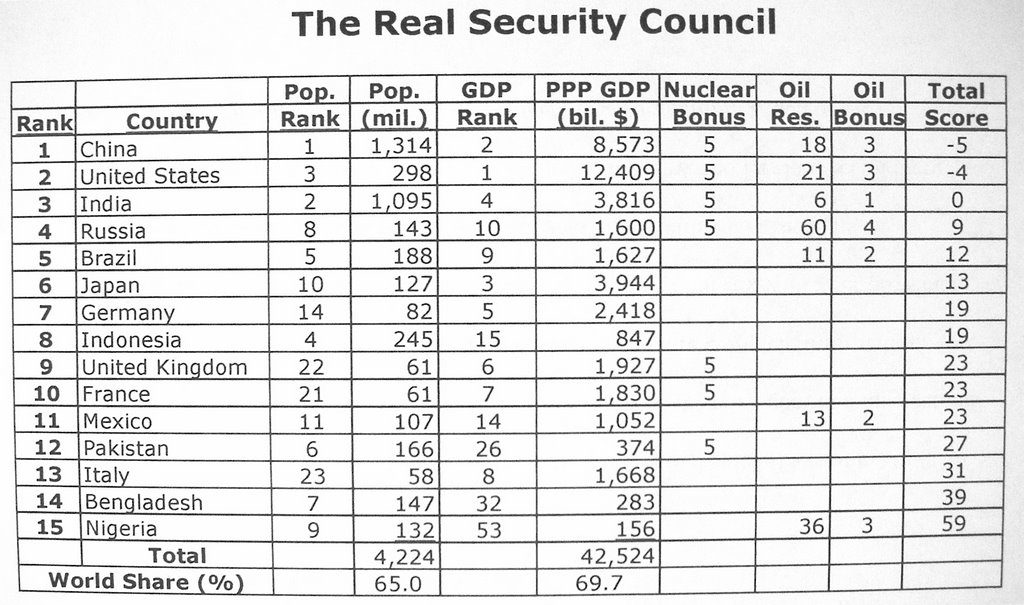
When I picked the top 15 countries and called them “the Real Security Council” (chart above), I wasn’t out to reform the UN. I was just making the point that we can identify the 15 most important nations, and should look at the world by starting with them.

Two people who are serious about reforming the UN, G. John Ikenberry and Anne-Marie Slaughter of Princeton’s Woodrow Wilson School, have presented their plan for reforming the Security Council. Along the lines of my top 15, they argue that:

We need a Security Council that is both representative and effective. That means expanding its membership to include Germany, Japan, India, Brazil, South Africa, Nigeria and at least one Muslim nation such as Egypt or Indonesia. . .

Expanding the Security Council membership has been on the UN's agenda for more than 15 years, spawning countless working groups and task forces and rounds of diplomatic wrangling. Germany, Japan, India and Brazil have been the most vocal countries in seeking a Security Council seat . . .


My list would add Mexico, Pakistan, Bangladesh, and Italy to their Germany, Japan, India, Brazil, Nigeria, and Indonesia, and would omit South Africa (with only 27 million people). Still, our lists are similar. And Ikenberry/Slaughter are also willing to go outside the UN to make this all work, proposing “a new organization for liberal democracies willing to commit themselves to a stringent set of obligations toward one another.”

Called a Concert of Democracies, this organization . . . would not be "the West versus the rest," but would instead include countries such as India, South Africa, Turkey, Indonesia, South Korea, Mexico, Brazil and Argentina. Its creation would also signal that the world is not stuck forever with old institutions if they cannot be reformed for a new world.


South Africa, Turkey, South Korea, and Argentina are all in my “Next 25,” which while I didn't advocate an organization, I see as part of a more sensible way of viewing the world than today's absurd UN, which treats 192 nations as equal.